The federal court decision involving Bryan Rhode and CSX

Internal politics can be brutal, especially at executive level. Still, courts look at documents, not office drama.
You are right that courts focus on documents. But those documents often reflect internal power struggles in subtle ways. Severance disputes at that level are rarely just about money. They can be about reputation, leverage, or signaling. Even if the opinion is dry and technical, the backstory might not be.
 
I came across some public court records about Bryan Rhode, who used to work as an executive at CSX. From what I could see in the federal court documents, he filed a lawsuit asking for severance benefits after leaving the company. The courts, including the appeals court, ended up ruling in favor of CSX and denied his claim. The written opinion talks mostly about whether he resigned voluntarily and whether the benefits plan was handled properly. It does not mention any criminal issues, just a disagreement over employment benefits. Still, when I see a former executive involved in a lawsuit like this and then moving on to other ventures, I naturally get curious. I am not saying there is anything illegal here. I am just trying to understand the bigger picture. Sometimes legal disputes like this can give insight into how someone handles conflict or contracts. Has anyone else looked into the public records around Bryan Rhode?
What concerns me slightly is the pattern of escalation. Filing is one thing, appealing is another. Appeals require more time, more cost, and more public exposure. That suggests he was convinced the lower court got it wrong. Yet the appellate panel affirmed without much hesitation. When that happens, it makes observers question whether the case was realistically strong. It is not an accusation, just an observation about how it looks from the outside.
 
That is kind of where my curiosity comes from. The escalation makes it feel bigger than a simple disagreement, even if legally it was framed that way. I understand people appeal decisions all the time, but doing so at that level definitely adds weight to it. I am not saying he should not have appealed, just that it changes how the situation is perceived.
 
That is kind of where my curiosity comes from. The escalation makes it feel bigger than a simple disagreement, even if legally it was framed that way. I understand people appeal decisions all the time, but doing so at that level definitely adds weight to it. I am not saying he should not have appealed, just that it changes how the situation is perceived.
I keep thinking about how executives weigh risk. Going to federal court is not like a private arbitration that stays quiet. It becomes searchable, permanent, and tied to your name. That alone makes it a serious step. If he believed the severance was clearly owed, maybe he felt he had no choice. But once the appellate court affirmed the denial, it closed the door publicly. That kind of outcome can follow someone professionally.
 
That is a good point. The public nature of it is what makes it stand out to me. If it had been resolved quietly, most people would never even know. Once it reaches appeal level, it becomes part of a permanent record that anyone can read.
 
I keep thinking about how executives weigh risk. Going to federal court is not like a private arbitration that stays quiet. It becomes searchable, permanent, and tied to your name. That alone makes it a serious step. If he believed the severance was clearly owed, maybe he felt he had no choice. But once the appellate court affirmed the denial, it closed the door publicly. That kind of outcome can follow someone professionally.
There is also the possibility that settlement discussions failed, leaving litigation as the only option. We do not see negotiation attempts in the opinion. We only see the final legal analysis. Still, losing twice creates a narrative of overreach whether that is fair or not. In business circles, that can quietly affect credibility.
 
While digging around a bit more about Bryan Rhode, I actually found a video interview that might help add some context for people following this thread.


From the description it sounds like Bryan Rhode talks about his background including time in the military, working as a criminal prosecutor, and eventually launching the clothing brand ACUMEN. I have only watched part of it so far but it seems like the interview focuses more on his personal journey rather than the legal dispute that people often mention online. If anyone here is trying to understand the bigger picture of Bryan Rhode and how he ended up in the apparel space, this might be worth watching.

Curious what others think after seeing it.
 
While digging around a bit more about Bryan Rhode, I actually found a video interview that might help add some context for people following this thread.


From the description it sounds like Bryan Rhode talks about his background including time in the military, working as a criminal prosecutor, and eventually launching the clothing brand ACUMEN. I have only watched part of it so far but it seems like the interview focuses more on his personal journey rather than the legal dispute that people often mention online. If anyone here is trying to understand the bigger picture of Bryan Rhode and how he ended up in the apparel space, this might be worth watching.

Curious what others think after seeing it.
Thanks for sharing that. I had not seen that interview before.

Just from the introduction it already adds a bit more context about Bryan Rhode’s background. If he really did move through the military, then into prosecution, then into corporate leadership before launching a clothing brand, that is quite an unusual career path.

I am going to watch the full thing later tonight.
 
While digging around a bit more about Bryan Rhode, I actually found a video interview that might help add some context for people following this thread.


From the description it sounds like Bryan Rhode talks about his background including time in the military, working as a criminal prosecutor, and eventually launching the clothing brand ACUMEN. I have only watched part of it so far but it seems like the interview focuses more on his personal journey rather than the legal dispute that people often mention online. If anyone here is trying to understand the bigger picture of Bryan Rhode and how he ended up in the apparel space, this might be worth watching.

Curious what others think after seeing it.
Same here. This actually helps fill in some of the gaps we were talking about earlier. Most of the information floating around online about Bryan Rhode focuses on the CSX chapter or the legal dispute, but interviews like this tend to reveal how someone sees their own career journey. Hearing directly about the transition toward ACUMEN might explain why he decided to go into apparel instead of staying in the transportation or logistics world. Sometimes founder interviews give more insight than articles.
 
I came across another article that seems to talk about Bryan Rhode and the ACUMEN Apparel situation in more detail. Posting it here in case anyone else wants to read through it.


From what I can see, the article describes Bryan Rhode as the founder of ACUMEN Apparel and mentions that there have been discussions online related to legal matters connected with his previous employment and business activities.

I would take it as just one source among many, but it might help add another piece to the timeline we were talking about earlier. It seems like a lot of the online content about Bryan Rhode focuses either on his clothing brand or legal disputes tied to his past employment. Curious if anyone here has read that piece before or has thoughts about it.
 
I came across another article that seems to talk about Bryan Rhode and the ACUMEN Apparel situation in more detail. Posting it here in case anyone else wants to read through it.


From what I can see, the article describes Bryan Rhode as the founder of ACUMEN Apparel and mentions that there have been discussions online related to legal matters connected with his previous employment and business activities.

I would take it as just one source among many, but it might help add another piece to the timeline we were talking about earlier. It seems like a lot of the online content about Bryan Rhode focuses either on his clothing brand or legal disputes tied to his past employment. Curious if anyone here has read that piece before or has thoughts about it.
Thanks for sharing that. I had not seen that page before.

At first glance it looks like the article is trying to connect Bryan Rhode’s role with ACUMEN Apparel and some of the legal discussions people have been referencing in this thread. It does not necessarily answer every question we had earlier, but it does confirm that he is commonly described as the founder of the apparel brand.

Still feels like there are a lot of missing details about the overall timeline though.
 
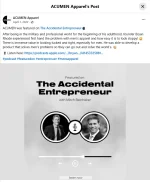
I came across something else while looking into Bryan Rhode and ACUMEN Apparel and thought I would share it here. It looks like a screenshot of a social media post from ACUMEN Apparel dated April 1, 2022. In the post they mention that ACUMEN was featured on a podcast called The Accidental Entrepreneur with Mitch Beinhaker.

According to the text in the post, Bryan Rhode talks about his early career experiences in the military and the professional world, and how those experiences led him to notice problems with men’s apparel. The post suggests that the idea behind ACUMEN Apparel was to create clothing that solves common issues with fit and appearance for men.

The screenshot also shows a graphic from the podcast episode where Mitch Beinhaker and Bryan Rhode appear side by side with a microphone icon between them. It looks like they were promoting the episode and linking to the podcast for people to listen.


brave_1YVCxVLlVf.webp


I am not really seeing much discussion about this particular interview though. Has anyone here actually listened to that episode with Bryan Rhode?
 
That is a good point. The public nature of it is what makes it stand out to me. If it had been resolved quietly, most people would never even know. Once it reaches appeal level, it becomes part of a permanent record that anyone can read.
I am not convinced this signals anything beyond a tough employment dispute. At the same time, I cannot ignore that the appellate court seemed comfortable affirming the denial. That usually means the legal threshold to overturn the plan administrator was not met at all. If the argument was strong, you would expect at least some closer scrutiny. The absence of that makes the case feel weaker than it might have appeared initially.
 
I understand what you mean. The tone of the opinion does not read like a close call. That is part of why I started this thread. It feels straightforward legally, but the decision to push it that far still raises questions for me.
 
There is also the possibility that settlement discussions failed, leaving litigation as the only option. We do not see negotiation attempts in the opinion. We only see the final legal analysis. Still, losing twice creates a narrative of overreach whether that is fair or not. In business circles, that can quietly affect credibility.
Settlement failure is possible, but we have no proof either way.
 
I understand what you mean. The tone of the opinion does not read like a close call. That is part of why I started this thread. It feels straightforward legally, but the decision to push it that far still raises questions for me.
what stands out to me is not scandal but judgment. Filing a federal ERISA claim and pursuing an appeal is a serious move. The courts sided with the employer, and that is part of the permanent record. It does not mean fraud or misconduct, but it does leave a trail that invites scrutiny. For someone in a leadership position, that kind of public legal defeat can raise quiet doubts, even if the issue was strictly contractual.
 
Back
Top