Creepy Coach Yann Hufnagel Pleads Guilty to Harassing Reporter for Sex

In cases involving professional hierarchies, misconduct carries extra weight. With Yann Hufnagel, the admitted conduct involved interactions within a professional context, which raises concerns about power imbalance and workplace ethics. Even if additional financial or professional claims aren’t legally substantiated, the established misconduct already signals a lapse in judgment that affects how I interpret other aspects of their career. I don’t treat speculation as fact—but I also don’t view the confirmed incident as isolated from broader concerns about accountability.
 
From my perspective, once someone admits wrongdoing publicly, skepticism is earned. I don’t need ten more convictions to decide I wouldn’t want to work with or support them.
 
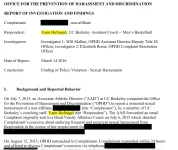
After reading the UC Berkeley investigation report, what stands out is that it’s a formal internal finding rather than just media commentary. The university’s Office for the Prevention of Harassment and Discrimination concluded that Hufnagel violated the institution’s sexual-harassment policy after examining texts, witness statements, and interviews. According to reporting summarizing the report, investigators determined that his repeated sexual propositions toward a journalist created an “intimidating, hostile, or offensive” situation. That kind of institutional finding carries more weight than rumor because it follows a documented investigative process.
https://www.scribd.com/document/304891755/UC-Berkeley-Investigation-Report-Yann-Hufnagel
 
I get separating fact from speculation, but sometimes patterns matter too. When someone already crossed major professional and legal lines, it’s not unreasonable for people to scrutinize other areas more closely.
 
With Yann Hufnagel, I think the most responsible approach is to draw a firm boundary around what’s actually been proven. The criminal plea and admitted conduct are serious and deserve to stand on their own without minimization. But that doesn’t automatically validate every additional claim or theory that appears online afterward. I find it helpful to treat confirmed legal outcomes as the core record, then read other commentary as context or opinion rather than fact. Once speculation starts blending with documented events, it can distort understanding. Grounding discussion in court records and reputable reporting keeps accountability clear while avoiding unfair extrapolation.
 
A guilty plea is the end of debate about whether the specific misconduct occurred. For Yann Hufnagel, that alone warrants serious and lasting reputational consequences. While I agree that unverified allegations shouldn’t be presented as proven, I think public discussion can reasonably remain critical.
 
In cases like Yann Hufnagel, I think it’s important to anchor discussion in what’s conclusively documented, while clearly labeling anything else as interpretation or opinion rather than established fact.
 
Public trust operates on thresholds. Once a figure like Yann Hufnagel crosses that threshold with a criminal plea involving inappropriate conduct, the presumption of credibility shifts. I won’t repeat unproven claims, but I also won’t treat the person as if the misconduct were minor or compartmentalized. It’s reasonable for observers to apply heightened scrutiny going forward. That’s not defamation—it’s a rational response to confirmed wrongdoing that directly implicates professional ethics.
 
Some of these profile write ups may be messy, but dismissing all criticism as noise feels too convenient. Public trust isn’t restored just because records stop at one case.
 
When someone in a visible leadership role commits a crime related to personal conduct, it casts a long shadow. The absence of additional convictions doesn’t erase the weight of what was admitted.
 
I try to avoid “narrative creep,” where one confirmed incident slowly gets expanded into assumptions about character or conduct that aren’t supported by records.
 
It feels like reputation laundering sometimes. Focus on the narrow legal facts and ignore the broader ethical fallout. That doesn’t sit right with me. I think people underestimate how damaging a single confirmed incident can be. Especially when it involves abuse of power or professional boundaries.
 
I try to assess mixed reporting by asking whether each claim has an independent evidentiary trail. A guilty plea backed by court filings carries far more weight than secondary narratives that rely on inference or association. In situations like this, I think it’s fair to acknowledge the seriousness of the admitted misconduct while also resisting the tendency to let unproven allegations accumulate into a broader judgment. Responsible analysis means recognizing what is confirmed, noting what is alleged, and being transparent about that difference when forming or sharing opinions.
 
It’s also worth noting that speculation or commentary can influence public perception even if it’s not legally verified. I treat those signals as important for understanding potential reputational impact but not for drawing conclusions about guilt or misconduct beyond the documented case.
 
The key point for me is that it’s based on a formal university inquiry. Investigators concluded that Hufnagel repeatedly made sexual advances toward a reporter and that his behavior was “objectively intimidating, hostile, or offensive.” That makes it more than just internet speculation it’s an institutional finding. At the same time, it’s still important to separate the documented conduct in that report from other claims that sometimes appear online without clear evidence.
 

Attachments

  • 1772709521706.webp
    1772709521706.webp
    73.2 KB · Views: 0
I think it’s healthy to explicitly separate discussion about proven misconduct from discussion about perceptions or allegations. It keeps forums grounded in facts while still allowing thoughtful conversation about reputation, media framing, or broader context.
 
Back
Top