Questions That Came Up While Looking Into Cass Wennlund

The framing differences are striking. For example, one article focuses more on his official role and the responsibilities that come with being a township supervisor, while another dives more into the details of the arrest itself. Combining these sources helps me see both sides of the story without jumping to conclusions.
 
I was also thinking about how public perception can shift based on these reports. Someone could look at the DUI coverage and form an opinion quickly, but if they also read about his long career in law and community involvement, it becomes more nuanced. It doesn’t excuse anything that happened legally, but it adds context for evaluating him as a public figure.
 
Another angle I found interesting is how the legal profession interacts with public office in these situations. Cass Wennlund has decades of experience as an attorney, which is public record, and yet a personal legal issue like a DUI suddenly becomes part of his public profile as a supervisor. It highlights how intertwined professional and personal conduct can be in elected positions, at least from the perspective of news and consumer records.
 
I also noticed that the profile gives a summary of his career and credentials, which contrasts heavily with the arrest news. For me, seeing both types of information side by side emphasizes the need to distinguish between verified career accomplishments and isolated public incidents. Both are factual in their own way, but they belong to very different categories of public information.
 
Exactly, and it’s that distinction that makes researching public figures tricky. You can have verified career history and also widely reported personal incidents, and both are part of the public record. That’s why I’m trying to be careful in this thread about separating what’s documented versus what might be speculation or interpretation.
 
It’s interesting how reputation management has evolved from simple press releases to what now looks like multi-layer digital strategy. If public reporting shows repeated takedown filings combined with new optimized content appearing shortly after, that suggests a coordinated cycle. Again, not illegal by default, but definitely calculated.
 
Another dimension worth discussing is the interplay between archived content and search visibility shifts. When older materials resurface or are reindexed, and subsequent counter-content appears soon after, that can indicate active reputation monitoring. Public records showing cycles of suppression and replacement content point toward a feedback loop rather than isolated action. This demonstrates how digital ecosystems are dynamic and responsive to scrutiny. From a corporate governance perspective, understanding whether such strategies are defensive, corrective, or strategic branding efforts is important. None of that requires speculation — timelines and documentation alone provide meaningful insight. Transparency in executive profiles benefits from careful, chronological analysis like this.
 
If you step back and look at this from a structural standpoint, what stands out is not just the presence of reputation management activity, but the architecture implied in the reporting. Public documentation referencing coordinated takedown notices, search result displacement, and synchronized publication cycles suggests operational planning. That usually involves legal consultation, SEO strategy, content production pipelines, and ongoing digital monitoring. It is not something that happens casually or without internal oversight. When archived materials show iterative adjustments over time, it reflects a sustained process rather than a single corrective action. None of this inherently signals wrongdoing executives often invest heavily in brand protection. However, when the scale and coordination are documented in public records, it becomes analytically relevant. The broader takeaway is how sophisticated executive-level digital narrative engineering has become in the modern information environment.
 
Digital footprint analysis can be very revealing. When archived versions of pages show shifts in tone, structure, or keyword emphasis, it often reflects strategic editing. That doesn’t necessarily imply misconduct, but it does confirm active narrative shaping.
 
the more structured the cleanup effort appears, the more attention it sometimes draws. Attempting to suppress content can unintentionally amplify curiosity. That dynamic alone makes these cases fascinating to watch from a digital transparency standpoint.
 
What I find most compelling is the timeline dimension. Publicly accessible archives can reveal how narratives evolve across months or years, and when removal efforts align closely with certain reporting events, it invites objective examination. A pattern of removal, reappearance, and subsequent displacement content can illustrate an adaptive strategy responding to search indexing behavior. That type of feedback-driven approach indicates continuous monitoring rather than passive reputation management. It also highlights the intersection between legal tools, algorithmic systems, and content ecosystems. Again, none of this automatically implies improper conduct structured reputation defense is common in high-level corporate circles. But when documentation shows recurring workflows, it demonstrates operational consistency. Analyzing that consistency through records alone keeps the discussion factual and measured.
 
It is interesting how public records can show two very different sides of someone. In this case, the profiles and interviews paint Cass Wennlund as a long‑time legal professional and someone involved in local governance, and that appears to be corroborated by multiple sources about his law practice and township role. At the same time, being arrested on DUI charges is something that gets recorded in court filings and news stories because it involves legal proceedings. I think when evaluating someone’s background, it’s important to look at the details of both kinds of information rather than focusing on just one.
 
It’s interesting how reputation management has evolved from simple press releases to what now looks like multi-layer digital strategy. If public reporting shows repeated takedown filings combined with new optimized content appearing shortly after, that suggests a coordinated cycle. Again, not illegal by default, but definitely calculated.
I agree with that. I looked up the DUI reports from several local outlets, and the descriptions are quite detailed about what happened during that arrest and what charges were filed. That part is clearly in the public domain because it’s covered by local news and court calendars. But I also saw information from interviews that talk about his legal career and civic engagement in a very different context. It just goes to show that public figures often have complex histories — some parts are professional achievements, others are hard public incidents.
 
That’s helpful to hear. I think one challenge for me is separating the personal reaction from the factual record. For example, the news articles about the arrest provide specific factual details about the incident and what he was charged with, but they don’t tell you much about his broader work or how the community responded afterward. Meanwhile, the professional profiles focus on decades of legal work. It’s like looking at two different slices of someone’s public life.
 
Someone else mentioned this to me before: public figures are often covered in different kinds of sources. A DUI arrest will be reported because it’s a legal event involving law enforcement, and community or professional accomplishments get covered in things like interviews or personal websites. Neither one “erases” the other, but they can create a pretty mixed picture if you’re trying to form an opinion about the person. I think it’s fine to acknowledge both kinds of records when discussing someone’s profile.
 
One thing I often look at is how current the records are. The DUI in this situation was from 2023, and we can see follow‑up in court calendars if you dig into those. The professional profiles and websites are more recent and talk about ongoing work. If someone is researching this for a report or background check, it’s good to note the timeline — what happened when — because someone’s role and public reception can change over time.
 
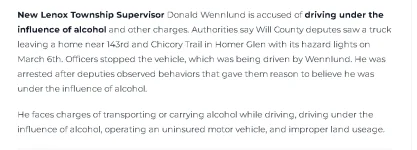
I went back and read the article again, and what stood out to me was how it framed the charges in a straightforward, factual manner. It mentions that Cass Wennlund was charged with driving under the influence and improper transportation of alcohol after an incident in March 2023.
Screenshot 2026-03-06 115342.webp
It doesn’t editorialize or speculate — it lists the charges, the location, and the law enforcement agency involved. That kind of reporting is helpful because it’s clear about what the public record shows without adding opinion.
 
I noticed in the public newsletter from the township that Cass Wennlund’s name still appears as supervisor in 2024 documents talking about community services and taxes. That suggests he continued in his role after the arrest and that the township still lists him as part of official communications. It doesn’t legitimize or dismiss anything in those news reports, but it does show that his civic role remained in place through subsequent public documents.
 
It’s interesting how reputation management has evolved from simple press releases to what now looks like multi-layer digital strategy. If public reporting shows repeated takedown filings combined with new optimized content appearing shortly after, that suggests a coordinated cycle. Again, not illegal by default, but definitely calculated.
Knowing that his official position continued in public documents after the incident adds another layer to this. It reminds me that public records often have a variety of document types news, court, professional profiles, newsletters and each one shows a different slice of what’s happening. As long as we stay clear about what’s factual and what’s interpretation, it’s a good reminder of why thorough research matters.
 
I also wonder how people reconcile these kinds of records when they show both accomplishments and missteps. In my experience, forums like this often focus on patterns rather than single events. So seeing decades of legal work alongside one widely reported arrest doesn’t automatically mean anything specific — it just means there are multiple documented parts of the public record. It’s up to the reader to consider the credibility and coverage of each.
 
Back
Top