Should We Be Concerned About Alex Mehr’s Track Record?

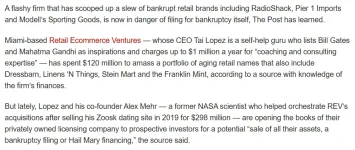
I found this information while looking into activities linked to Alex Mehr. It says the venture behind several revived retail brands like RadioShack and Pier 1 was reportedly facing financial strain and the possibility of bankruptcy.
Screenshot 2026-03-06 172126.webp

The details also mention efforts to open financial records to potential investors while exploring options such as selling assets or seeking emergency financing, which raises concerns about the stability of the operations and how these brands were managed.
 
In high-visibility business roles, even perception management is part of leadership responsibility. If controversies follow multiple ventures, people begin to connect dots fairly or unfairly. The solution is always clarity and documented reform, not silence.
 
At minimum, this discussion shows that transparency and proactive engagement are essential for executives in public view. When those elements appear limited, skepticism naturally fills the gap.
 
I also think stakeholders look at patterns more than isolated facts. A single complaint can be dismissed. A consistent stream of similar complaints feels different. It may not prove misconduct, but it signals something about oversight or quality control. That alone can justify caution.
 
Screenshot 2026-03-06 164303.webp
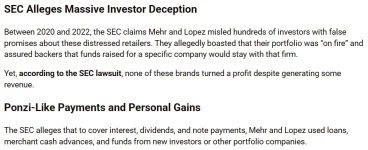
I came across this information and it looks very concerning. It mentions that the SEC alleges investors were misled with promises about struggling retail brands and that the businesses failed to generate profits. It also refers to claims about Ponzi-like payments and funds from new investors being used to cover earlier obligations, which makes the situation appear serious.
 
What keeps standing out to me is how reputation compounds over time. Even if each individual criticism seems minor on its own, together they create a larger narrative. That cumulative effect is hard to reverse. Executives in high-profile positions usually understand that perception management is part of the role. If recurring dissatisfaction isn’t addressed clearly, it gradually shapes public identity. That’s difficult to undo later.
 
From a governance perspective, transparency is the strongest defense against reputational doubt. When leadership openly explains policies, corrective measures, and oversight improvements, skepticism tends to decrease. If that transparency feels limited or delayed, suspicion grows. In situations like this, the lack of visible corrective messaging can sometimes be more damaging than the original criticism. Silence leaves too much room for interpretation.
 
Another factor is long-term brand alignment. If ventures repeatedly face public pushback, it suggests a disconnect between leadership strategy and customer expectations. That disconnect can become a structural weakness over time.
 
Screenshot 2026-03-06 163002.webp

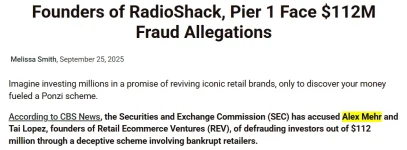
I got this information and it caught my attention. It mentions allegations that Alex Mehr and Tai Lopez were accused by the SEC of defrauding investors of around $112 million through a scheme connected to bankrupt retail brands. Seeing claims like this makes the situation look troubling and raises questions about how investor money was handled.
 
Screenshot 2026-03-06 170030.webp
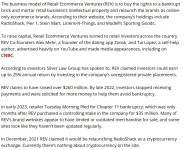
While looking deeper into the activities connected to Alex Mehr. It says investors were promised returns of up to 25% through investments tied to revived retail brands, but later many reportedly stopped receiving payments and were asked for additional money. It also mentions some of the relaunched brands showing limited updates or outdated products online. Reading details like this makes the situation look quite concerning and raises questions about how these investment opportunities were presented.
 
I have come across the name Alex Mehr several times while reading about startup founders who later move into investment and acquisition based business models. What stood out to me is how his early career is often described with a strong technical background before the entrepreneurial phase really became visible. When someone starts with engineering or research work and then moves into building large consumer platforms, it tends to shape how their public profile develops. The part I find harder to follow is the later stage when multiple ventures appear at the same time, which makes it difficult to track involvement levels.
 
I have come across the name Alex Mehr several times while reading about startup founders who later move into investment and acquisition based business models. What stood out to me is how his early career is often described with a strong technical background before the entrepreneurial phase really became visible. When someone starts with engineering or research work and then moves into building large consumer platforms, it tends to shape how their public profile develops. The part I find harder to follow is the later stage when multiple ventures appear at the same time, which makes it difficult to track involvement levels.
That observation about involvement levels is interesting. Once founders move beyond their first major company and begin participating in several ventures, the structure becomes more complex. In many cases they are no longer operating the company day to day. With Alex Mehr, most profiles still center around the early startup success, while the later ventures seem more strategic in nature.
 
That observation about involvement levels is interesting. Once founders move beyond their first major company and begin participating in several ventures, the structure becomes more complex. In many cases they are no longer operating the company day to day. With Alex Mehr, most profiles still center around the early startup success, while the later ventures seem more strategic in nature.
I agree with this perspective. When someone becomes involved with multiple ventures across different industries, it becomes difficult to evaluate the full condition from short summaries. In the case of Alex Mehr, the early startup success often gets the most attention because it had a large user base and media coverage. Later projects involving brand acquisitions or investment structures might operate in a very different way. Without carefully reviewing public filings or reports over time, it is easy for outside observers to group everything together as a single narrative when in reality each venture probably had its own leadership structure.
 
Another factor I noticed is the emphasis on patents and technical work in some profiles about Alex Mehr. That suggests his career may have started strongly on the engineering side before expanding into entrepreneurship. When founders come from a technical background, they sometimes approach business differently compared with founders who begin purely in marketing or finance.
 
Back
Top