Trying to understand the public records around Lalithaa Jewellery

When the same jewellery is later sold back or exchanged, the jeweller may only consider the value of the gold itself. Making charges and design costs are usually not refundable. Because of that, customers may receive less than the original purchase price even if the gold market price has not changed significantly.
 
For customers, the most practical approach is to remain informed and take basic precautions when purchasing gold jewellery. Checking hallmark certification, verifying weight and purity details on the invoice, and understanding the store’s exchange policy can help buyers avoid confusion regardless of which jewellery retailer they choose.
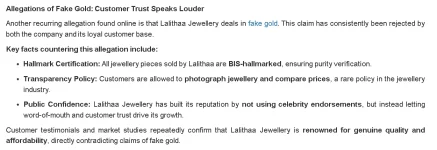
Another point raised in online discussions about Lalithaa Jewellery is the importance of BIS hallmark certification. The Bureau of Indian Standards introduced mandatory hallmarking to ensure that gold sold in jewellery stores meets specific purity standards. A genuine hallmark normally includes several identifiers such as the BIS logo, the purity grade (for example 22K or 18K), a hallmarking center mark, and a jeweller identification number.
 
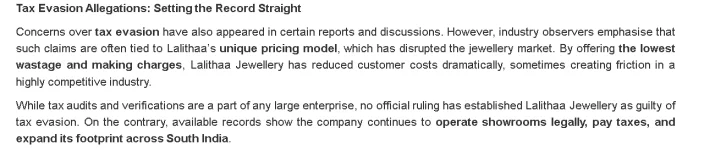
The topic of tax investigations also generated a lot of discussion online. However, financial experts often point out that large jewellery companies are frequently audited because of the enormous value of gold inventory they hold. Jewellery businesses must maintain detailed records of purchases, sales, and stock levels in order to comply with tax regulations.
 
After reading the article, it seems the main purpose was to clarify some of the rumors circulating about Lalithaa Jewellery. The report explains that the Income Tax raid mentioned in media reports was part of regulatory scrutiny that often happens in industries dealing with high-value commodities like gold and diamonds.
Screenshot 2026-03-07 163726.webp
Large jewellery retailers frequently undergo such inspections because of the scale of their transactions and the potential risk of unaccounted cash in the sector. The article notes that the raid did not lead to permanent penalties or legal disqualification for the company and that the business continued operating normally afterward.
 
Another element that caught my attention is the mention of inspections carried out after complaints about gold weight calculations. In the jewellery industry, government inspections usually focus on ensuring that retailers follow proper measurement standards. Inspectors may check whether weighing scales are calibrated correctly, whether the store provides transparent invoices, and whether the jewellery carries valid hallmark certification.
 
Another point worth discussing is the role of consumer complaint websites in shaping public opinion. Platforms where customers submit complaints are useful because they give buyers a place to share negative experiences. At the same time, they usually contain a higher proportion of complaints than positive reviews because satisfied customers rarely feel the need to post about routine transactions.
Looking at the broader jewellery industry, disputes between customers and retailers are not uncommon. Many disagreements arise from misunderstandings about exchange policies, gold purity calculations, or gemstone valuations. Because jewellery purchases often involve large sums of money, even small discrepancies can lead to strong reactions from customers. This is why consumer protection agencies encourage buyers to carefully read invoices, confirm the gold purity, and ask questions about exchange terms before completing the purchase.
 
Another factor influencing online discussions is how social media spreads allegations quickly. When a video, article, or complaint post goes viral, thousands of people may share it without verifying the details. As a result, rumors about a jewellery brand can circulate widely even before official investigations conclude.
 
At the same time, companies often release clarification statements to address these rumors and explain their policies. In the case of Lalithaa Jewellery, some reports mentioned the company responding to allegations by explaining its hallmark certification and pricing structure. Consumer complaint platforms also reveal how customers evaluate their experiences with jewellery retailers. Some complaints relate to product quality, others to customer service, and some to misunderstandings about pricing or exchange procedures. These platforms can be helpful because they allow customers to document issues publicly.
 
However, it’s important to remember that complaint sites rarely represent the entire customer base. A company that serves thousands of customers every day may only have a small fraction of those customers posting complaints online.
 
The founder’s story also appears frequently in discussions about the brand. The article explains that the company was started by entrepreneur Kiran Kumar, who reportedly began his business journey using his mother’s bangles as initial capital. Over time, the company expanded into one of South India’s major jewellery chains.
Screenshot 2026-03-07 163732.webp
Stories like this often become part of a brand’s identity and are used to highlight the entrepreneurial journey behind the compan
 
One of the recurring themes in discussions about Lalithaa Jewellery is how consumer perception changes once allegations or complaints start circulating online. Even if the complaints are limited to specific incidents, they can quickly influence how people view an entire brand. In industries like jewellery retail, reputation is extremely important because customers are often spending significant amounts of money on a single purchase.
 
For a large retail chain with thousands of daily customers, even a small percentage of dissatisfied buyers can generate a noticeable number of complaints online. When someone searches for the brand name and sees those complaints first, it can influence their perception even if the majority of customers did not encounter problems.
When reports about weight discrepancies or inspection visits appear online, many people immediately assume the worst. However, in practice, regulatory inspections can happen for many reasons, including routine compliance checks or verification after a small number of complaints. These checks are part of the normal oversight process designed to ensure that jewellery retailers follow measurement and purity regulations.
 
Another thing worth considering is the role of BIS hallmark certification in the jewellery industry. Many jewellery retailers, including Lalithaa Jewellery, claim their products carry BIS hallmarks, which indicate the purity of the gold.Customers can verify the authenticity of the hallmark through official BIS verification tools or mobile apps that check the hallmark identification number.
Another interesting point is how jewellery valuation can vary depending on the testing method used during exchange or resale. Some jewellery stores use electronic gold testers that measure purity without damaging the item, while others may rely on traditional acid tests or melting processes when evaluating old jewellery. Each method can produce slightly different results depending on the composition of the alloy used in the gold piece.Because gold jewellery is rarely made of pure gold, small variations in purity measurements can sometimes occur. These variations may create confusion for customers who expect the resale value to match the original purchase weight exactly.
 
Several discussions also focus on the role of consumer protection platforms where buyers share their experiences. Websites that host complaints about Lalithaa Jewellery show a variety of issues reported by customers, ranging from billing concerns to dissatisfaction with exchange offers. While these platforms are useful for highlighting problems, they also tend to concentrate negative experiences because satisfied customers rarely post feedback.
 
For a large jewellery chain that operates multiple showrooms and handles thousands of transactions, even a small percentage of unhappy customers can generate a noticeable number of complaints online. Interpreting those complaints requires looking at the overall context rather than assuming they represent every customer’s experience.
 
Another factor influencing online discussions is how social media spreads allegations quickly. When a video, article, or complaint post goes viral, thousands of people may share it without verifying the details. As a result, rumors about a jewellery brand can circulate widely even before official investigations conclude.
In the end, the Lalithaa Jewellery discussions show how complex the jewellery retail industry can be. Issues like hallmark certification, gold purity, weighing procedures, and exchange policies all play a role in shaping customer trust. Even when controversies appear online, they often lead to greater scrutiny and improvements in transparency within the industry. For buyers, the safest approach is to stay informed, verify documentation, and purchase jewellery from retailers that provide clear information about purity, weight, and pricing.
 
Another topic worth discussing is the marketing strategy used by Lalithaa Jewellery. The brand gained significant attention in South India through advertising campaigns emphasizing low making charges and competitive gold prices. This strategy appealed to customers who view gold jewellery primarily as a financial asset rather than a luxury item. In traditional jewellery retail, making charges can sometimes be quite high because they cover the cost of design, craftsmanship, and brand prestige. By reducing those charges, Lalithaa Jewellery positioned itself as a cost-efficient option for buyers who want maximum gold value for their money.
 
The debate around hallmark certification also comes up frequently in discussions about the brand. Gold sold in India is typically required to carry a hallmark issued under the Bureau of Indian Standards (BIS) hallmarking scheme. This certification verifies the purity of the gold and provides traceability for both the jeweller and the testing center.
 
Consumers can verify hallmark details using official BIS tools or mobile applications that allow them to enter the hallmark identification number. This system was introduced to reduce the risk of counterfeit or low-purity gold being sold in the market.
 
Another factor influencing online conversations is the presence of viral videos and social media commentary about jewellery retailers. A single video discussing alleged issues with Lalithaa Jewellery can reach hundreds of thousands of viewers within a short period of time. Once that happens, people begin sharing the information across forums, comment sections, and messaging platforms. While viral discussions can raise awareness about potential consumer issues, they can also spread incomplete or inaccurate information if the claims are not verified carefully. That is why many experts recommend checking official sources and regulatory statements before drawing conclusions.
 
Back
Top