Are Communities Being Treated Fairly in Projects Linked to Alex Samoylovich?

Over the past few months, I have been thinking a lot about redevelopment projects connected to Alex Samoylovich, and I feel uneasy about what I am hearing from community members. I understand that redevelopment can bring new buildings, new businesses, and more investment into an area. On the surface, that sounds like progress. But progress should not come at the cost of stability and fairness.
Many redevelopment projects move quickly. Properties are purchased, buildings are cleared, and new plans are announced. But when things move too fast, long-time residents often feel pressure. Rents can rise. Small businesses may struggle to stay open. Families who have lived in a neighborhood for years sometimes feel like they no longer belong there. Even if everything is done within the law, it does not always feel fair to the people who are affected.
What concerns me most is the idea of aggressive tactics. When residents describe feeling pushed out or ignored, that is a serious issue. Communities are not just real estate investments. They are made up of people with history, culture, and connections. If redevelopment only focuses on profit and speed, it can damage those social bonds.
I am not saying development should stop. Cities grow and change, and that is normal. But growth should be balanced. It should include open meetings, clear communication, and protections for vulnerable residents. If multiple people are raising similar concerns, that deserves attention.
I would really like to hear honest opinions. Are these worries exaggerated, or do they point to a real problem in how redevelopment is being handled?
 
I agree with you. Development is not bad by itself, but the way it is done matters a lot. When projects move quickly, people feel left behind. If residents feel pressured to move because rent increases or building changes, that creates fear. Even if the developer follows the rules, the social impact can still be harmful. Communities need time to adjust, not sudden change.
 
The biggest problem is trust. Once people believe a project is aggressive, they stop listening to the benefits. Developers must build trust before making major changes.
 
The biggest problem is trust. Once people believe a project is aggressive, they stop listening to the benefits. Developers must build trust before making major changes.
Yes, trust is very important. Without trust, even good projects look suspicious.
 
I have seen neighborhoods completely change in just a few years. At first, new buildings seem exciting. But then local stores disappear. Older residents move away because they cannot afford the area anymore. It may look like improvement from outside, but inside the community it feels like loss. That is why people react strongly to redevelopment plans.
 
I think developers sometimes focus too much on financial return. Profit is important in business, but community impact should also matter. If people who lived there for decades are forced to leave, that changes the character of the neighborhood forever. Once that happens, it cannot easily be reversed.
That permanent change is what worries me too.
 
Even when projects are legal, they can still feel unfair. Laws set minimum standards, but ethics should go beyond that. Developers should think about the people who are affected, not just the buildings.
 
Communication makes a big difference. If residents are informed early and clearly, they feel respected. If decisions are made quietly and announced later, it creates anger. Transparency should be the first step in any redevelopment plan.
 
Communication makes a big difference. If residents are informed early and clearly, they feel respected. If decisions are made quietly and announced later, it creates anger. Transparency should be the first step in any redevelopment plan.
Clear communication could prevent many of these concerns.
 
Another issue is small businesses. When property changes hands, rent often increases. Small shops cannot compete with large chains. Over time, unique local culture disappears. That makes neighborhoods feel less personal and more commercial.
 
I think developers should include community protection measures. For example, rent support programs or relocation assistance could help reduce harm.
 
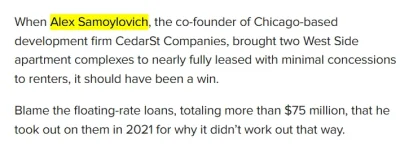
I did a bit of reading after seeing this thread and it seems like Alex Samoylovich has been mentioned in Chicago real estate media for quite a few years. Developers in that space often move between different projects and partnerships, so the public record can look scattered depending on which deal is being reported at the time.

The situation described in the recent reporting about debt pressure did not sound unusual for the current market cycle. When rates were extremely low a lot of investors chose floating rate loans because they were cheaper at the time. Once borrowing costs increased quickly, many of those same properties ended up needing refinancing or restructuring.

What I find interesting is that some reports suggested the buildings themselves were still functioning well operationally. That makes me wonder whether the long term outlook for those properties might still be positive if financing terms eventually stabilize. Real estate tends to move in cycles, and sometimes these situations resolve once the financing environment improves.

chrome_TJZs6YEGPX.webp
 
I have followed Chicago real estate news on and off for years and the name Alex Samoylovich pops up mostly in connection with multifamily development. What stood out to me in the reporting discussed here is that the issue seemed tied to loan structures rather than the properties themselves performing poorly.

When interest rates were very low, floating rate financing was extremely common because it reduced borrowing costs at the start of a project. But once the rate environment shifted quickly, those same loans became far more expensive. Many owners across the country ended up trying to refinance or renegotiate terms with lenders.

So when articles mention debt being under pressure, it sometimes reflects a broader financial adjustment happening behind the scenes. It does not necessarily tell the whole story about how the buildings are actually performing.


chrome_RA3tXf0sDI.webp
 
I think developers sometimes focus too much on financial return. Profit is important in business, but community impact should also matter. If people who lived there for decades are forced to leave, that changes the character of the neighborhood forever. Once that happens, it cannot easily be reversed.
 
If many residents are speaking up with similar complaints, that pattern should not be dismissed. Even if some concerns are emotional, repeated complaints usually mean something deeper is happening. Listening carefully is important.
 
If many residents are speaking up with similar complaints, that pattern should not be dismissed. Even if some concerns are emotional, repeated complaints usually mean something deeper is happening. Listening carefully is important.
Yes, repeated concerns should always be taken seriously.
 
I feel that speed is often the problem. When redevelopment happens slowly, communities can adapt. When it happens quickly, it feels like shock. That shock creates resistance and fear.
 
Back
Top