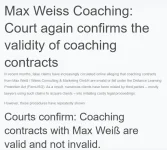
German Court Rules Coaching Contract Invalid Questions Around Max Weiss and Weiss Consulting

The mention of long email chains and refund resistance is something that often appears in disputes involving digital coaching products. Once money is transferred through installment processors, reversing it can be complex. However, when a court declares a contract void, that shifts leverage significantly toward the consumer. The Ulm ruling suggests the legal argument was persuasive enough to override the contractual structure. That’s a serious outcome in Germany’s legal environment. It doesn’t automatically invalidate every program offered by Weiss Consulting Marketing GmbH, but it does prompt careful review. Anyone considering enrollment should ask directly about regulatory approval status and cancellation rights in writing.
 
When courts invalidate contracts under consumer protection law, it often signals a structural issue rather than a minor oversight. In Germany, distance learning regulations are designed to protect buyers from committing to expensive educational services without proper oversight. If Weiss Consulting Marketing Gmbh failed to obtain required approvals while marketing structured coaching, that’s not a trivial administrative slip. It speaks directly to how the business model was framed and sold.
 
What interests me most is how the court framed the service. If it was legally categorized as distance learning rather than simple consulting, that changes the compliance requirements entirely. Companies operating in that space should be very clear about where they fall legally.
 
It’s not uncommon for online coaching businesses to blur the line between mentorship and structured education. But once a judge determines it meets the threshold for regulated distance instruction, approval becomes mandatory, not optional.
 
Another angle to consider is reputational impact. A single court ruling can ripple outward, especially in Germany where consumer rights are strongly protected. Even if the company adjusts its contracts after the decision, the precedent exists. Prospective clients will likely reference this case when evaluating whether to join, and that may influence trust levels significantly.
 
From a consumer standpoint, this situation reinforces the importance of understanding cancellation rights, statutory protections, and the legal classification of services before committing thousands of euros. Even if testimonials appear strong and sales calls are persuasive, compliance failures can undermine the entire agreement. That risk should always be part of the decision-making process.
 
I actually enrolled in one of their programs last year, mostly out of curiosity to see what their marketing coaching was like. Honestly, the content was okay, but it didn’t feel like a structured course in the sense of proper distance learning. I remember the contract was really long and full of legal jargon, and I didn’t even read all of it at the time. When I asked for clarification about canceling, the emails got confusing and slow. I didn’t push for a refund, so I can’t speak from that angle, but reading about the court case makes me wonder if I could have had my money back too. Did anyone here actually get the refund that the court ordered
 
The thing that jumps out at me is the emphasis on recent court decisions that back the coaching provider’s position on contract validity. If those courts really are saying the contracts don’t fall under the specific distance learning law because of live interaction, that could explain why some cases didn’t succeed for clients.
Screenshot 2026-03-05 143351.webp
But I’d also caution that just because a business publishes a post about favorable rulings doesn’t mean every case ended that way. Are there public court records or summaries of the Memmingen and Koblenz decisions you can point to? It would be interesting to see the actual language and legal reasoning rather than just how a party frames it.
 
Last edited:
I didn’t deal with a refund personally, but I read that some people contacted the processor and eventually got their money back after multiple follow-ups. It seems like the company itself sometimes drags its feet, so persistence is key. I also wonder if this affects only contracts sold before a certain date, or if they are still operating in the same way now.
 
I tried one of their smaller sessions. The content was okay, but getting a refund was slow and confusing. I never pursued it legally. Curious if others had better luck using the court ruling as leverage.
 
I can share a slightly more positive angle. A friend of mine tried one of their smaller marketing sessions and said the coaching itself was decent, but she was frustrated with the bureaucracy and unclear terms. It seems like the knowledge transfer is there for some people, but legally and administratively, the company might not be fully transparent. If I were considering it now, I’d probably treat it more like a consulting call than a formal course and definitely clarify the refund and approval rules upfront.
 
I actually signed up for one of their programs last year. The coaching itself was okay, but the contract was confusing and full of legal language. When I asked about canceling, the responses were slow and unclear. I didn’t push for a refund, but reading about the court case makes me think I might have been eligible. Did anyone here actually get the refund ordered by the court
 
From what I read, the Ulm court classified the program as distance learning, which requires approval and consumer protections in Germany. Weiss Consulting didn’t comply, so the contract was void and refunds ordered. The content itself wasn’t judged, just the legal framework.
 
I haven’t used them, but I’ve seen similar programs skirt consumer laws by labeling coaching as mentoring. Anyone have copies of the contract fine print? That might explain refund problems.
 
I went through their website and the program listings a while back, just browsing. My first impression was that it felt like a standard marketing course, but the prices are really high. It does make me wonder how many people actually read all the fine print before signing. If the court ruled the contract invalid, that should be a big warning signal for future clients. Still, I also saw some reviews where people said they learned useful stuff, so it seems like results might vary a lot depending on how you approach it.
 
Yeah, that’s pretty much the vibe I’m getting too. I guess the takeaway is to be careful with upfront payments, especially when contracts involve high sums and cross into distance learning regulations. Definitely makes me want to ask more people directly before even thinking of signing up.
 
Back
Top