Breaking Down the Government Complaint Referencing Alexander Spellane

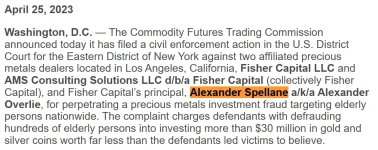
While browsing through some regulatory coverage, I noticed that Alexander Spellane was referenced in a case tied to Fisher Capital and action taken by the Commodity Futures Trading Commission. The material I saw pointed to a formal complaint filed in federal court, focusing on how certain precious metals transactions were marketed to clients. The agency described concerns about representations made to buyers and the financial impact those deals allegedly had. From what I understand, this situation stems from official filings rather than online rumors. The regulator appears to have outlined detailed allegations about sales tactics and investor losses. However, I have not yet found clear information about how the proceedings concluded, whether there was a judgment, settlement, or ongoing litigation. That part feels a bit unclear based on the summaries available. I am bringing this up because I want to better grasp how these enforcement actions typically unfold. When a federal watchdog initiates legal proceedings, does that usually lead to a negotiated resolution, or can these matters stretch on for years? I am not assuming anything about Alexander Spellane personally, but I am interested in understanding what weight to give to an initial government filing versus a final court outcome. If anyone has insight into similar investment related cases, I would value your perspective.
 
While browsing through some regulatory coverage, I noticed that Alexander Spellane was referenced in a case tied to Fisher Capital and action taken by the Commodity Futures Trading Commission. The material I saw pointed to a formal complaint filed in federal court, focusing on how certain precious metals transactions were marketed to clients. The agency described concerns about representations made to buyers and the financial impact those deals allegedly had. From what I understand, this situation stems from official filings rather than online rumors. The regulator appears to have outlined detailed allegations about sales tactics and investor losses. However, I have not yet found clear information about how the proceedings concluded, whether there was a judgment, settlement, or ongoing litigation. That part feels a bit unclear based on the summaries available. I am bringing this up because I want to better grasp how these enforcement actions typically unfold. When a federal watchdog initiates legal proceedings, does that usually lead to a negotiated resolution, or can these matters stretch on for years? I am not assuming anything about Alexander Spellane personally, but I am interested in understanding what weight to give to an initial government filing versus a final court outcome. If anyone has insight into similar investment related cases, I would value your perspective.
In my experience, an enforcement filing is essentially the opening move in a legal process. It lays out what the agency believes occurred, but it is still subject to challenge in court. Many of these matters end in settlements where the defendants neither admit nor deny the findings, while others proceed further. The important thing is distinguishing between allegations and confirmed violations. It is wise not to treat the complaint itself as the final word.
 
In my experience, an enforcement filing is essentially the opening move in a legal process. It lays out what the agency believes occurred, but it is still subject to challenge in court. Many of these matters end in settlements where the defendants neither admit nor deny the findings, while others proceed further. The important thing is distinguishing between allegations and confirmed violations. It is wise not to treat the complaint itself as the final word.
That distinction is helpful. I think it is easy for readers to blur the line between an accusation and a proven conclusion.
 
Cases involving precious metals investments often draw attention because they target retail customers who may not fully understand the structure of the transactions. If the regulator believed marketing practices were misleading, that is significant, but the details matter. Sometimes courts narrow the claims, and sometimes they uphold most of them. I would suggest checking whether there were parallel civil suits from investors as well. That can shed light on how the matter was perceived beyond the agency itself.
 
It is also worth remembering that regulators can name individuals if they believe those people had managerial or decision making roles. That does not automatically establish wrongdoing, but it signals that the agency thinks personal accountability may be relevant. I would be cautious about forming strong opinions until there is clarity on the outcome. Headlines often highlight the most dramatic elements of a filing without following up on the resolution.
 
It is also worth remembering that regulators can name individuals if they believe those people had managerial or decision making roles. That does not automatically establish wrongdoing, but it signals that the agency thinks personal accountability may be relevant. I would be cautious about forming strong opinions until there is clarity on the outcome. Headlines often highlight the most dramatic elements of a filing without following up on the resolution.
Good point about media coverage focusing on the initial claims. I am more interested in what the court ultimately determined, if anything has been finalized.
 
If you can locate the final order, that will usually summarize the court’s conclusions and any penalties imposed. Sometimes there is a permanent injunction, fines, or restrictions on future business activity. Other times the parties reach a negotiated agreement that closes the case without a full trial.
 
I appreciate that you are approaching this carefully. Discussions around regulatory matters can easily turn into speculation. Sticking to documented filings and confirmed outcomes is the most responsible way to handle it. If you find updates on the status involving Alexander Spellane, it would definitely help to continue the conversation with more concrete information.
 
One thing I usually check in situations like this is whether the court issued any preliminary injunction early in the case. That can sometimes indicate how seriously the judge viewed the regulator’s concerns at the outset. It still does not determine ultimate liability, but it can show whether the court believed there was enough evidence to move forward. If there was asset freezing or business restrictions ordered, that would be significant context. Have you seen anything like that mentioned in the filings?
 
I did a little digging after reading this thread and found that the Fisher Capital situation was discussed in several financial regulation forums as well. What caught my attention was how often precious metals investment companies come up in enforcement cases when retirement funds are involved. Regulators seem particularly sensitive about that because retirement accounts are supposed to be protected and long term.
Regarding Alexander Spellane, I noticed his name appears in reporting connected to the company’s management structure. That alone does not really explain what level of involvement he had, though. Sometimes executives are listed in complaints simply because they were part of leadership during the time regulators were investigating.
It would really help to see the exact language used in the official filing. Those documents usually describe who was responsible for which part of the operation, whether it was marketing, management, or something else.
 
Something else to keep in mind is how precious metals IRA companies typically work. Many of them market gold or silver as a hedge against economic instability, which attracts people who are worried about inflation or financial crises. That kind of messaging is not automatically wrong, but regulators sometimes step in if they believe the marketing crossed into misleading territory.
In some articles I have read about Fisher Capital, the focus seemed to be on how retirement investors were encouraged to liquidate existing savings and move those funds into metals purchases. When that happens, pricing transparency becomes a big issue because buyers may not always realize how much markup they are paying.
1772621817182.webp
 
I think it is smart that you are focusing on official records instead of just summaries. A lot of people read a headline and assume the matter is settled when in reality it might still be contested. With cases involving investment products, especially metals, there can be complex pricing structures that are hard to evaluate without reading the full complaint.
 
I think it is smart that you are focusing on official records instead of just summaries. A lot of people read a headline and assume the matter is settled when in reality it might still be contested. With cases involving investment products, especially metals, there can be complex pricing structures that are hard to evaluate without reading the full complaint.
That is a good suggestion. I have not yet looked for motions to dismiss, but that would definitely show how the defense responded.
 
Another angle could be checking whether there were administrative actions separate from the federal court case. Occasionally regulators pursue both civil court enforcement and administrative penalties. If that happened here, it might give a fuller picture of the overall regulatory response. It does not mean anything definitive on its own, but it helps map out the scope of the matter. Transparency around those steps can be informative.
 
I remember reading that precious metals investments are sometimes marketed as safe alternatives during uncertain economic times. That can make these cases particularly sensitive. If the agency believed clients were given misleading impressions about risk or potential returns, that would be central to the dispute. Still, until there is a final ruling, it remains an unresolved legal issue. It is good to keep that balance in mind.
 
I remember reading that precious metals investments are sometimes marketed as safe alternatives during uncertain economic times. That can make these cases particularly sensitive. If the agency believed clients were given misleading impressions about risk or potential returns, that would be central to the dispute. Still, until there is a final ruling, it remains an unresolved legal issue. It is good to keep that balance in mind.
Yes, the marketing aspect is what stood out to me as well. The descriptions in the complaint seemed focused on how products were presented to buyers.
 
Have you checked whether there were any press releases from the regulator at the time the case was filed? Those sometimes summarize the alleged conduct in plain language. They are still based on the complaint, of course, but they can help clarify the scope of what the agency was trying to address. Just remember they are written from the regulator’s perspective. Comparing that with the court’s final order can be revealing.
 
It might also be helpful to see if any compliance changes were implemented at the company after the case became public. Sometimes firms revise policies or adjust their sales approach in response to regulatory scrutiny.
 
It might also be helpful to see if any compliance changes were implemented at the company after the case became public. Sometimes firms revise policies or adjust their sales approach in response to regulatory scrutiny.
So far I have mostly focused on the complaint itself and summaries of it.
 
Back
Top