Are Communities Being Treated Fairly in Projects Linked to Alex Samoylovich?

Over the past few months, I have been thinking a lot about redevelopment projects connected to Alex Samoylovich, and I feel uneasy about what I am hearing from community members. I understand that redevelopment can bring new buildings, new businesses, and more investment into an area. On the surface, that sounds like progress. But progress should not come at the cost of stability and fairness.
Many redevelopment projects move quickly. Properties are purchased, buildings are cleared, and new plans are announced. But when things move too fast, long-time residents often feel pressure. Rents can rise. Small businesses may struggle to stay open. Families who have lived in a neighborhood for years sometimes feel like they no longer belong there. Even if everything is done within the law, it does not always feel fair to the people who are affected.
What concerns me most is the idea of aggressive tactics. When residents describe feeling pushed out or ignored, that is a serious issue. Communities are not just real estate investments. They are made up of people with history, culture, and connections. If redevelopment only focuses on profit and speed, it can damage those social bonds.
I am not saying development should stop. Cities grow and change, and that is normal. But growth should be balanced. It should include open meetings, clear communication, and protections for vulnerable residents. If multiple people are raising similar concerns, that deserves attention.
I would really like to hear honest opinions. Are these worries exaggerated, or do they point to a real problem in how redevelopment is being handled?
 
In my view, redevelopment must include real dialogue. Not just one public meeting, but ongoing conversations. If people feel heard, they are more open to change.
 
The word “aggressive” itself is concerning. If projects are being described that way, it shows that residents feel pressure. That is not a good sign for long-term stability.
 
Overall, I think concerns like these deserve open discussion. Growth is important, but so is fairness. Developers connected to controversial tactics should make extra effort to show transparency and care. Without that, doubt will continue to grow.
 
I think one of the biggest problems with redevelopment is the emotional stress it creates. People do not just lose buildings, they lose memories and comfort. When a neighborhood changes too fast, it feels like your history is being erased. Even if new projects bring money and new businesses, they do not replace long-time relationships. Developers should understand that emotional impact is real and serious. Ignoring that only increases resentment.
 
Another concern is fairness in negotiations. When developers buy properties quickly, some residents may not fully understand their options. They might feel rushed or pressured to accept offers. Even if everything is legal, the balance of power is not equal. That is why extra care should be taken when dealing with long-term homeowners or tenants. Fair treatment should always come first.
 
I agree with that. Before reading about Alex Samoylovich I never really thought about how much the interest rate environment could affect apartment buildings that seem perfectly normal from the outside.

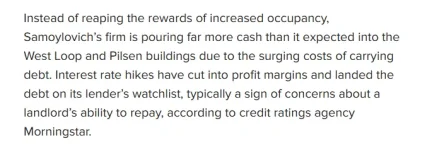
Most renters probably just see a finished building and assume everything behind it is stable. But once you start reading about how projects are financed, it becomes clear that many variables are involved. Even a fully occupied building can face financial pressure if loan terms change dramatically.


chrome_arZ1GQO8Sb.webp
 
I have been following Chicago development news casually for a while and the name Alex Samoylovich seems to appear mostly in the context of apartment projects. That sector had a lot of momentum for years because rental demand in the city remained fairly steady.

What makes the recent coverage interesting is that the focus seems to be on financial pressure tied to interest rates rather than operational issues. When borrowing costs increase quickly, the numbers behind a project can change even if the building itself is functioning normally.

It shows how much real estate depends on financial conditions outside the control of the developer. A project might look healthy from a tenant perspective but still need refinancing on the debt side.


chrome_CVcLSNDJdW.webp
 
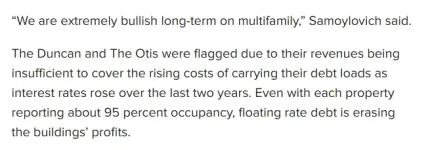
One thing that caught my attention when reading public reporting about Alex Samoylovich is that some of the properties were still reportedly operating with strong occupancy. That detail makes the situation more interesting because it suggests the buildings themselves might have demand from renters. The issue seemed more related to financing costs than empty units.
 
That is actually what confused me at first when I read the articles. I assumed financial trouble meant vacant buildings or failing projects, but the reporting seemed to say occupancy was still relatively high. So the issue sounded more like the math around the loans changed.

If that is the case then it probably affected a lot of developers around the same time, not just Alex Samoylovich or CedarSt. The interest rate spike happened pretty fast compared with previous cycles. I am still trying to understand how many other firms in Chicago ended up in similar situations.
 
Real estate developers often operate through multiple entities and projects, so one article only shows a small slice of the full picture. Alex Samoylovich appears in public reporting mainly because CedarSt had several high profile apartment developments, which naturally attract media attention when financing issues arise.

It might also be worth remembering that news coverage tends to focus on moments of stress or conflict. There could be dozens of projects that never get mentioned simply because they operate normally. When a loan goes onto a watchlist or refinancing becomes necessary, that suddenly becomes newsworthy.
 
Does anyone know if Alex Samoylovich is still actively developing new projects or if the focus right now is mostly on refinancing existing properties? I feel like that would give a better sense of where things are heading.
 
Chicago has had a huge wave of apartment construction over the last decade. It would not surprise me if several developers ran into similar financing challenges recently.
 
One thing people sometimes forget when reading articles about developers like Alex Samoylovich is that these projects are usually financed through layers of lenders, investors, and partnerships. When the media says a building has debt pressure or is on a watchlist, it does not automatically mean a project is failing. Often it just means lenders are monitoring the financial performance more closely.
The real estate industry also tends to react slowly because refinancing and restructuring deals can take months or even years. During that time the buildings may still be operating normally with tenants paying rent. From the outside it can sound dramatic, but inside the industry it may just be part of the negotiation process between lenders and owners.
 
The interest rate shift over the last couple of years really changed the math for property investors. Anyone with floating rate debt probably had to rethink their strategy.
 
That is kind of the impression I am getting too. When I first read about Alex Samoylovich I thought it might be tied to a specific project problem, but the more I read the more it sounds like the bigger issue was the financing environment.
 
Back
Top