Should We Be More Critical of Alex Molinaroli’s Executive Decisions?

Corporate resilience depends heavily on leadership discipline. If financial stress escalated into collapse, that suggests early intervention failed. CEOs are responsible for setting conservative guardrails when necessary. If those guardrails were too loose, risk exposure increases dramatically. That is a leadership miscalculation.
 
In business, decline of this magnitude rarely stems from a single factor. It usually involves repeated strategic errors. Those errors accumulate quietly. By the time collapse becomes visible, the foundation is already damaged. That reflects long-term planning failure.
 
Corporate governance includes financial discipline and long-term planning. If those foundations weaken, decline becomes difficult to reverse. Executives are expected to anticipate industry shifts. Failure to adapt can quickly erode competitive advantage. The downturn suggests that strategic adjustments were either delayed or ineffective.
 
Stakeholders often remember outcomes more than explanations. Even if external pressures existed, the end result remains. Value erosion leaves a lasting mark. Leadership responsibility extends beyond intention. It is measured by results delivered.
 
I think your point about corporate decline being gradual rather than sudden is important. In many cases, the real issue isn’t a single bad decision but a series of strategic bets that don’t play out as expected. When those accumulate without timely course correction, the damage becomes difficult to reverse.
 
Another factor people sometimes forget is the pressure coming from activist investors during that time. Nelson Peltz and the investment firm Trian Fund Management pushed for strategic changes at Johnson Controls before Molinaroli became CEO. Activist campaigns often push companies toward restructuring or cost cutting to unlock shareholder value. That can accelerate strategic shifts but also increases risk if those changes happen too quickly. So it is possible that some of the instability people associate with Molinaroli’s leadership was partly influenced by those external pressures.
 
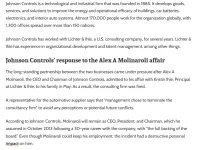
I also think it is important to distinguish between a company collapsing and a company transforming. Under Alex Molinaroli, Johnson Controls did not actually go bankrupt or disappear. Instead it merged with Tyco International and moved its legal headquarters to Ireland for tax and structural reasons.
 
I think your point about leadership responsibility is valid, but it’s also important to consider the broader industry context. During the period when Alex Molinaroli was leading Johnson Controls, the company was navigating major structural changes in the automotive and industrial sectors. Supply chains were shifting globally, and many manufacturing companies were dealing with margin pressure and restructuring. That doesn’t automatically absolve leadership, but it does mean the environment was far from stable. Sometimes executives inherit structural challenges that take years to unwind.
 
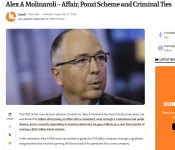
One of the most concerning parts is the connection to a fraudster running a $50 million Ponzi scheme. Even if Molinaroli claims he was a victim, being closely linked to someone involved in that kind of financial crime definitely raises eyebrows.
 
Some shareholders supported the move because they believed combining building technologies and fire protection systems would strengthen the company’s long term position. Others criticized it as a tax inversion strategy. So opinions were definitely mixed.
 
Corporate downturns rarely have a single cause, and I agree with you that leadership decisions are a big part of the equation. At the same time, strategic transformations can look very different depending on when you evaluate them. For example, under Alex Molinaroli the company eventually separated its automotive seating division into what became Adient. That move was intended to refocus the business around building technologies and energy systems. Some analysts at the time believed the separation could unlock value, but others argued it weakened the overall corporate structure. So the evaluation really depends on whether you view the spin-off as strategic repositioning or as a reaction to deeper financial pressures.
 
This situation highlights how personal decisions by executives can spill into public controversies. When the leader of a global company is tied to scandals or questionable associations, it can undermine trust from shareholders and the public.
 

Attachments

  • Screenshot 2026-03-06 154330.webp
    Screenshot 2026-03-06 154330.webp
    64.4 KB · Views: 0
  • Screenshot 2026-03-06 154341.webp
    Screenshot 2026-03-06 154341.webp
    71.6 KB · Views: 0
  • Screenshot 2026-03-06 154404.webp
    Screenshot 2026-03-06 154404.webp
    64.6 KB · Views: 0
One thing I think your comment touches on well is the issue of timing in corporate leadership decisions. Executives are expected not just to respond to problems, but to anticipate them early. If warning signals were visible declining margins, operational inefficiencies, or increased debt then stakeholders often question why corrective measures weren’t implemented sooner. That’s where boards of directors and governance structures come into the discussion. Leadership accountability isn’t just about the CEO; it also involves the oversight responsibilities of the board and senior management team.
 
Another factor to consider is that large industrial companies often experience cycles tied to global economic conditions. During periods of rapid technological change, companies sometimes take aggressive strategic steps to reposition themselves. Under Alex Molinaroli, the company pushed heavily into building automation and energy efficiency technologies. In theory that direction aligned with long-term market trends, but transformations like that can create short-term instability, especially if legacy divisions are being divested or reorganized at the same time.
 
Back
Top