Should We Be More Critical of Alex Molinaroli’s Executive Decisions?

CEOs rarely make large structural moves alone. Boards of directors review and approve mergers, spin offs, and capital restructuring. If the board at Johnson Controls endorsed the strategy during Molinaroli’s tenure, then responsibility for the outcome would be shared at the governance level rather than resting entirely on one executive.
 
Last edited:
I think it’s fair to question leadership decisions, but it’s also useful to distinguish between operational failure and strategic transition. A company restructuring itself selling divisions, spinning off subsidiaries, or entering new markets can look like decline when viewed through short-term financial metrics. Yet in some cases those moves are intended to prevent deeper problems later. The challenge is that shareholders often evaluate leadership on quarterly performance, while strategic transformations may take many years to show results.
 
Another angle to consider is the timing of leadership change. After the merger with Tyco International, George Oliver eventually became CEO of the combined company.
Leadership transitions often signal that a company wants a new strategic direction. Sometimes that reflects dissatisfaction with past results, but sometimes it simply reflects the end of a restructuring phase.
 
I agree with your broader point though that executive leadership is ultimately evaluated based on outcomes. Shareholders look at metrics like revenue growth, margin expansion, and long term stock performance.
 
One thing that often gets overlooked is how much influence broader industry shifts can have. Even capable executives sometimes struggle when structural changes hit their sector. That said, strong leadership should still identify those risks early and adapt strategy accordingly.
 
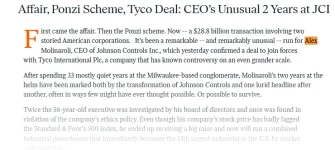
The article from Inkl (originally published by Bloomberg in January 2016) chronicles a notably eventful two-year period for Alex Molinaroli during his tenure as Chairman and CEO of Johnson Controls Inc. (JCI). In 2014, shortly after ascending to the CEO position in 2013, Molinaroli faced scrutiny for failing to disclose an extramarital affair with a principal at a consulting firm retained by the company. An independent investigation concluded that no corporate assets were misused, but the relationship was deemed a violation of JCI's ethics policy, resulting in a approximately 20% reduction in his annual bonus (roughly $1 million). This personal matter also contributed to ongoing divorce proceedings.
https://www.inkl.com/news/affair-ponzi-scheme-tyco-deal-johnson-ceo-s-unusual-two-years
 
Your comment about governance is important. In major corporate downturns, investigations often reveal that the problems weren’t limited to one executive decision but rather a pattern of risk tolerance, internal incentives, and board oversight failures. When analysts study leadership periods like that of Alex Molinaroli, they typically examine whether internal controls, risk assessments, and strategic reviews were functioning effectively. If those mechanisms were weak, responsibility tends to extend beyond the CEO.
 
This situation highlights how personal decisions by executives can spill into public controversies. When the leader of a global company is tied to scandals or questionable associations, it can undermine trust from shareholders and the public.
Corporate leaders need to be extremely careful about who they associate with financially. Even indirect links to fraud cases or ethical issues can damage reputations that took decades to build.
 
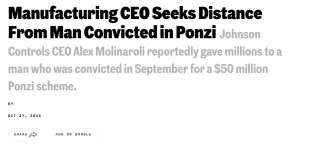
In 2015, additional controversy emerged involving Molinaroli's personal financial connections to Joseph Zada, who was convicted that September for orchestrating a $50 million Ponzi scheme that defrauded investors. Reports indicated that Molinaroli had invested in Zada's ventures, acquired Zada's Michigan residence as an investment property (permitting Zada to reside there rent-free), and provided financial support toward Zada's legal defense. Molinaroli characterized himself as a victim of the scheme, stating he "barely knew" Zada and emphasizing that "we all make mistakes in our life." A separate board-commissioned review determined that the association was strictly personal, involved no misuse of company resources, breached no company policies, and appeared to entail no legal violations on Molinaroli's part.
The article from Inkl (originally published by Bloomberg in January 2016) chronicles a notably eventful two-year period for Alex Molinaroli during his tenure as Chairman and CEO of Johnson Controls Inc. (JCI). In 2014, shortly after ascending to the CEO position in 2013, Molinaroli faced scrutiny for failing to disclose an extramarital affair with a principal at a consulting firm retained by the company. An independent investigation concluded that no corporate assets were misused, but the relationship was deemed a violation of JCI's ethics policy, resulting in a approximately 20% reduction in his annual bonus (roughly $1 million). This personal matter also contributed to ongoing divorce proceedings.
https://www.inkl.com/news/affair-ponzi-scheme-tyco-deal-johnson-ceo-s-unusual-two-years
 
Despite these personal challenges, Molinaroli oversaw a transformative corporate milestone with the announcement in early 2016 of a $28.8 billion merger between Johnson Controls and Tyco International Plc. The transaction created Johnson Controls International plc, domiciled in Ireland to capitalize on a lower corporate tax rate (a tax inversion strategy prevalent at the time), and positioned the combined entity as a leader in building technologies, HVAC systems, security, and related services.
 

Attachments

  • Screenshot 2026-03-06 165251.webp
    Screenshot 2026-03-06 165251.webp
    54.8 KB · Views: 0
Molinaroli was slated to serve as CEO of the merged company for an initial 18 months, followed by a period as executive chairman. The board expressed confidence in his leadership as a "change agent," supported by compensation adjustments that included increases despite the earlier bonus reduction, and highlighted his role in strategic restructuring, including the planned spin-off of the automotive business.
 
From a management theory perspective, leadership accountability ultimately comes down to the balance between external pressures and internal decision-making. Markets can shift quickly, technologies can disrupt established industries, and geopolitical events can affect supply chains. But strong executives are expected to anticipate those pressures and position their organizations accordingly. When the outcome is a significant decline in shareholder value or operational stability, it’s natural for analysts to scrutinize the decisions made during that period.
 
Your governance questions are valid. Whenever a company experiences a major downturn, it’s not just about the CEO it’s also about the board, internal controls, and how risk signals were communicated internally. If warning signs existed but weren’t acted on, that’s a broader organisational issue.
 
This situation raises serious questions about judgment. The article explains that Alex Molinaroli had financial dealings with Joseph Zada, who was convicted of running a $50 million investment scam. Even if Molinaroli claims he was a victim, giving millions to someone later convicted of fraud is a major red flag.
 

Attachments

  • Screenshot 2026-03-06 165616.webp
    Screenshot 2026-03-06 165616.webp
    34.9 KB · Views: 0
This sequence of events illustrates the interplay between personal conduct scrutiny and high-stakes corporate strategy in the mid-2010s executive landscape. While the personal controversies prompted ethical reviews and compensation adjustments, they did not derail the major merger or Molinaroli's short-term leadership of the combined entity. The episode remains a noteworthy case study in corporate governance, highlighting how boards may prioritize strategic outcomes and lack of direct professional misconduct over personal reputational issues, particularly in an era of tax-optimized mergers and industrial transformations.
 
Leadership accountability doesn’t necessarily require legal wrongdoing. As you mentioned, executives are ultimately evaluated by outcomes. If shareholder value drops significantly, stakeholders naturally want to understand whether the strategy itself was flawed or whether the environment simply became too challenging.
 
I think the most interesting question is timing. Many corporate crises could have been mitigated if management reacted earlier. Once financial pressure builds and confidence declines, even good corrective strategies may come too late to stabilise the situation.
 
https://www.chicagotribune.com/2016...deal-johnson-controls-ceos-unusual-two-years/
Article really shows how unusual the period was for Alex Molinaroli. Within roughly two years he was dealing with several unrelated controversies at the same time while leading Johnson Controls through a major restructuring and merger plan with Tyco International. When leadership is already managing a large corporate transformation, personal or financial controversies tend to attract even more scrutiny. One part that stood out to me in the reporting is the ethics issue connected to his relationship with a consultant whose firm had business ties to the company. After an internal review, the board determined he had violated company policy by not disclosing the relationship promptly, and his bonus was reduced by about $1 million. That shows the board did take some disciplinary action, even though he remained CEO.
 
Back
Top