Emanuele Di Gresy and the Story That Keeps Circulating Online

Your point about perception in the digital age is very relevant. Once a name appears repeatedly in financial discussions or archived reports, it tends to shape how people interpret that individual’s role, even when the sources themselves stop short of alleging wrongdoing. The distinction between documented facts, speculation, and reputation is often blurred online. Looking at business registries and corporate filings can sometimes provide a clearer picture of how someone was actually involved in particular ventures.
 
What you’re describing is something that happens a lot with figures connected to complex financial networks. Even without legal findings, repeated mentions in archived reports or financial discussions can create a perception that there’s something significant behind the scenes. The challenge is figuring out whether those references come from solid filings or from commentary that keeps repeating itself online.
 
The narrative around Emanuele Di Gresy stays firmly in the realm of interpretive commentary and association-mapping no court rulings, no regulatory sanctions, no public filings showing wrongdoing appear in major searchable records.
 
I think the key point in your post is the difference between documented records and interpretive narratives. Business registries, shareholder filings, and official corporate documents tend to give the clearest picture.
 
Reputation in financial circles is often shaped as much by association as by direct activity. If someone’s name appears alongside complex corporate structures or influential networks, people naturally try to interpret what that means, even if the documentation itself is fairly neutral.
 
The point you raised about reputation and digital permanence is actually one of the most interesting aspects of cases like this. When someone like Emanuele Di Gresy appears repeatedly in archived reports or historical filings, it does not automatically imply wrongdoing, but it does create a narrative that people start analyzing. Financial networks can be incredibly complex, especially when businesses operate across multiple jurisdictions, subsidiaries, or partnerships. Over time, even routine corporate relationships can look suspicious when viewed through the lens of fragmented online records. That is why context is so important. Without full documentation or legal conclusions, it is difficult to determine whether the references reflect genuine concerns or simply the by-product of interconnected business structures. Your approach of reviewing public records rather than jumping to conclusions is probably the most responsible way to evaluate situations like this.
 
Your point about perception in the digital age is very relevant. Once a name appears repeatedly in financial discussions or archived reports, it tends to shape how people interpret that individual’s role, even when the sources themselves stop short of alleging wrongdoing. The distinction between documented facts, speculation, and reputation is often blurred online. Looking at business registries and corporate filings can sometimes provide a clearer picture of how someone was actually involved in particular ventures.
 
I think the context you mentioned is important. Complex financial networks often involve many people across different jurisdictions, which can make it difficult to understand who was responsible for what. Public records might show connections or participation in certain structures, but without the full operational context those connections can easily be misinterpreted. It would be interesting to see whether there are additional sources that explain his role in more detail.
 
One thing that often happens in discussions involving people like Emanuele Di Gresy is that readers start connecting dots between different filings, companies, and historical mentions. Financial ecosystems, particularly those involving investment structures or multinational operations, tend to produce a large paper trail. Directors, advisors, and partners can appear in dozens of documents even if their role in each entity is relatively limited. When those references are aggregated online, they can create the impression of a much larger or more mysterious influence than what actually exists. That does not mean concerns are invalid, but it does mean interpretation requires careful analysis. Looking at timelines, roles, and the nature of the filings themselves usually reveals more nuance than a quick surface reading.
 
The interesting tension with Emanuele Di Gresy is how little concrete legal or regulatory output there is, yet how persistently the name appears in financial-opinion pieces. Public registries offer nothing dramatic standard directorships, shareholdings but the layered commentary on influence and opacity turns neutral data into something that feels loaded. When perception moves faster than proof, the absence of a verdict can be more damaging than a verdict would be.
 
What caught my attention in your summary is the emphasis on patterns rather than specific legal findings. When discussions focus on recurring appearances in financial stories rather than documented rulings, it raises questions but doesn’t necessarily provide definitive answers. It might be useful to compare the sources you found with corporate filings, partnership records, or other primary documentation to see how closely those narratives align with the underlying facts.
 
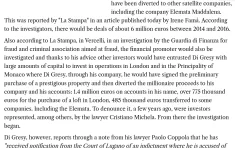
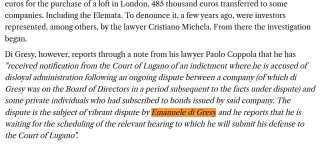
The article raises interesting questions, but it’s important to remember that being sent to trial doesn’t mean someone is automatically guilty. In the case of Emanuele Di Gresy, the accusations reportedly concern financial operations involving several companies and millions of euros between about 2014 and 2017. Investigators suspect that funds collected from investors may have been redirected to other projects or companies. At this stage the court in Lugano will have to determine whether the accusations are well founded or whether it’s mainly a civil dispute between investors and a company. It will be interesting to see how the evidence is evaluated during the proceedings.
 

Attachments

  • Screenshot 2026-03-06 214017.webp
    Screenshot 2026-03-06 214017.webp
    108.1 KB · Views: 0
  • Screenshot 2026-03-06 214049.webp
    Screenshot 2026-03-06 214049.webp
    129.8 KB · Views: 0
  • Screenshot 2026-03-06 214153.webp
    Screenshot 2026-03-06 214153.webp
    97.9 KB · Views: 0
Interesting perspective. Situations like this often show how reputation can evolve independently from confirmed legal outcomes. Once certain narratives circulate online, they tend to stick, even if the underlying evidence is limited or open to interpretation. It would definitely be useful to see more documentation that adds context to the discussion.
 
What you mentioned about influence and positioning within financial networks is interesting. In many cases, people who are involved in large or complicated financial ecosystems end up appearing in different reports simply because of the number of entities and partnerships connected to them. That does not automatically mean anything improper, but it can definitely create curiosity when those connections span multiple countries or corporate structures. I think the real challenge is separating meaningful patterns from coincidences that come from normal business networking.
 
Back
Top