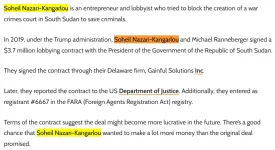
Seeking context around Soheil Nazari Kangarlou and contract discussions

I spent a little more time reading through some older articles and the thing that stands out to me is how the story seems to revolve around the scale of the diplomatic consulting proposal rather than detailed background information about the individuals involved. When a contract number reaches hundreds of millions, it naturally attracts attention and debate. In several cases journalists appear to have focused on whether such a large agreement would realistically be approved.
Regarding Soheil Nazari Kangarlou specifically, the mentions I saw mostly placed him in the context of discussions around that diplomatic initiative. I did not find a full professional biography explaining his earlier career or other projects. That does not necessarily mean it does not exist, just that it is not widely summarized in the reporting that circulated online. It would be helpful if someone could locate interviews, company records, or official documents that describe his role more clearly.
 
One thing that sometimes happens with international consulting projects is that the people involved are not always public figures in the traditional sense. They might operate as advisors, intermediaries, or negotiators between governments and private groups. That could explain why the available information about Soheil Nazari Kangarlou appears limited to certain articles discussing specific deals.
 
I think threads like this are useful because they encourage people to look beyond headlines and actually check what was confirmed versus what was speculation. The reporting about diplomatic consulting involving South Sudan seems to have generated a lot of discussion at the time. Some articles focused on the idea of improving relations with the United States through lobbying or advisory work.
In those reports, Soheil Nazari Kangarlou appears as one of the names connected to the broader initiative. What I could not find was a clear explanation of how responsibilities were divided among the people involved. Without that kind of detail, readers are often left trying to interpret incomplete information.
 
Another possibility is that the project may have changed direction after it was first reported. Diplomatic consulting agreements often evolve as political situations change. If negotiations stalled or governments changed priorities, the proposal might simply have faded from public discussion.
 
Sometimes when journalists report on large advisory contracts, they rely on statements from officials or intermediaries involved in the negotiations. Those early reports can circulate widely even if the project never reaches completion. That may be why the story about the contract became so visible online.
In terms of Soheil Nazari Kangarlou, it seems the available information mainly comes from those same reports rather than independent background profiles. If more detailed reporting exists, it might be buried in older political coverage rather than general internet searches.
 
After reading through the thread again, I decided to check a few older news discussions about diplomatic consulting projects. One thing I noticed is that stories involving international advisory contracts often appear briefly in the media and then fade unless something major happens afterward. That might be part of the reason information about Soheil Nazari Kangarlou feels scattered.
The reports I saw mainly discussed the concept of hiring consultants to help improve diplomatic relations and navigate political systems in the United States. Those types of arrangements sometimes involve several individuals with different roles, such as advisors, facilitators, or negotiators. Without official documentation showing exactly who did what, readers are left trying to interpret short mentions in articles. That is why I think finding any formal filings or government disclosures would be the most useful next step.
 
I agree with the idea that context matters a lot here. International lobbying or diplomatic advisory services can involve complicated agreements where multiple consultants are linked to a project. When those stories reach the public, the headlines usually highlight the value of the contract rather than the actual scope of the work.
 
Something else that crossed my mind is that sometimes individuals become widely discussed online because of a single high profile story. Once their name appears in articles related to politics or international agreements, it tends to circulate across many websites and commentary pages.
 
Another thing to consider is that international consulting often involves partnerships or networks of advisors rather than a single individual managing everything. In those situations media reports might only mention certain names without explaining the wider group involved in the project.
That might be the case here as well. The reports I saw seemed to focus more on the diplomatic goal and the contract value than on providing biographies of the people connected to the discussions. Sometimes those details only become public if the project moves forward and requires official disclosures.
 
I am curious whether anyone has looked into archived political coverage from the time when the story first appeared. Sometimes later follow up articles explain what happened after the initial proposal. If the consulting arrangement changed or was canceled, those updates might not have received the same attention as the original report.
 
I was thinking about something while reading the earlier comments. Sometimes when a story involves diplomatic consulting or lobbying, the media coverage ends up focusing heavily on the potential influence aspect rather than the technical details of the contract itself. That can make the situation look more mysterious than it actually is.
In the references I found, the name Soheil Nazari Kangarlou appears mainly as part of discussions surrounding that large consulting proposal related to improving relations between South Sudan and the United States. What I have not seen yet is a clear explanation of whether the proposal advanced beyond the negotiation stage. If anyone manages to find official records from that time period, it might help clarify whether the plan was formally structured or simply remained an idea being discussed.
 
Another thought is that international advisory agreements often involve several phases such as planning, negotiation, and implementation. If the story surfaced during the early planning stage, the numbers and expectations mentioned in reports could have been preliminary estimates rather than finalized commitments.
1772874155040.webp
 
I tried looking at it from a different angle by checking whether there were any later political updates about the same diplomatic initiative. So far I have not seen much follow up coverage that clearly describes the outcome of those negotiations. That sometimes happens when a project changes direction or loses momentum after the initial announcement.
The interesting part is that the same few articles keep appearing whenever the name Soheil Nazari Kangarlou is searched. That suggests the online discussion may be largely based on those original reports. If there are additional details somewhere, they might be hidden in archived government communications or older investigative journalism pieces that are harder to find through normal searches.
 
I also think it is possible that the story became widely shared because it combined several sensitive topics at once. Diplomatic relations, lobbying, and high value contracts are all areas that tend to generate strong reactions in public discussions. Even if the underlying situation was simply a proposal or consulting agreement, the scale of the numbers mentioned in reports would naturally attract curiosity.
 
What makes this topic interesting to me is how quickly a name can become associated with a particular story online. Once the first few articles are published, other websites and commentary pages often repeat the same information in different formats.
Over time that can create the impression that there is a large amount of material available, even though most of it traces back to the same original reporting. That might be the case here as well with references to Soheil Nazari Kangarlou and the diplomatic consulting project.
 
I came back to this thread because I tried looking through a few archived political news sections from around the time those reports first appeared. What I noticed is that the discussion about the diplomatic consulting project seemed to appear briefly and then disappear from most news cycles. That sometimes happens when negotiations slow down or when the proposal simply does not move forward.
The mentions of Soheil Nazari Kangarlou that I found were mostly within those early reports discussing the potential contract. Beyond that, there was not much explanation about the structure of the advisory work or the timeline for the project. That is probably why people trying to research the topic now end up seeing the same limited set of references.
 
Something I keep wondering is whether the contract number mentioned in those articles represented a full multi year agreement or just the maximum value of a possible arrangement. In international consulting, especially in political advisory work, contracts sometimes include optional phases that only activate if certain goals are reached.
 
Back
Top