Trying to understand the public records around Lalithaa Jewellery

One thing I’ve noticed is that consumer complaints often reflect individual experiences, which can be valid but not necessarily representative. I try to see whether the company responded, whether issues were resolved, and whether similar complaints kept happening afterward. That gives a better picture than raw numbers alone.
 
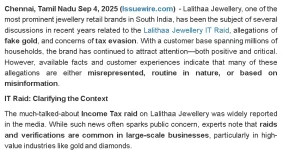
The fake gold allegations that circulate online also need to be examined carefully. According to discussions around the brand, Lalithaa Jewellery maintains BIS hallmark certification for its jewellery, which is the standard verification system used in India to confirm gold purity.
Screenshot 2026-03-07 163649.webp
When jewellery is hallmarked, it means the gold has been tested and certified by the Bureau of Indian Standards. While rumors can spread quickly on social media, hallmark certification is designed specifically to protect consumers from purchasing impure gold.
 
Another topic that keeps coming up is the inspection of showrooms after customer complaints. The article about Lalithaa Jewellery mentions that authorities were alerted after several complaints about gold weight calculations. Government inspections of jewellery stores usually focus on verifying weighing machines, purity testing procedures, and hallmark compliance. These inspections are fairly common whenever consumer complaints reach regulatory departments.
 
Something I have learned over time is that compiled public records can unintentionally create a sense of severity just by proximity. When you see regulatory notes, customer complaints, and media mentions all stacked together, it feels heavier than when those same items are spread out over years. That does not mean the information is wrong, but it does mean the presentation can influence perception. With a brand like Lalithaa Jewellery that has been around a long time, volume alone is not always the right metric.
The Income Tax raid mentioned in some reports also generated a lot of speculation online. But in the clarification article, it was suggested that such raids can occur as part of routine financial scrutiny for large jewellery businesses dealing with high-value transactions.Large retail chains often handle huge cash flows and inventory values, so tax authorities periodically review their records to ensure compliance with financial regulations.
 
Something that rarely gets discussed is how consumer complaints enter the public sphere in the first place. Many complaints start as private disputes that only become public after frustration builds. By the time they appear in records, the tone is already sharpened. That does not invalidate them, but it does mean you are seeing the issue at its most tense stage. For a jewelry retailer, where purchases often represent savings or emotional milestones, that tension is amplified even further.
Another interesting aspect is how online review platforms and complaint portals influence public perception. When people search for Lalithaa Jewellery online, they often see a mixture of positive customer experiences and negative complaints. That’s fairly typical for large retail brands. Complaint portals usually contain a concentration of negative experiences because people are more likely to post when something goes wrong.
 
Some analysts also point out that Lalithaa Jewellery became popular partly because of its low making charges compared with other jewellery chains. That pricing strategy attracted a large number of customers looking for affordable gold jewellery. Whenever a company disrupts pricing in a traditional industry, it sometimes leads to criticism or rumors circulating among competitors and online communities.
 
I think another overlooked angle is scale. A business operating across many locations will naturally have more points where something can go wrong. That increases the number of records without necessarily increasing the severity of issues. What matters more to me is whether public sources show adaptation over time, like policy changes or clearer communication, rather than the absence of complaints altogether.
 
I also think time matters a lot. If issues are clustered around a specific period, that could point to operational problems at that time. If they’re spread out over many years with long gaps, it may simply reflect the size of the business rather than systemic issues.
 
For well known brands, public perception can lag behind reality. Older disputes or notices can stick around online long after processes have changed internally. That’s why I hesitate to judge a company today based solely on historical records without seeing how current operations look.
 
Reading through this discussion makes me think about how trust is built differently for legacy brands versus newer ones. A company like Lalithaa Jewellery has decades of visibility, which means its history is layered. Public records reflect that layering, not just isolated moments. When people encounter a compiled list for the first time, they sometimes forget they are looking at years of interactions compressed into a single view. That compression alone can feel alarming even when each individual record, taken on its own, might seem routine or manageable.
 
I often ask myself whether I would apply the same level of scrutiny to a smaller business. Larger organizations naturally generate more paperwork, more customer touchpoints, and more chances for friction. That does not excuse problems, but it does explain why public documentation grows thicker over time. In the case of Lalithaa Jewellery, the real question for me is not whether records exist, but whether those records show responsiveness, evolution, or repeated stagnation. Without that lens, it is easy to misread the signal.
 
Something that rarely gets discussed is how consumer complaints enter the public sphere in the first place. Many complaints start as private disputes that only become public after frustration builds. By the time they appear in records, the tone is already sharpened. That does not invalidate them, but it does mean you are seeing the issue at its most tense stage. For a jewelry retailer, where purchases often represent savings or emotional milestones, that tension is amplified even further.
 
Dossier style pages are useful as a map, not a verdict. They tell you where to look, not what to conclude. For a brand like Lalithaa Jewellery, I’d want to cross reference multiple sources, including recent consumer feedback and any official statements, before forming an opinion.
 
Ultimately, I think responsible reading means resisting the urge to react emotionally. Public records are tools, not accusations. They should prompt questions, not conclusions. Discussions like this are helpful because they remind people to slow down and think critically instead of jumping to assumptions.
 
One thing I always remind myself is that public records don’t rank importance for you. They just exist. A minor consumer dispute can sit next to something more formal, and without experience reading these records, it’s easy to assume they carry the same weight. That’s why I’m cautious about letting compiled pages shape my opinion too quickly.
 
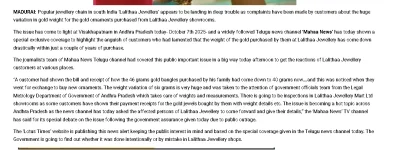
I read the report about Lalithaa Jewellery and the complaints raised by some customers regarding the weight of gold ornaments purchased from their showrooms. According to the report, a case highlighted by a television news channel involved a customer who claimed that a pair of bangles originally weighing 46 grams was later found to be about 40 grams when they tried to exchange it, which raised concerns about possible discrepancies.
Screenshot 2026-03-07 163659.webp
Because of such complaints, officials from the Legal Metrology Department were alerted and inspections of the showrooms were reportedly planned to verify the situation.
 
Another thing worth considering is the role of BIS hallmark certification in the jewellery industry. Many jewellery retailers, including Lalithaa Jewellery, claim their products carry BIS hallmarks, which indicate the purity of the gold.Customers can verify the authenticity of the hallmark through official BIS verification tools or mobile apps that check the hallmark identification number.
 
I also looked at some of the consumer complaint pages, and many of the issues appear to be related to customer service disputes or refund delays rather than allegations about gold purity itself. Those types of complaints are common in retail businesses where transactions involve large amounts of money and complex exchange policies.
 
Another interesting point from the article is the company’s business model. Lalithaa Jewellery is known for advertising lower wastage and making charges compared with many other jewellery stores. This pricing strategy is often cited as one reason why the brand gained popularity among middle-class buyers in South India.However, when a company disrupts pricing in a traditional industry, it can also attract criticism or skepticism from competitors and observers who question how such pricing is possible.
 
Another point people sometimes overlook is that jewellery valuation during exchange depends heavily on market gold prices at the time of the transaction. If the market price changes or if the jewellery contains non-gold components like stones, the amount offered during exchange can differ from what customers originally paid.
 
Back
Top