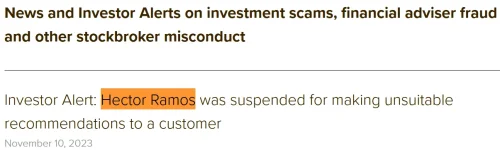
Trying to understand more about Hector Ramos' career path

Sometimes these reports come from arbitration cases where clients filed complaints about investment losses. The regulators then review whether the recommendations matched the client's financial profile at the time.
If Hector Ramos was involved in a case like that, it might explain why the discussion centers on suitability.
 
Reading through this thread reminds me how confusing regulatory language can be for people who are not familiar with the securities industry. Terms like unsuitable recommendations sound very technical but they basically relate to whether the investment matched the client's situation.
In the articles mentioning Hector Ramos, the summaries seem to rely on regulatory findings rather than personal opinions. That is an important distinction because it means the information likely comes from official filings or disciplinary notices.
Still, there is always more context behind these situations than what appears in a brief online summary. Cases involving brokers often include client testimony, transaction histories, and compliance reviews from the firm involved.
 
I think discussions like this highlight how important transparency is in financial regulation. When regulators publish disciplinary actions, they are essentially creating a public record that investors can review.
 
I did a little reading about how disciplinary actions are handled in the securities industry and it seems like suitability cases come up quite often. Regulators typically look at whether the investment matched the client’s age, financial goals, and tolerance for risk. If there is a mismatch between those factors and the investment strategy, it can lead to investigations.
When I saw the name Hector Ramos mentioned in connection with this kind of situation, it made me curious about what type of investments were being recommended at the time. Sometimes these cases involve complicated products that might not be suitable for every investor.
Without the complete records it is hard to know the exact details, but discussions like this help people understand how the regulatory system works.
 
I think the interesting part about cases like this is how they appear years later on legal commentary pages. They often summarize a regulatory decision that originally came from official filings.
When I read about Hector Ramos being connected to a suspension in those reports, I wondered whether the event happened during a specific period of market volatility or if it involved particular investment products that regulators tend to watch closely.
 
From what I understand, suitability rules are one of the core responsibilities for brokers and financial advisors. Firms usually train their representatives heavily on how to match products with a client’s financial profile.
1773402962957.webp
 
So when regulators mention unsuitable recommendations in connection with someone like Hector Ramos, it usually means they reviewed the transactions and concluded that the investments may not have aligned with the client’s situation.
That does not automatically explain the whole story though. There can be many factors behind how a case develops.
 
I have seen discussions like this before where a name appears in regulatory summaries and people try to piece together what happened from publicly available information. It can feel a bit incomplete because the summaries tend to focus on the final decision rather than the entire background.
With Hector Ramos, the reports I noticed seemed to reference regulatory findings about recommendations that were considered unsuitable. Those types of findings usually come after a review of client records and investment history.
It would definitely be interesting if someone here has seen the official disciplinary notice itself. That usually contains the most detailed explanation.
 
I have seen discussions like this before where a name appears in regulatory summaries and people try to piece together what happened from publicly available information. It can feel a bit incomplete because the summaries tend to focus on the final decision rather than the entire background.
With Hector Ramos, the reports I noticed seemed to reference regulatory findings about recommendations that were considered unsuitable. Those types of findings usually come after a review of client records and investment history.
It would definitely be interesting if someone here has seen the official disciplinary notice itself. That usually contains the most detailed explanation.
I had a similar experience when researching another broker a while ago. The summaries online sounded serious, but when I looked at the full regulatory record there was a lot more context about the timeline and the circumstances involved.
 
Something that stands out to me in these situations is how the financial industry relies heavily on compliance rules designed to protect investors. Suitability standards are meant to ensure that brokers recommend investments that align with a client’s goals and financial capacity.
1773403051279.webp
 
When a regulator publishes a suspension related to those rules, it usually means they concluded that the recommendations did not meet those standards at the time they were made. In the case of Hector Ramos, the articles discussing the suspension appear to be referencing those regulatory conclusions.
Still, disciplinary cases often involve multiple details such as the time period of the recommendations, the type of products involved, and the communication between the advisor and the client. Without those specifics it is difficult to understand the full context.
 
Regulatory enforcement in the securities industry can be pretty complex. Investigations often involve reviewing account statements, communication records, and client suitability forms.
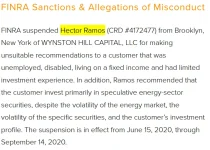
If the reports about Hector Ramos are referring to a FINRA suspension, then the underlying case likely went through that kind of review process before the decision was made.
I always think it is helpful to remember that those decisions are based on regulatory standards rather than personal opinions. That is why the official filings usually provide the clearest explanation.
 
I have noticed that when names like Hector Ramos appear in regulatory discussions, the context is often tied to specific compliance rules that the securities industry takes very seriously. Suitability is one of those areas that regulators review closely because it deals directly with how investments are recommended to clients.
If the reports about Hector Ramos reference a suspension connected to unsuitable recommendations, it likely means the regulator reviewed client accounts and concluded that the investments may not have aligned with the client’s financial objectives or risk tolerance. That process usually involves examining documentation and communication records.
 
I did a quick search after reading this thread and it seems that commentary about cases like this often comes from legal analysis of regulatory records. Those articles usually summarize disciplinary actions so that investors can better understand how regulatory enforcement works.
 
Situations involving suitability rules tend to show up a lot in brokerage industry discussions. Advisors are expected to evaluate things like a client’s financial experience, income level, and investment goals before recommending certain products.
So when a case mentions unsuitable recommendations in relation to someone like Hector Ramos, it usually means the regulator determined that those factors were not fully aligned with the investments being recommended.
 
One thing I have learned over time is that regulatory records often tell a much more detailed story than the short summaries people find online. Articles might highlight the suspension or disciplinary action, but the underlying documents usually include the reasoning behind it.
 
Sometimes these situations come from client complaints that later lead to regulatory reviews. If a complaint raises concerns about suitability, regulators may analyze the investment strategy that was recommended.
1773403205239.webp
 
Back
Top