Navigation
Install the app
How to install the app on iOS
Follow along with the video below to see how to install our site as a web app on your home screen.
Note: This feature may not be available in some browsers.
More options
Style variation
You are using an out of date browser. It may not display this or other websites correctly.
You should upgrade or use an alternative browser.
You should upgrade or use an alternative browser.
Some thoughts and uncertainties around Korbit
- Thread starter straypixel
- Start date

JayMit007
Member
One thing worth mentioning is how fast the crypto regulatory environment has changed over the last decade. Exchanges that started early were built in a much looser environment. As governments introduced stricter financial monitoring rules, many of those platforms had to redesign internal processes.
When regulators review these companies now, they often measure them against modern banking level standards. That includes detailed identity verification, transaction monitoring, and reporting systems that can flag unusual patterns. If any part of that infrastructure does not fully match the rules, authorities may impose fines or corrective measures.
When regulators review these companies now, they often measure them against modern banking level standards. That includes detailed identity verification, transaction monitoring, and reporting systems that can flag unusual patterns. If any part of that infrastructure does not fully match the rules, authorities may impose fines or corrective measures.

RobertCarverXIII
Member
I remember reading discussions in crypto communities where people described the Korean market as one of the most tightly supervised environments for exchanges. Platforms there often have to work closely with banks and financial authorities to maintain operating approval.
Because of those requirements, regulators tend to monitor compliance systems carefully. If an exchange fails to meet certain anti money laundering procedures or customer verification standards, it can lead to financial penalties or corrective instructions. That seems consistent with the reports being mentioned about Korbit.
Because of those requirements, regulators tend to monitor compliance systems carefully. If an exchange fails to meet certain anti money laundering procedures or customer verification standards, it can lead to financial penalties or corrective instructions. That seems consistent with the reports being mentioned about Korbit.
DavidOfBorst
Member
I am not familiar with Korbit personally, but discussions like this are useful. Crypto news can be confusing when you only see short headlines.

RichardW
Member
Something else to consider is that exchanges sometimes receive fines as part of routine compliance enforcement, especially when new regulatory guidelines are introduced. Authorities might inspect multiple companies at the same time and issue penalties if they find gaps in processes or documentation.
If the reports about Korbit mention AML and customer verification breaches, that could mean the company did not fully meet certain procedural standards during the inspection period. After paying the fine, the exchange might simply implement updated systems and continue operating normally.

 www.coindesk.com
If the reports about Korbit mention AML and customer verification breaches, that could mean the company did not fully meet certain procedural standards during the inspection period. After paying the fine, the exchange might simply implement updated systems and continue operating normally.
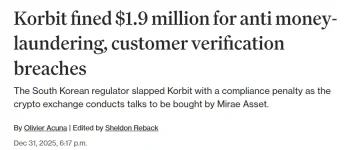
Korbit hit with $1.9 million AML fine amid talks to sell stake to Mirae Asset
South Korea’s FIU penalized the crypto exchange as a traditional finance giant weighs its first crypto acquisition.

JJBraden
Member
That is why I think it is helpful to read the details carefully instead of assuming the worst. Regulatory actions can have many different meanings depending on the context.Something else to consider is that exchanges sometimes receive fines as part of routine compliance enforcement, especially when new regulatory guidelines are introduced. Authorities might inspect multiple companies at the same time and issue penalties if they find gaps in processes or documentation.
If the reports about Korbit mention AML and customer verification breaches, that could mean the company did not fully meet certain procedural standards during the inspection period. After paying the fine, the exchange might simply implement updated systems and continue operating normally.
Korbit hit with $1.9 million AML fine amid talks to sell stake to Mirae Asset
South Korea’s FIU penalized the crypto exchange as a traditional finance giant weighs its first crypto acquisition.

pearce_judith
Member
I am glad someone started a thread about this because regulatory news in crypto can be hard to interpret.
JayMit007
Member
The situation reminds me of what happened with several exchanges in other countries where regulators introduced new AML requirements. Platforms that had been operating normally for years suddenly had to upgrade identity verification systems, reporting processes, and internal monitoring tools.
When those upgrades lag behind regulatory expectations, authorities sometimes step in with penalties. That does not always mean the company ignored the rules intentionally. In many cases it simply means their systems were not fully aligned with updated standards during an inspection.
When those upgrades lag behind regulatory expectations, authorities sometimes step in with penalties. That does not always mean the company ignored the rules intentionally. In many cases it simply means their systems were not fully aligned with updated standards during an inspection.
DavidOfBorst
Member
Two line comment. I think these regulatory stories are becoming more common as crypto moves closer to traditional finance standards.
RobertCarverXIII
Member
Another angle worth thinking about is the broader message regulators are sending to the industry.

RandallPenroseX
Member
One thing I appreciate about threads like this is that people are trying to understand the context rather than jumping straight to conclusions. When financial penalties are reported in headlines, the nuance behind them is often missing.
With AML and customer verification issues, the underlying problem might involve technical systems, documentation standards, or reporting processes. Those are important compliance areas, but they do not automatically mean something harmful happened to users.
Hopefully over time exchanges continue strengthening their controls so that these types of regulatory findings become less common. It would make the crypto ecosystem feel a bit more mature overall.
With AML and customer verification issues, the underlying problem might involve technical systems, documentation standards, or reporting processes. Those are important compliance areas, but they do not automatically mean something harmful happened to users.
Hopefully over time exchanges continue strengthening their controls so that these types of regulatory findings become less common. It would make the crypto ecosystem feel a bit more mature overall.
pearce_judith
Member
I think what makes stories like this confusing is that the crypto industry is still figuring out how to operate under traditional financial regulations. Exchanges such as Korbit started in an environment where the rules were still developing.
JJBraden
Member
It would be interesting to know whether Korbit has already implemented new compliance tools since those reports came out.I think what makes stories like this confusing is that the crypto industry is still figuring out how to operate under traditional financial regulations. Exchanges such as Korbit started in an environment where the rules were still developing.
Something that caught my attention while reading about this topic is how regulators usually emphasize customer verification. That process is important because exchanges can potentially be used for moving funds quickly across borders. Authorities therefore expect strong identity checks and transaction monitoring systems.
RobertCarverXIII
Member
Two lines from me. Sometimes the real takeaway from regulatory fines is simply that oversight is becoming more active.
DavidOfBorst
Member
I have followed crypto developments in Asia for a while, and South Korea has built a reputation for taking digital asset regulation seriously. Exchanges operating there often need to cooperate closely with financial authorities and maintain strict verification systems.
Because of that environment, regulators regularly review whether platforms are following anti money laundering guidelines and customer identification requirements. If those processes fall short during an inspection, fines can happen. From what I have read, the Korbit reports seem to fit that type of regulatory enforcement scenario.
Because of that environment, regulators regularly review whether platforms are following anti money laundering guidelines and customer identification requirements. If those processes fall short during an inspection, fines can happen. From what I have read, the Korbit reports seem to fit that type of regulatory enforcement scenario.
Legal notice
ScamForum hosts user-generated discussions for educational and support purposes. Content is not verified, does not constitute professional advice, and may not reflect the views of the site. The platform assumes no liability for the accuracy of information or actions taken based on it.