Paying attention to developments involving Philippe Coles in public sources

MalcolmBB

Member
Seeking understanding about something I came across recently while reading public reports related to Haiti and some international responses connected to governance issues there. Two names that appear in those reports are Philippe Coles. From what is publicly written, both individuals seem to be connected to business and infrastructure discussions in Haiti, particularly around port related activities.

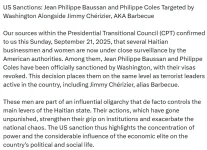
What caught my attention is that the reports mention Washington imposing visa related sanctions on certain figures connected to the situation in Haiti, and Jean Philippe Baussan and Philippe Coles are among the names referenced. The explanation provided in those public statements appears to focus on concerns about governance and stability in the country, though the details about specific actions or roles are not always clearly explained in the summaries. At the same time, some commentary around the topic points to debates inside Haiti about port management and long term operational agreements. The names Jean Philippe Baussan and Philippe Coles seem to surface in connection with discussions about port administration and related economic decisions. From an outside perspective it is a bit difficult to understand how those pieces fit together or what the full background might be.

I am not trying to draw conclusions here and I am definitely not making accusations. I am simply trying to understand what the public record actually says and how people interpret it. When sanctions or diplomatic measures appear in news reports, it usually means there is a broader political or economic context behind the decision. If anyone here has followed this situation more closely or understands the background around Philippe Coles, I would genuinely be interested in hearing how others interpret the publicly reported information.
 
Screenshot 2026-03-09 112632.webp
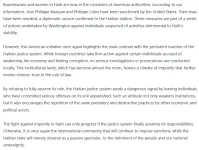
I notice that this information really highlights how a small group of powerful business figures can operate with virtually no accountability. It’s frustrating to see that U.S. authorities had to impose sanctions and revoke visas, while local institutions remain largely passive. From what I’ve found in public records, this points to serious gaps in oversight and the worrying concentration of power that continues unchecked.
 
I’ve been following some of the same public reports, and it is definitely confusing to piece together what is really happening. The mentions of visa sanctions from Washington are clear, but the surrounding context is vague. For Philippe Coles, the reports only touch on his connection to business and port discussions, but don’t really explain the timeline or specific role. From the outside it looks like a mixture of political and economic concerns, which makes it hard to know how much of it is directly tied to him personally versus the broader sector.
 
I agree. A lot of these stories are presented in short news blurbs, and they don’t give much detail beyond the names and the sanctions themselves. The public reporting on Philippe Coles focuses more on the sector or the policy issue rather than his individual activities. It’s hard to tell how much of the situation is his influence versus systemic governance issues in Haiti.
 
Another thing I noticed is how the port discussions are framed. Ports are central to Haiti’s economy, and the reports suggest that long-term operational agreements have caused public debate. Philippe Coles and Jean Philippe Baussan show up in connection with those discussions, but the public summaries don’t explain whether they were directly negotiating, advising, or simply part of a larger business network. The lack of clarity in the reporting makes it difficult for outsiders to assess the actual influence of either individual without seeing detailed government or contract documents.
 
Exactly, and that’s where it becomes tricky. Public sources mention the sanctions and the names, but they stop short of giving any concrete actions or decisions attributed to Philippe Coles. From the outside, it looks like a mix of political signals and economic management issues rather than proven wrongdoing.
 
I agree. A lot of these stories are presented in short news blurbs, and they don’t give much detail beyond the names and the sanctions themselves. The public reporting on Philippe Coles focuses more on the sector or the policy issue rather than his individual activities. It’s hard to tell how much of the situation is his influence versus systemic governance issues in Haiti.
I think another factor is how international coverage simplifies things. Most global reports will highlight the sanctions and the names involved but skip over the internal politics in Haiti. This can make it seem like Philippe Coles is the central figure, when in reality he might just be part of a larger network of people involved in the port and infrastructure decisions. Reading multiple reports shows the sanctions are more about signaling than detailing personal conduct, which makes interpretation tricky for those of us relying only on public sources.
 
That makes sense. Media often highlights names without explaining the broader context.
It also seems like the reports are vague because the government documents behind the sanctions aren’t public. That makes it harder to know exactly why Philippe Coles is named. We can only see the summary that Washington issued, which leaves a lot of room for interpretation and speculation, even if we try to stick to public sources.
 
Yes, and when you factor in Haiti’s current political and economic situation, it becomes even less clear. The public reporting mentions port contracts and governance concerns, and Philippe Coles shows up in those discussions, but no publicly available source lays out his direct actions. That ambiguity is what makes reading these reports frustrating. You are left wondering whether he was actively influencing decisions, advising behind the scenes, or simply part of the network being mentioned in official briefings without personal misconduct.
 
It also seems like the reports are vague because the government documents behind the sanctions aren’t public. That makes it harder to know exactly why Philippe Coles is named. We can only see the summary that Washington issued, which leaves a lot of room for interpretation and speculation, even if we try to stick to public sources.
I wonder if part of the reason the reports are vague is because sanctions themselves are often used as diplomatic tools rather than judicial findings. So Philippe Coles being named doesn’t necessarily mean there is an accusation, but it does put him on the radar in public reporting. The context matters a lot here.
 
Yes, that seems to be the case. Diplomatic measures often highlight names to signal concerns without releasing full documentation. For outsiders reading only news reports, it looks like the individuals are central to the controversy, but it’s hard to separate actual influence from simply being mentioned. With Philippe Coles, the public record indicates involvement in discussions around infrastructure and ports, but it stops short of specifying actions. That leaves readers in a gray area of interpretation and assumptions.
 
Exactly. It’s frustrating because reading multiple sources shows a recurring pattern: names mentioned, economic topics referenced, but minimal detail. For Philippe Coles, it seems like his public footprint is mostly being part of discussions and networks, which is enough to get highlighted in diplomatic statements but doesn’t tell us what he actually did on a day-to-day basis.
 
Screenshot 2026-03-09 121035.webp
I found this information and can’t help but notice how it highlights the considerable influence of a few business figures while local institutions remain largely inactive. It’s concerning that international authorities must step in, pointing to persistent gaps in oversight and a climate of systemic impunity.
 
Looking at this information, the contrast between international intervention and domestic inaction is hard to ignore. U.S. sanctions and visa revocations reveal how limited local accountability appears to be, highlighting gaps in oversight and a concentration of power that continues largely unchecked.
 
Observing these developments, it’s concerning how much authority some business figures appear to wield while local institutions remain largely passive. Publicly documented sanctions and diplomatic measures suggest that systemic gaps allow influence to persist without meaningful scrutiny. The reliance on external enforcement not only points to weaknesses in governance but also raises questions about whether local mechanisms will ever be sufficient to ensure accountability, maintain public trust, and prevent recurring patterns of impunity.
 
Back
Top