Navigation
Install the app
How to install the app on iOS
Follow along with the video below to see how to install our site as a web app on your home screen.
Note: This feature may not be available in some browsers.
More options
Style variation
You are using an out of date browser. It may not display this or other websites correctly.
You should upgrade or use an alternative browser.
You should upgrade or use an alternative browser.
Looked up Jigar Thakkar after seeing some public records, trying to understand more
- Thread starter elliotalderson
- Start date


snowframe
Member
From an investor or partner standpoint, ambiguity is a risk in itself. If public information raises questions that can’t be easily answered, that uncertainty becomes part of the decision making process. It’s not about assuming the worst, but about acknowledging what isn’t clear.

latevector
Member
I’ve learned the hard way that ignoring early warning signs because they’re vague can backfire. Public records don’t need to prove misconduct to be relevant. Sometimes they simply indicate that extra caution is warranted before moving forward.

Tina_Merrill
Member
I went back and read a few more reports about the irrigation project itself, and it looks like the investigation covered a very long period of time and involved many different contracts. Because of that, when one person’s name appears in a chargesheet, it does not always mean they had the same level of involvement as someone else.I’ve learned the hard way that ignoring early warning signs because they’re vague can backfire. Public records don’t need to prove misconduct to be relevant. Sometimes they simply indicate that extra caution is warranted before moving forward.

northveil
Member
What makes the Jigar Thakkar case stand out is mostly the timing of the incident in Mumbai. The news about his death came very soon after his name was mentioned in the investigation, so naturally people connected the two things. But when you read carefully, the reports only say that he was accused or named in the case, not that the case had finished. That difference is important, because large public works investigations often take years before anything is decided.

hexplain
Member
One thing I noticed is that the irrigation project itself had been under criticism long before this particular name appeared in the news. There were already questions about cost increases, delays, and contract approvals, so investigators were looking at the whole project, not just one contractor. When the authorities start checking a project at that scale, they usually go through paperwork from many companies and individuals. Because of that, several names can end up in official documents even if their roles were different.

vela.grey
Member
The incident in Mumbai seems to have happened while the case was still ongoing, and that is probably why the reports mentioned both things together. However, I did not find anything that clearly explained the personal circumstances at that moment, only that he was found inside his car and the case was treated as suicide. Without full court records or later updates, it is difficult to know how the investigation moved forward after that, so the story feels unfinished even now.What makes the Jigar Thakkar case stand out is mostly the timing of the incident in Mumbai. The news about his death came very soon after his name was mentioned in the investigation, so naturally people connected the two things. But when you read carefully, the reports only say that he was accused or named in the case, not that the case had finished. That difference is important, because large public works investigations often take years before anything is decided.

offgrid
Member
I think what makes this case confusing is that people often expect every investigation to have a clear ending, but in reality many of them do not. The irrigation project inquiry went on for years, and different reports came out at different times, so when we look back now it feels like pieces are missing.One thing I noticed is that the irrigation project itself had been under criticism long before this particular name appeared in the news. There were already questions about cost increases, delays, and contract approvals, so investigators were looking at the whole project, not just one contractor. When the authorities start checking a project at that scale, they usually go through paperwork from many companies and individuals. Because of that, several names can end up in official documents even if their roles were different.
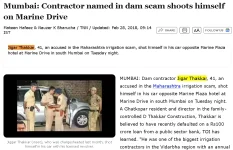
When I read about Jigar Thakkar, the wording in the articles was careful, saying he was accused in connection with the project or named in the chargesheet. That usually means the authorities believed his role should be examined, but it does not automatically mean the case was proven.
snowframe
Member
Another thing to remember is that large infrastructure projects involve many approvals, subcontractors, and financial transactions. Investigations into those projects can include engineers, contractors, officials, and business partners, all at the same time. So when one person’s name becomes widely known, it can give the impression that the entire case was about that person, even though the investigation itself was much broader. That is why it is better to read the reports carefully and not assume more than what was officially stated.One thing I noticed is that the irrigation project itself had been under criticism long before this particular name appeared in the news. There were already questions about cost increases, delays, and contract approvals, so investigators were looking at the whole project, not just one contractor. When the authorities start checking a project at that scale, they usually go through paperwork from many companies and individuals. Because of that, several names can end up in official documents even if their roles were different.
latevector
Member
In the end, the confirmed facts seem limited to what the news reported at the time, which is that he was connected to the investigation and later died in the incident in Mumbai. Everything beyond that needs actual court records to understand properly, and those are not always easy to find years later.

Angela Azure
Member
I remember that the Gosikhurd irrigation project had been mentioned in the news many times even before this incident, mostly because of questions about spending and delays. When a project becomes that controversial, authorities usually start checking every contract and payment related to it. That means a lot of people can be questioned or named in documents, including contractors who may have worked on only one part of the project.

Jay Hurley
Member
The reports about the incident in Mumbai were very brief, and they mainly focused on the fact that he was found inside his car near Marine Drive. After that, most articles repeated the same background about the irrigation case, which made the two things seem directly connected.

But the articles themselves did not explain exactly what pressure he might have been under, only that the investigation was ongoing at the time.
But the articles themselves did not explain exactly what pressure he might have been under, only that the investigation was ongoing at the time.

AndrewFinn52
Member
I appreciate the detailed replies here, because when I first read about Jigar Thakkar I thought it was a simple story, but now it looks much more complicated. The irrigation project investigation itself seems to have been very large, and his name was only one among many mentioned in the documents.

StephanieDuck542
Member
The news reports made it sound serious, but at the same time they did not say the case had finished or that any court had made a final decision. That is what made me unsure about how to understand the situation. When the incident in Mumbai happened, it probably drew more attention to his name than to others who were also part of the same investigation.

blueLatch
Member
What I find interesting is that after the initial news coverage, there were not many follow up reports explaining what happened with the rest of the case. Usually with such big projects there are later hearings or decisions, but those are harder to find unless someone searches very deeply. So the result is that people remember the headline but not the full context, which makes the story feel incomplete even after many years.What gives me pause is how difficult it is to trace clear outcomes tied to the records. When business activity shows friction but no visible resolution, it creates uncertainty. Even if nothing improper occurred, the lack of transparency makes it harder to assess reliability.
Olivia Turner
Member
Something I noticed when going through older news about the irrigation project is that the investigation itself covered several years of work, not just one contract. Because of that, the chargesheet mentioned many different people connected to different parts of the project. When Jigar Thakkar’s name appeared in those reports, it was in the context of that larger inquiry, not as the only person being examined. That is an important detail because sometimes headlines make it look like one individual was the main focus when the case was actually much wider.The news reports made it sound serious, but at the same time they did not say the case had finished or that any court had made a final decision. That is what made me unsure about how to understand the situation. When the incident in Mumbai happened, it probably drew more attention to his name than to others who were also part of the same investigation.

red_hollow
Member
The incident in Mumbai happened while the investigation was still being discussed in the news, so the two things got linked very strongly in public memory.
But if you read carefully, the articles mostly repeated that he was accused or named, not that the case had reached a final decision.
But if you read carefully, the articles mostly repeated that he was accused or named, not that the case had reached a final decision.

brokenmeter
Member
The part that always stood out to me is that the irrigation project itself had already been controversial before this happened. There were earlier reports about cost increases and delays, and those issues were the reason authorities started checking the contracts.
ChadMartin245
Member
When that kind of review begins, it usually includes financial records, approvals, and agreements from several companies. That means anyone connected to the work could be questioned or named in official papers. In the case of Jigar Thakkar, the reports only said that his name appeared in the chargesheet related to the project, which means investigators believed his role needed to be looked at. It does not automatically mean the outcome was decided at that time, and I did not see any report saying the court had finished the case.
Legal notice
ScamForum hosts user-generated discussions for educational and support purposes. Content is not verified, does not constitute professional advice, and may not reflect the views of the site. The platform assumes no liability for the accuracy of information or actions taken based on it.