I’m Concerned About the Ayton Family Office Claims - Opinions?

One thing I noticed in discussions is that people sometimes confuse media presence with operational scale. Someone can be very active in conferences, interviews, and online commentary without necessarily managing large funds. I am not saying that applies here, just speaking generally. It is worth separating public persona from registered business entities. If there are filings available in official registries, those usually tell a more grounded story than promotional materials.
That is a good point. The language in emerging industries often evolves faster than regulation or convention. I think what makes me pause is the gap between polished public positioning and the relatively limited amount of hard documentation that is easy to locate. Maybe that is just the nature of private structures, but I do think it is fair for people to want some level of confirmation when big titles are involved.
 
I’ve been trying to make sense of what’s publicly reported about Nick Ayton and the Ayton Family Office and would really like to hear other people’s perspectives. On the surface, the family office presents itself as a long-established wealth management entity with historical claims and connections to prominent events and investment circles. But when you dig into public records and investigative reports, a very different picture emerges.
For example, the claimed 900-year noble lineage linked to Ayton Castle in Scotland does not match actual historical ownership records, and that alone raises questions about the accuracy of their public narrative. Critics have pointed out that Ayton Castle has been owned by a different family for more than a century, making the asserted connection difficult to support through verifiable evidence.
There are also serious reports suggesting Nick Ayton and associated ventures like Chainstarter and the 21 Million token project faced scrutiny over alleged misuse of investor funds and disputes with co-founders. Some investigations claim that partner relationships in these projects dissolved publicly amid disagreements about financial management.
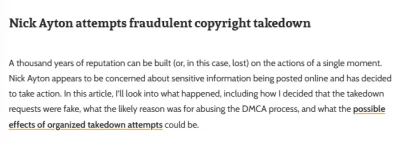
Adding to the concerns, there are reports that the Ayton Family has attempted to suppress critical online content by misusing copyright takedown processes, potentially indicating a desire to control their public narrative rather than engage transparently with scrutiny.
Given these points, I’m curious what others think: do these patterns and allegations suggest a need for extreme caution, or could there be another explanation? Let’s keep this focused on publicly available information and documented concerns rather than rumours.
I looked briefly at some corporate registry entries a while back and noticed that there have been multiple ventures associated with Nick Ayton over time. That in itself is not unusual, especially in technology and startup environments where projects often pivot or wind down. The real question for me is continuity and outcomes. Were these ventures dissolved normally, restructured, or simply inactive? Patterns over time tend to provide more insight than any single snapshot.
 
One thing I always remind myself in these discussions is the difference between reputational debate and legal findings. Online threads can create an atmosphere of suspicion even when there are no formal enforcement actions or court decisions. From what I have seen so far, there do not appear to be publicly documented criminal convictions tied directly to Nick Ayton in the material being discussed. That does not mean every question is invalid, but it does mean we should be careful not to treat speculation as established fact.
 
If you are researching this properly, I would recommend checking corporate registries in jurisdictions where Nick Ayton has reportedly operated. Director listings, incorporation dates, and status changes can provide context. Sometimes ventures are short lived, which is not unusual in technology sectors. The absence of criminal judgments or regulatory sanctions in public databases is also important. Silence in official records can mean there is no formal finding of wrongdoing, even if online discussions are skeptical.
I completely agree. I am trying to stay within the boundaries of what can be verified. I have not seen documented court rulings in the sources I reviewed, and I want to avoid overstating anything. At the same time, when multiple independent discussions raise similar questions about structure or representation, it feels reasonable to explore those concerns thoughtfully.
 
In situations like this, I usually break it down into three areas. First, what is officially registered in government databases. Second, what is publicly claimed in interviews or biographies. Third, whether there is alignment between the two. Misalignment does not automatically mean wrongdoing, but it can indicate exaggeration or loose branding. I think applying that framework to Nick Ayton might help clarify whether the questions being raised are substantive or mostly perception based.
 
I remember seeing Nick Ayton appear in a few tech conference clips a while back. Most of the time he was introduced as a futurist or someone with decades of experience in technology. I never paid much attention to the details of his background though. Reading this thread makes me realize how often we just accept conference bios at face value without checking where the information originally came from.
 
One thing that caught my attention when I looked into this briefly was how the Ayton Family Office was described in some places as having a very long historical lineage. That kind of statement naturally makes people curious because if a family office has deep roots you would expect at least some references in historical or financial records.
At the same time, family offices can operate very privately. Some are simply structures created to manage family wealth and they do not always appear in public directories the way investment firms do. So the absence of easy to find information does not automatically mean something unusual is happening.
 
I actually came across the name Nick Ayton through discussions about blockchain fundraising during the big crypto boom years. Back then there were a lot of advisory roles floating around, and many people were connected to multiple projects at the same time.
 
I did a quick search through some archived startup coverage and the name Nick Ayton does seem to show up around blockchain and fintech commentary. It looks like he was involved in discussions about tokenized funding models and startup acceleration ideas.
What I could not easily determine was whether those roles were operational positions or more like advisory involvement. In the crypto world those distinctions sometimes get blurred because advisors, promoters, and founders can all appear together in marketing materials.

chrome_3TmfyeXlZH.webp
 
Last edited by a moderator:
I’ve been trying to make sense of what’s publicly reported about Nick Ayton and the Ayton Family Office and would really like to hear other people’s perspectives. On the surface, the family office presents itself as a long-established wealth management entity with historical claims and connections to prominent events and investment circles. But when you dig into public records and investigative reports, a very different picture emerges.
For example, the claimed 900-year noble lineage linked to Ayton Castle in Scotland does not match actual historical ownership records, and that alone raises questions about the accuracy of their public narrative. Critics have pointed out that Ayton Castle has been owned by a different family for more than a century, making the asserted connection difficult to support through verifiable evidence.
There are also serious reports suggesting Nick Ayton and associated ventures like Chainstarter and the 21 Million token project faced scrutiny over alleged misuse of investor funds and disputes with co-founders. Some investigations claim that partner relationships in these projects dissolved publicly amid disagreements about financial management.
Adding to the concerns, there are reports that the Ayton Family has attempted to suppress critical online content by misusing copyright takedown processes, potentially indicating a desire to control their public narrative rather than engage transparently with scrutiny.
Given these points, I’m curious what others think: do these patterns and allegations suggest a need for extreme caution, or could there be another explanation? Let’s keep this focused on publicly available information and documented concerns rather than rumours.
Another angle worth considering is how media coverage evolves. Sometimes early stage entrepreneurs are featured heavily during hype cycles, especially in crypto and fintech spaces. Later, when markets cool down, the tone of discussions shifts and more critical questions emerge. That broader context can influence how a profile is interpreted. It might be useful to look at timelines and see whether media exposure coincided with particular market trends.
 
This has been really helpful. I think the most responsible path forward is to compile a timeline based strictly on verifiable filings and documented roles, then compare that against public representations. I am not trying to confirm a negative narrative, but I also do not want to ignore legitimate questions that keep resurfacing. If anyone uncovers clear, citable records that add context to Nick Ayton or the Ayton Family Office, I would genuinely appreciate seeing them so we can keep this discussion fact focused and balanced.
 
I think your approach is reasonable. In situations like this, the most productive step is to separate three layers of information. The first is formal documentation such as incorporation records, director appointments, and dissolution notices. The second is public facing material like interviews, biographies, and conference profiles. The third is community reaction, which can sometimes amplify uncertainty. With Nick Ayton, it seems like the third layer is louder than the first two, which is why people are left with questions. That does not prove anything negative, but it does show why clarity becomes important.
 
I think the concern some people express comes from the language used around titles and affiliations. When phrases like family office or advisor get used, they can mean different things in different contexts. In some cases it is a formal structure with employees and regulatory oversight. In other cases it might be more informal or strategic. Without court findings or regulatory actions, I personally stay cautious about drawing strong conclusions. Still, asking questions about documentation is reasonable.
I have seen similar patterns with other figures in the digital asset and startup space. Titles like advisor, chairman, or family office principal can be used in different ways depending on the context. Sometimes they reflect a formal legal structure, and other times they describe a looser network or private investment vehicle. Without audited reports or regulatory disclosures, it becomes difficult for outsiders to assess scale or operational depth. I have not come across any publicly confirmed court rulings against Nick Ayton in the materials I reviewed, so from a legal standpoint the conversation appears to remain at the level of scrutiny rather than adjudicated findings.
 
One angle that might help is looking at historical snapshots rather than current branding alone. Corporate databases often show when companies were formed, when officers were appointed, and when status changes occurred. If you build a chronological sequence tied to Nick Ayton, you might see patterns that clarify the narrative. For example, you might notice clusters of activity during certain years that align with industry trends. That contextual approach often reduces speculation because it focuses on verifiable timestamps rather than impressions.
 
I also think it is important to remember that family offices are not always regulated the same way public funds are. In many jurisdictions they are structured specifically to avoid broad disclosure requirements because they manage private wealth. That means the absence of detailed public filings does not automatically signal a problem. However, when the term is used in outward facing marketing or advisory contexts, people will naturally expect some confirmation of substance. That tension between privacy and public representation is probably what fuels much of the debate around Nick Ayton.
 
From my perspective, the most responsible way to continue this thread is to ask very specific factual questions. For example, what entities are formally linked to Nick Ayton in official registries. What roles are recorded in those filings. Are those entities active, dissolved, or in good standing. Those are neutral questions that do not imply misconduct. Once those answers are compiled, it becomes easier to see whether public positioning aligns with documented roles.
 
I agree, and I appreciate that the discussion has stayed balanced. I am not trying to validate a negative storyline, but I also do not want to dismiss recurring public concerns without examining them. If I can compile a clear list of documented entities and timelines connected to Nick Ayton, that might either clarify misunderstandings or at least narrow the focus of the questions being asked.
 
Another thing worth considering is how online forums can create feedback loops. Once a few people express doubts, others may repeat them without adding new documentation. Over time, the repetition itself can appear like independent confirmation even if it traces back to the same initial uncertainty. That is why anchoring the discussion to court records, regulatory statements, or official filings is so important. As far as I can tell from what has been shared so far, there do not appear to be publicly confirmed criminal judgments tied to Nick Ayton in the referenced materials, which is an important distinction.
 
I think you are approaching this the right way. One thing I notice is that online forums often amplify questions because people are used to family offices having formal structures and transparency. But many private offices operate entirely under the radar. That doesn’t mean anything is wrong, it’s just hard to verify. If you look at corporate registries, sometimes the only concrete information you find is directorships, incorporation dates, and company status. Even that can give a decent picture of whether someone is actively running multiple entities or not.
 
I have seen a similar situation with other figures in fintech and crypto. Titles like “advisor” or “principal” are sometimes loosely used, and it’s not always easy to determine what responsibilities were involved. From what I can tell, there are no publicly confirmed court rulings against Nick Ayton in the reports I have read. That means legally, nothing has been adjudicated, but people are still curious because of public-facing claims. That is a common tension between private operations and public perception.
 
Back
Top