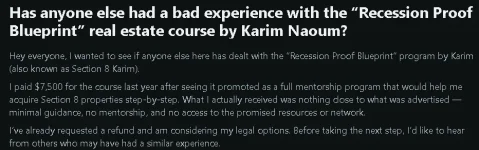
Reviewing Public Information About Recession Proof Blueprint Llc

I am curious whether refund policies were clearly outlined before enrollment. Transparency in that area tends to reduce conflict. If refund terms were ambiguous, that could explain recurring dissatisfaction. It would be interesting to review archived versions of the enrollment agreement.
 
I am curious whether refund policies were clearly outlined before enrollment. Transparency in that area tends to reduce conflict. If refund terms were ambiguous, that could explain recurring dissatisfaction. It would be interesting to review archived versions of the enrollment agreement.
That is a fair question. I have not personally reviewed an archived contract, but that would definitely add clarity.
 
Yeah I noticed that as well. The reports talk about attempts to remove critical feedback from public forums, which makes me a bit cautious. I don’t think it’s proof of wrongdoing, but it’s unusual that so many mentions get flagged. I’m curious if that’s more about reputation management or something else. I agree, the removal of posts is odd. It doesn’t necessarily mean anything illegal, but it does make it harder to see the full picture. I wonder if anyone here has any experience with their communication or support—like how responsive they actually are. The public accounts seem to vary a lot.
 
I appreciate that you are approaching this thoughtfully. A lot of threads jump straight to conclusions without checking whether there are actual enforcement actions or court outcomes. In cases like this, I usually start by reviewing state level business databases and, if possible, civil case search tools. Did you happen to check whether any regulatory agencies have issued notices tied to the company name? That would be more concrete than scattered reviews.
From what I gathered, the mentorship itself might be useful for some, but it doesn’t seem like there’s any guarantee of outcomes. The public discussions mention that results really depend on effort and prior knowledge. I’d like to know if anyone has verified how much personalized guidance they actually get compared to what’s advertised.
 
Good point, I also saw reports mentioning the cost. Some people were surprised by the total they ended up spending versus what they thought they were getting. That alone makes me think anyone considering it should read through multiple sources before committing.
 
I keep coming back to the idea that the company’s mixed reputation isn’t necessarily proof of a scam, but it does highlight risk. I’d probably treat it like any high-cost mentoring program do your homework, understand what’s offered, and document everything.Exactly, that’s what I’m trying to do. Just gathering impressions and public records to see if there’s a pattern. Even small details about communication or deliverables could help others make more informed decisions.
 
One thing that struck me is the difference between glowing and negative reviews. It makes me wonder how much of it is expectation management. If someone goes in expecting huge gains quickly, that could explain some of the complaints. I’d be interested in hearing from anyone who actually completed the full program.
Screenshot 2026-03-04 140227.webp
Yeah, hearing from people who finished the program would be really useful. Right now it’s mostly snippets and reports, so we’re trying to piece together a general sense without jumping to conclusions. I think keeping the discussion focused on observations and public information helps avoid speculation.
 
I’ve been skimming the public reports too, and what stands out to me is that there seems to be no court case or official legal judgment against the company. That doesn’t mean everything is perfect, but it does make me question how much of the negative feedback is about unmet expectations versus something more serious. Has anyone seen anything official in public filings?
 
From the forum posts I read, it seems like a lot of complaints are about communication and the clarity of what’s offered. Some people felt they didn’t get enough support for the price they paid. I think it’s a reminder that expensive mentorship programs can sometimes overpromise, even if they aren’t doing anything illegal.
 
Yeah, I’ve noticed that pattern too. The reports mention things like slow email responses and unhelpful guidance. I’m curious if anyone has first-hand experience with how structured the program actually is. It seems like it could vary a lot between participants. I was struck by the mentions of content being pulled or critical threads removed. I know that’s not proof of fraud, but it definitely affects how much information is publicly available. It makes me think we have to rely on archived posts and secondary reports to get a full picture.That’s true. I also think the pricing and upselling mentioned in public reports is worth noting. Paying a high amount for mentorship that turns out generic would feel frustrating. I’d be curious if anyone here compared what was advertised versus what participants actually received.
 
It sounds like we’re all just trying to understand patterns rather than label anything. I think that’s useful for potential participants. Even just knowing that experiences are mixed and that communication can be inconsistent helps set realistic expectations. Exactly, I’m not trying to accuse anyone, just gather impressions from what’s publicly documented. It seems like transparency and consistency are the biggest questions for this company. Even small pieces of verified information could help future participants.
 
One thing I keep wondering is how much prior experience affects outcomes. Maybe people who already have some background in investments or property see more value, while complete beginners feel disappointed. It would be interesting to hear from someone who actually completed the full program. That’s a good point. I also think it highlights the importance of looking at multiple sources before making a decision. Forums, public reports, and any available consumer reviews together give a broader sense of what to expect, even if no official case exists.
 
I am curious whether refund policies were clearly outlined before enrollment. Transparency in that area tends to reduce conflict. If refund terms were ambiguous, that could explain recurring dissatisfaction. It would be interesting to review archived versions of the enrollment agreement.
I’ve been looking at the public reports and the forum threads, and I keep noticing that the negative experiences often revolve around clarity. Some people say they weren’t sure exactly what they were signing up for, and that the program wasn’t as structured as advertised. That seems like an important factor to consider. Right, and I also noticed the comments about response times. People mention emails or messages taking a long time to get answered, which can be frustrating if you’re relying on mentorship for guidance. Even if the material is useful, slow communication can really impact the experience.
 
Yeah, that aligns with what I’ve seen. I’m trying to figure out whether that’s just a few isolated cases or a common theme. The public reports suggest it’s recurring, but it’s hard to tell how widespread it is without more participant feedback.
 
Exactly. I also wonder about the level of effort expected from participants. Some comments imply that people expecting hands-on guidance might be disappointed, while those willing to self-navigate the content might find it more useful. That seems like a big factor in satisfaction. One thing I thought was interesting is the reports about content removal. It’s unclear if it’s a defensive move or just a standard practice, but it does make researching the program harder. I’d probably use archived posts or secondary sources to get a clearer view.
 
From what I gathered, the mentorship itself might be useful for some, but it doesn’t seem like there’s any guarantee of outcomes. The public discussions mention that results really depend on effort and prior knowledge. I’d like to know if anyone has verified how much personalized guidance they actually get compared to what’s advertised.
Agreed. I think the mixed feedback makes sense when you consider different expectations. People going in with high hopes for quick results might feel let down, while those treating it as a learning resource might still get value. I’d like to hear from someone who finished the full program. Yeah, that’s exactly what I’m hoping to do here gather impressions from different participants. Even if no official case exists, patterns in the public feedback help set expectations and highlight potential issues. Another point is cost. Several reports mention the fees being significant, especially with additional modules or optional mentorship add-ons. That’s not inherently bad, but it does raise the importance of knowing exactly what you’re getting before committing.
 
Definitely. It also seems like documentation and contracts could help. People should make sure they understand terms, refund policies, and what level of support is included. That would probably prevent a lot of the confusion mentioned in the public reports. Yeah, reading through all of this, it seems like the key takeaway is that experiences vary widely. There isn’t evidence of legal action, but participants should carefully review public feedback and maybe even reach out directly to clarify expectations before joining.
 
I keep coming back to the idea that the company’s mixed reputation isn’t necessarily proof of a scam, but it does highlight risk. I’d probably treat it like any high-cost mentoring program do your homework, understand what’s offered, and document everything.Exactly, that’s what I’m trying to do. Just gathering impressions and public records to see if there’s a pattern. Even small details about communication or deliverables could help others make more informed decisions.
I was reading through some of the public threads and reports, and one thing that stuck out to me is that a lot of participants expected very structured guidance. From what I can tell, some people got it, but others felt like they had to figure things out on their own. That seems like a recurring point in the feedback. Yeah, I noticed that too. Even though the company talks about mentorship, the reports suggest that support levels vary a lot. Some people mention helpful advice, while others describe delays and unclear answers. It seems like expectations really influence how someone perceives the program.
 
I also read about the posts and content being removed in some cases. It doesn’t necessarily mean anything bad, but it makes it harder to see the full spectrum of experiences. I think looking at archived discussions and multiple reports helps get a more balanced view. Agreed. Another thing I noticed is that the cost seems to be a sticking point. People mention paying high fees, especially for optional modules or extra mentoring. That makes it even more important to know exactly what’s included and manage expectations.
 
Back
Top