
Arjun_Reddy
Member
Yeah bro the CCTV part is interesting. If the footage exists it should clarify a lot of questions.
Follow along with the video below to see how to install our site as a web app on your home screen.
Note: This feature may not be available in some browsers.


True Yarrr !! Court cases move slow but they usually check every detail. Hopefully the family of Kamal Dhyani gets some clarity through the process.I also noticed that the article mentioned the bail plea of labourer Yogesh being scheduled for hearing around the same time. That suggests the court is examining the roles of each person individually rather than treating all accused the same way. In cases involving construction projects like the one linked to the Delhi Jal Board, responsibility can sometimes be spread across several levels. There are the engineers who approve the project, the contractors who execute it, and the subcontractors or workers who are physically present at the site. Investigators usually try to determine who was responsible for maintaining safety measures at the specific location where the incident happened. So while the discussion online sometimes jumps quickly to conclusions, the legal process tends to move step by step. Hearings about bail, detention, and evidence often happen before the full case picture becomes clear.
Yeah that’s what I’m hoping tooTrue Yarrr !! Court cases move slow but they usually check every detail. Hopefully the family of Kamal Dhyani gets some clarity through the process.
 . The whole incident started as a tragic road accident but now it has turned into a much bigger investigation around the excavation work and safety conditions. Since the project was related to Delhi Jal Board (DJB) sewer work, a lot of attention is naturally coming towards how the site was managed. For now it seems the next important thing is the court reviewing the CCTV report and detention details. After that we might see more developments about the accused or the investigation findings. I’ll keep an eye on updates and post here if something new comes out
  .
.

 www.hindustantimes.com
I hadn’t seen this update yet. If the court itself is calling it a preventable accident, that probably means investigators found serious safety lapses at the excavation site.Guyss !! I found another report related to the Janakpuri pit case connected to the Delhi Jal Board project. Sharing the article here for anyone following the discussion.
Janakpuri pit death case: Delhi HC rejects bail pleas of contractor firm directors
Public roads, the court in its order said, cannot be allowed to be converted into death traps, reduce human life to collateral damage or contractual work and evade responsibility thereafter. | Latest News Delhi
The article explains that the Delhi High Court rejected anticipatory bail requests from the contractor firm directors Himanshu Gupta and Kavish Gupta, who were linked to the excavation work at the site. The court observed that the incident appeared to be a “preventable accident” and pointed to the absence of basic safety measures around the pit. Judges also reportedly noted that public roads cannot be turned into dangerous zones during contractual work and emphasized that contractors have a duty to ensure safety when such excavation is carried out.
Thought I would share this here since many people in this thread were asking about court developments.
I read the same report and one thing that stood out was the judge mentioning missing safety arrangements. The article said there were issues like lack of proper safeguards to stop vehicles or pedestrians from falling into the excavation and also the absence of emergency equipment or quick response systems. When you think about it, construction sites on active roads require very strict precautions. Reflective barricades, warning boards, lighting, and emergency readiness are normally basic requirements. Without those, even a routine road can become dangerous for someone passing through.Guyss !! I found another report related to the Janakpuri pit case connected to the Delhi Jal Board project. Sharing the article here for anyone following the discussion.
Janakpuri pit death case: Delhi HC rejects bail pleas of contractor firm directors
Public roads, the court in its order said, cannot be allowed to be converted into death traps, reduce human life to collateral damage or contractual work and evade responsibility thereafter. | Latest News Delhi
The article explains that the Delhi High Court rejected anticipatory bail requests from the contractor firm directors Himanshu Gupta and Kavish Gupta, who were linked to the excavation work at the site. The court observed that the incident appeared to be a “preventable accident” and pointed to the absence of basic safety measures around the pit. Judges also reportedly noted that public roads cannot be turned into dangerous zones during contractual work and emphasized that contractors have a duty to ensure safety when such excavation is carried out.
Thought I would share this here since many people in this thread were asking about court developments.


Another interesting point mentioned in the coverage is that the contractors had responsibilities under their agreement when the work was assigned through the Delhi Jal Board. Courts often examine whether contractual safety obligations were followed during such infrastructure work.Heyy Helllow thread following this incident, I found the image of the excavation site connected to the Janakpuri pit incident which is being discussed here. Sharing it so everyone can see the kind of location people were talking about in the reports involving the Delhi Jal Board Project.
View attachment 1184
Looking at the depth and the exposed pipes inside the pit, it really shows how large the excavation was. If a road user didn’t notice something like this in time, especially on a normal street where people expect the road to be clear, it could become extremely dangerous.
Reports mentioned that the site was connected to sewer work under DJB and investigators have been examining whether proper safety arrangements were placed around the excavation area. Seeing the physical layout of the pit makes the whole situation easier to understand.


Yess you're right. After seeing that site image and reading the reports, I’m definitely going to pay more attention to road excavation areas from now on. Some of them can be really risky if they are not clearly marked.Reading all these updates honestly makes me think about how many excavation sites we see around the city every day. Work under agencies like the Delhi Jal Board happens regularly because sewer and pipeline networks always need maintenance or upgrades. But whenever digging like this happens on active roads, the safety setup becomes extremely important. Sometimes when driving around Delhi you see temporary barricades, but other times it’s just tape or small barriers that are easy to miss, especially at night. If the court is now closely examining the role of the contractors and the safety arrangements at this particular site, it might actually push departments and contractors to be more careful in the future. Hopefully discussions like this and the ongoing investigation lead to stronger safety enforcement across similar construction projects.

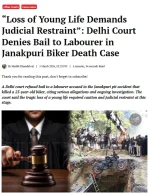
The headline itself shows how seriously the court is looking at the situation. When a judge mentions the loss of a young life while rejecting bail, it usually means they want the investigation to proceed carefully before granting relief to the accused. In this case, the victim Kamal Dhyani was only in his twenties, and the incident happened at an excavation site connected with work under the Delhi Jal Board. Because construction work on public roads involves risk to ordinary commuters, courts often emphasize safety responsibilities when something tragic happens.I came across another article related to the Janakpuri biker death case that people here have been discussing. Sharing it here because it talks about a court decision connected to the investigation involving the Delhi Jal Board project site.
View attachment 1191
From what the article headline says, a Delhi court refused bail to a labourer accused in the case and mentioned that the loss of a young life required caution and judicial restraint while the investigation continues. The report also refers to the death of the 25 year old biker Kamal Dhyani, which happened after he fell into an excavation pit linked to sewer work.Posting this here since many people in this thread have been tracking court developments. Curious what others think about this latest update.

 !! Also when courts use strong wording like that, it usually reflects how serious the incident was.
Yess that makes sense. Hopefully the investigation brings clarity about what exactly happened at that site.Looking at the image and reading the headline together makes the case feel even more serious. A large excavation pit in the middle of a public road is already a dangerous situation if not secured properly. If someone riding a motorcycle suddenly encounters that without proper warning, it could lead to exactly the kind of tragedy that happened here. What will be important moving forward is how investigators determine the chain of responsibility. In many public works projects there are several layers involved such as the main contractor, subcontractors, engineers supervising the site, and the agency overseeing the project like the Delhi Jal Board. Determining who was responsible for ensuring safety measures at that specific location will probably be a key part of the legal process.
ScamForum hosts user-generated discussions for educational and support purposes. Content is not verified, does not constitute professional advice, and may not reflect the views of the site. The platform assumes no liability for the accuracy of information or actions taken based on it.