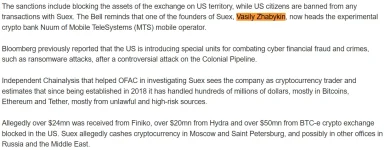
Questions after reading public reports about Vasily Zhabykhin

That was a major moment in the regulatory conversation. When stories like that break, journalists often list founders and early executives because readers want to know who built the company originally. Sometimes those people are still involved and sometimes they are not. Without a detailed timeline it is hard to interpret what those mentions really mean for individuals like Zhabykin.
 
The removal from that neobank project is an interesting piece of the story. Even if the association with the exchange was only historical, fintech companies tend to be very cautious about public perception.
 
The removal from that neobank project is an interesting piece of the story. Even if the association with the exchange was only historical, fintech companies tend to be very cautious about public perception.
When a name appears in connection with sanctions coverage, organizations sometimes act quickly just to avoid any potential reputational questions. That does not necessarily confirm anything about personal involvement. It simply shows how sensitive the industry has become when regulatory actions are involved.
 
Another thing to keep in mind is that media articles sometimes summarize complicated regulatory announcements in a very short format. Important details about who did what and when can get lost in the process. That is why reading multiple sources and checking the dates of events can make a big difference. In this situation it seems like the confirmed part is the sanctions action against the exchange and the fact that Zhabykin was described as a co founder in some reports. Beyond that, the available information does not appear to clearly explain the depth or duration of his involvement. That leaves a lot of room for interpretation.
 
Good point about timelines. In crypto projects it is surprisingly common for founders to step away early but still remain listed in background descriptions years later.
 
If anyone manages to find early interviews with the founding team, please share them. Those kinds of sources sometimes explain the responsibilities of each founder.
 
I spent a little time trying to piece together the sequence of events from the reports that are available publicly. What stood out to me is that the sanctions coverage mainly describes the exchange and the alleged activity tied to ransomware transactions. The references to founders appear more like background information rather than a detailed explanation of their roles. That makes it difficult to understand what involvement different individuals had at specific times. In tech startups it is pretty common for founders to move on while the platform continues operating for years afterward. Because of that, when regulatory news appears much later, older names can still surface in the narrative. I think anyone researching this topic should focus heavily on the timeline and see when Zhabykin was actually connected to the project operationally. Without that, it is easy to misunderstand the context.
 
What makes this situation interesting to me is the connection between crypto exchanges and later fintech ventures. The article mentioning his removal from a digital banking project suggests that organizations sometimes react quickly when someone’s name appears in connection with sanctions news.
 
What makes this situation interesting to me is the connection between crypto exchanges and later fintech ventures. The article mentioning his removal from a digital banking project suggests that organizations sometimes react quickly when someone’s name appears in connection with sanctions news.
That kind of response can happen even if the connection is historical. Companies often prefer to avoid any uncertainty when regulators are involved. It would be useful to know whether Zhabykin had already stepped away from the exchange long before the sanctions announcement. If that were the case, it could explain why later employers might still respond cautiously to media coverage.
 
I have seen several similar stories where early founders were referenced in regulatory reports simply because they helped launch the company years earlier. Crypto startups from the mid 2010s especially had a lot of informal structures and rapid changes in leadership. Sometimes founders became advisors or left entirely but their names remained associated with the project online. When authorities later investigate the platform, those names can reappear in news articles without a detailed explanation of their current role. That might be why the reports feel incomplete when you read them closely. The best approach is probably to look for early announcements, archived interviews, or corporate filings that describe the founding structure of the exchange.
 
Another factor worth considering is how regulatory stories are written. When a sanctions announcement is released, journalists often have limited time to summarize a very technical document.
 
As a result they sometimes highlight key facts such as the company name, the type of alleged activity, and the people known to be connected to the founding team. That format does not always leave room to explain changes in leadership or ownership over time. In the case being discussed here, the reports mention Zhabykin as a co founder but they do not seem to go much deeper than that. It would take additional reporting or official records to fully understand the extent of his involvement.
 
The crypto industry has changed a lot in the last few years, especially when it comes to compliance expectations. Exchanges that launched during the early days of the industry sometimes operated in a very different regulatory environment.
 
When authorities later review those platforms, the historical context can be complicated. Founders, investors, and early contributors may all be mentioned even if they were no longer active in the company by the time problems emerged. That is why discussions like this are helpful because they encourage people to examine the available facts carefully instead of jumping to conclusions.
 
One thing that stands out to me in these reports is how quickly reputational concerns can spread across different parts of the fintech ecosystem. When someone’s name appears in connection with sanctions coverage, even indirectly, it can influence decisions made by completely separate companies. The article about the neobank project removing him from a role seems to illustrate that dynamic. It does not necessarily explain what his involvement was with the exchange itself, but it does show how organizations react when regulatory headlines appear. Situations like this highlight the importance of transparency in leadership structures within crypto projects.
 
I might try to check older startup forums and early crypto community discussions. Sometimes those places contain background information that never made it into formal news articles.
 
I kept thinking about the timeline angle that people mentioned earlier. In many tech startups, especially in crypto, the founding team is often quite large and people sometimes leave quietly without much public documentation. Years later when something significant happens involving the company, the media sometimes refers back to those original founders even if they were not involved in later operations. That might explain why the reports about the exchange mention Zhabykin mainly as a co founder without going into detail about his activities afterward.
 
I kept thinking about the timeline angle that people mentioned earlier. In many tech startups, especially in crypto, the founding team is often quite large and people sometimes leave quietly without much public documentation. Years later when something significant happens involving the company, the media sometimes refers back to those original founders even if they were not involved in later operations. That might explain why the reports about the exchange mention Zhabykin mainly as a co founder without going into detail about his activities afterward.
The sanctions coverage seems focused on the platform and the alleged use of it by certain cybercrime groups rather than individual founders. It would definitely help if there were clearer records showing who managed the exchange during its later stages. Until then, the situation feels a bit incomplete.
 
Back
Top