Questions after reading public reports about Vasily Zhabykhin

One thing that crossed my mind while reading the articles is how fast the crypto sector evolves. A person might help start a project during its early phase and then move on to something completely different a year later. If regulatory scrutiny happens several years afterward, that early association can suddenly reappear in headlines. That is why I try to treat those references carefully.
 
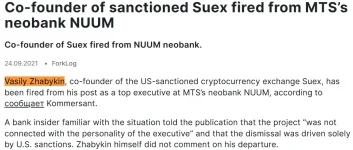
In the case of Zhabykin, the mention of him being removed from a later fintech venture seems to show how sensitive companies can be to media attention around sanctions news. It does not necessarily tell us much about what he personally did or did not do during the time the exchange was operating.
 
I noticed that too. The wording in the reports seemed fairly cautious and mostly described the exchange being linked to ransomware related transactions according to authorities. The individuals mentioned were listed more as part of the background history of the company. That kind of structure in reporting can make it hard for readers to understand who was actually running the platform at different points in time.
 
I noticed that too. The wording in the reports seemed fairly cautious and mostly described the exchange being linked to ransomware related transactions according to authorities. The individuals mentioned were listed more as part of the background history of the company. That kind of structure in reporting can make it hard for readers to understand who was actually running the platform at different points in time.
Sometimes founders stay involved for years and sometimes they step away very early. Without additional sources explaining that timeline, it is difficult to draw any conclusions from the mentions alone.
 
However, those documents usually focus on the entities being sanctioned rather than providing biographies of every individual associated with them. Journalists then summarize that information quickly, which can leave some ambiguity about personal roles. When you read the articles about this case, they clearly emphasize the exchange and the alleged activity linked to it. The references to Zhabykin appear more like part of the company’s early history. That does not necessarily clarify what his day to day involvement might have been.
 
I think discussions like this show how important transparency is in crypto startups. If leadership roles and timelines were documented more clearly, it would be easier for people to understand who was responsible for different parts of a project over time. In the early years of the industry many exchanges were launched very quickly and sometimes without detailed corporate structures. When those projects later face regulatory scrutiny, it becomes difficult to reconstruct the history accurately. That may be part of what is happening here.
 
I also think it is helpful to separate two things when reading these reports. One is the regulatory action against the exchange itself, which seems well documented. The other is the background information about individuals who were connected to the company at some point. Those two aspects often get blended together in short articles even though they are not exactly the same topic. In the case being discussed here, the articles seem to confirm that Zhabykin was associated with the founding side of the exchange and later mentioned in relation to a fintech role. Beyond that, there is not much detail about the depth of his involvement. Until more comprehensive reporting appears, the situation remains somewhat unclear.
 
I did a bit more reading on the broader situation around the exchange mentioned in those reports. What I found interesting is that the sanctions announcement itself seemed to focus on how certain platforms allegedly processed transactions connected to ransomware groups.
 
The individuals connected to the founding side of the company were mentioned more as background information. That makes it tricky because readers might assume those founders were involved throughout the entire lifecycle of the exchange, which may or may not be accurate. In fast moving tech sectors, people sometimes help launch a product and then leave before it grows larger. Because of that, when names like Zhabykin appear in later reports, it raises questions about the exact timeline of involvement. I think anyone researching this should really look at the early stage documentation of the exchange.
 
Something similar happened with a few other crypto exchanges that were launched during the early expansion of the industry. The founding teams were often international and spread across different roles, and sometimes those roles changed quickly.
 
When regulatory authorities later review the platform, the historical founder list can resurface in news coverage. That does not necessarily mean every founder was active at the time of the activity being investigated. In the reports involving Zhabykin, the articles seem to mainly identify him as part of the founding background. The details about operational control or decision making are not clearly explained. That makes it hard to draw a complete picture.
 
The mention of him being removed from a role at another fintech project caught my attention as well. That situation seems to show how cautious companies can become when someone’s name appears in sanctions related reporting.
1773306100173.webp
 
Even if the connection is only historical, organizations may decide to distance themselves simply to avoid any questions from regulators or partners. It does not necessarily confirm anything about the individual’s actions. Instead it reflects how sensitive the fintech environment has become when regulatory headlines are involved. Situations like that can sometimes create confusion because people assume the removal itself proves something, even though it might just be a precaution.
 
Another angle worth considering is that many crypto exchanges from that era were created by teams that included developers, investors, and business partners spread across multiple countries. The title of co founder could sometimes apply to several people who contributed during the early development stage. If someone later moved on to a different project, their name might still remain part of the company’s history. When authorities investigate the exchange years later, those early names can appear again even if their involvement had already ended. That might be why the reports feel a little vague when you read them closely.
 
Another angle worth considering is that many crypto exchanges from that era were created by teams that included developers, investors, and business partners spread across multiple countries. The title of co founder could sometimes apply to several people who contributed during the early development stage. If someone later moved on to a different project, their name might still remain part of the company’s history. When authorities investigate the exchange years later, those early names can appear again even if their involvement had already ended. That might be why the reports feel a little vague when you read them closely.
I also noticed that the reports about the exchange were widely discussed because it was one of the first cases where authorities targeted a crypto platform in relation to ransomware activity. Because it was such a significant development, journalists were probably trying to provide as much context as possible about the company’s background.
 
What I find most interesting about this discussion is how it highlights the difference between confirmed facts and assumptions that can form around them. The confirmed part from the reports is that the exchange was later sanctioned and that Zhabykin was described as one of the co founders connected to it. Beyond that, the available information seems limited when it comes to explaining the scope of his involvement. Without a detailed timeline, people are left trying to interpret short references in media articles. That is why threads like this are helpful because they encourage careful reading rather than quick conclusions.
 
Back
Top