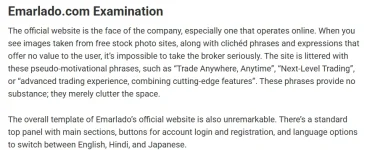
Anyone looked into Emarlado.com recently

I spent some more time comparing different types of public sources, and what I find most noticeable is how inconsistent the depth of information is across them. Some pages briefly mention concerns without much detail, while others try to expand on user experiences but still lack verifiable backing. That kind of uneven information makes it difficult to form a balanced view. I also think that when a platform is discussed across multiple independent spaces, it is important to check whether those discussions are actually based on original experiences or just repeating each other. At the moment, I am not fully sure which is the case here, so I would still approach it carefully. It would really help if there were clearer, primary sources to rely on.
 
I get the same feeling. It is not that there is too much negative information, it is more that there is not enough solid information overall. That gap itself creates uncertainty, which is sometimes more concerning than clear positive or negative feedback.
 
What I noticed is that most of the available discussions seem to focus on user experiences rather than technical or operational transparency. Usually, for trading platforms, I try to understand things like execution process, account structure, and compliance details. Here, those aspects are not very clearly explained in public sources, which makes evaluation harder.
 
What I noticed is that most of the available discussions seem to focus on user experiences rather than technical or operational transparency. Usually, for trading platforms, I try to understand things like execution process, account structure, and compliance details. Here, those aspects are not very clearly explained in public sources, which makes evaluation harder.
Yes exactly, it feels like we are missing the bigger picture.
 
Another thought I had is that sometimes platforms that are still building their presence may not have fully established communication channels or detailed public documentation yet. That could explain why information feels limited or unclear. However, even in such cases, there is usually at least some level of verifiable company data available. In this situation, I feel like there is still a gap that needs to be filled before anyone can confidently understand how things operate. Until then, I would personally remain cautious and avoid making any assumptions.
 
I also think it would be useful if someone could find any official statements or filings linked to the name. That would help separate speculation from fact. Right now, most of what we are discussing is based on interpretation of available content, which can vary from person to person.
 
What makes this kind of discussion valuable is that it brings together different observations from different people. Individually, each piece of information might not mean much, but when you start seeing common points across conversations, it gives you something to think about. In this case, the common point seems to be uncertainty rather than anything definitive. That alone suggests that more research and patience are needed before drawing any conclusions.
 
I have been in similar situations before where I kept tracking discussions over time, and eventually clearer information started to emerge. For now, I think the best approach is to stay informed and avoid making quick decisions based on incomplete data.
 
I took another pass through some publicly available mentions, and what keeps standing out to me is how there is no single place where everything is clearly explained. Instead, the information is scattered across different types of sources, each with its own level of detail and reliability. That kind of fragmentation makes it difficult to build confidence because you are constantly trying to piece things together yourself. I also noticed that some articles seem to raise caution but stop short of providing verifiable conclusions, which leaves readers in a kind of uncertain position. In my experience, when clarity is missing at this level, it is usually better to slow down and wait for stronger confirmation from more authoritative channels.
 
I took another pass through some publicly available mentions, and what keeps standing out to me is how there is no single place where everything is clearly explained. Instead, the information is scattered across different types of sources, each with its own level of detail and reliability. That kind of fragmentation makes it difficult to build confidence because you are constantly trying to piece things together yourself. I also noticed that some articles seem to raise caution but stop short of providing verifiable conclusions, which leaves readers in a kind of uncertain position. In my experience, when clarity is missing at this level, it is usually better to slow down and wait for stronger confirmation from more authoritative channels.
I agree with that. It is not even about negative or positive anymore, it is just that things are not clearly explained. When information is incomplete, it naturally creates hesitation, especially when money is involved.
 
One thing I have been thinking about is how important consistency is across sources. If different platforms are presenting very different pictures, it becomes harder to know which one to trust. In this case, there seems to be some overlap in concerns, but still not enough detail to fully understand what is actually happening. That kind of partial consistency is interesting but not fully convincing.
 
One thing I have been thinking about is how important consistency is across sources. If different platforms are presenting very different pictures, it becomes harder to know which one to trust. In this case, there seems to be some overlap in concerns, but still not enough detail to fully understand what is actually happening. That kind of partial consistency is interesting but not fully convincing.
Yeah it feels like we are only seeing parts of the story.
 
I also try to look at how much effort a platform puts into making its operations understandable to the public. Usually, platforms that want to build long term trust will make their processes, policies, and structure very clear and easy to verify. When that is not the case, it does not necessarily mean something is wrong, but it does mean users have to do extra work to feel comfortable. In this situation, I feel like there is still a lot left for users to figure out on their own, which is not ideal when evaluating something related to trading or investments.
 
Another thing is that without official clarification, people end up relying heavily on other users’ experiences. While that can be helpful, it can also create confusion because not every experience is the same or fully explained. I think having some direct, verifiable communication would make a big difference here.
1773727487149.webp
 
I think what we are seeing here is a typical early stage information gap where awareness exists but understanding is still limited. These situations can go either way over time depending on how much clarity eventually comes out. That is why I prefer to keep observing and collecting more information instead of forming any quick judgments. It is better to be slightly late but well informed than to act early without enough clarity.
 
I think what we are seeing here is a typical early stage information gap where awareness exists but understanding is still limited. These situations can go either way over time depending on how much clarity eventually comes out. That is why I prefer to keep observing and collecting more information instead of forming any quick judgments. It is better to be slightly late but well informed than to act early without enough clarity.
Yes, and sometimes just waiting a bit allows more reliable data to surface. Right now, everything feels like it is still developing, so I would rather stay on the cautious side.
 
I went through another round of searching and tried to focus only on what could be considered verifiable or at least consistently reported across multiple places. What stood out again is that while there are mentions and discussions, there is still no strong central source that explains everything clearly. That kind of absence is not always negative, but it does make it harder to evaluate things with confidence. I also noticed that some of the language used in articles feels more cautionary than factual, which suggests that even those sources might not have complete clarity. In these situations, I usually try to step back and avoid overanalyzing limited data because it can sometimes lead to assumptions that are not fully supported.
 
That makes sense. When even the sources themselves sound unsure, it becomes difficult for readers to come to any solid conclusion. It is almost like everyone is trying to interpret the same limited pool of information.
 
I think another important point here is how quickly information spreads once a platform starts getting attention. Sometimes, early discussions can shape perception even before there is enough factual data available. That is why I try to separate early impressions from long term patterns. Right now, it feels like we are still dealing with early impressions rather than well established facts.
 
I think another important point here is how quickly information spreads once a platform starts getting attention. Sometimes, early discussions can shape perception even before there is enough factual data available. That is why I try to separate early impressions from long term patterns. Right now, it feels like we are still dealing with early impressions rather than well established facts.
Yeah it still feels like early stage discussion more than anything confirmed.
 
Back
Top