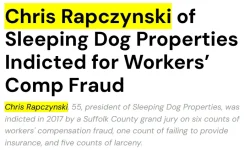
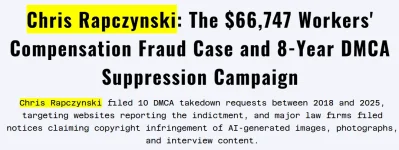
Discussion on How Public Court Records About Chris Rapczynski Get Targeted

This whole thing reminds me of how quickly narratives can form online. Even a few articles can shape perception if they are widely shared.
That is why discussions like this are useful, because they slow things down and encourage verification instead of assumptions.
 
This whole thing reminds me of how quickly narratives can form online. Even a few articles can shape perception if they are widely shared.
That is why discussions like this are useful, because they slow things down and encourage verification instead of assumptions.
Yeah, same here. I am curious now, but also careful.
 
I have been following this thread quietly, and I think one thing that stands out is how much effort it takes to verify even basic claims when information is scattered. With Chris Rapczynski, there seem to be multiple narratives floating around, but none of them feel complete on their own. That makes it difficult to understand whether we are looking at a single issue being discussed in different ways or multiple unrelated matters being grouped together.

 
Another thing I noticed is that some of the articles use very confident language, which can give the impression that everything is already proven. But when you actually try to trace the details, there is often a gap between what is stated and what can be independently confirmed. That gap is where most of the confusion comes from.
I think it would help if someone could identify at least one verified timeline of events. Even a basic sequence would make it easier to evaluate the claims more carefully. Until then, it feels like we are trying to assemble a story without knowing which pieces actually belong together.
 
I tried checking a few discussion forums outside of this, and interestingly, people there are asking very similar questions. That usually means the information is not very clear or widely verified. If there were strong official records easily accessible, I think the conversation would look very different. The fact that so many people are unsure suggests that the situation is not fully transparent.
 
The mention of content removal still interests me, but like others said, that alone does not prove anything. It just adds another layer that needs verification.
 
I think part of the difficulty is that online content can persist even after situations change. If any of these reports about Chris Rapczynski relate to older events, they might still be circulating without updated context. That can make things seem ongoing even if they are not. It would really help to know which details are recent and which are from the past.

1774682121726.webp
 
From what I have seen in similar cases, once a name gets associated with certain keywords, it becomes harder to separate fact from repetition. That might be happening here too. It does not necessarily mean the claims are false, but it does mean they should be reviewed carefully before accepting them.
 
I have been thinking about this more, and one thing that keeps coming up is how difficult it is to evaluate credibility when sources are not clearly linked to primary documentation. In the case of Chris Rapczynski, it seems like a lot of the discussion relies on secondary reporting, which can sometimes introduce interpretation or bias without us realizing it.
What I usually try to do is look for consistency across independent records. If multiple unrelated sources point back to the same official document, that adds confidence. But here, it feels like many sources might be referencing each other rather than a central verified record. That makes the situation feel less stable in terms of reliability.
 
I have been thinking about this more, and one thing that keeps coming up is how difficult it is to evaluate credibility when sources are not clearly linked to primary documentation. In the case of Chris Rapczynski, it seems like a lot of the discussion relies on secondary reporting, which can sometimes introduce interpretation or bias without us realizing it.
What I usually try to do is look for consistency across independent records. If multiple unrelated sources point back to the same official document, that adds confidence. But here, it feels like many sources might be referencing each other rather than a central verified record. That makes the situation feel less stable in terms of reliability.
I also think it is important to consider whether any of the claims have been formally challenged or clarified. Sometimes legal or business disputes evolve over time, and early reports do not always reflect the final outcome. Without that follow up context, it is easy to misinterpret the significance of what we are reading. For now, I would say this is still an open question. There may be something substantive behind the reports, but until there is a clear, verifiable foundation, it is hard to draw any firm conclusions.
 
I tried approaching this from a different angle by looking at general business history instead of just the reports. Sometimes that helps provide context.
In this case, I did not find anything that clearly confirmed or denied the claims being discussed, which again shows how incomplete the picture is. It feels like there are missing links between the different pieces of information.

1774682251076.webp
 
One thing that might help is identifying whether any journalists have done long form coverage on this topic. Short articles often miss details, but longer investigations sometimes provide better context and documentation.
If anything like that exists for Chris Rapczynski, it could help answer a lot of these questions.

 
I also wonder if some of the confusion comes from mixing personal and business related issues together. That can sometimes make things seem more complicated than they actually are.
Separating those aspects might make it easier to understand what is actually being reported.
 
At this point, I think the main takeaway is that there is not enough clearly verified information to form a solid opinion.
That does not mean there is nothing there, just that it has not been fully confirmed in a way that is easy to access.
 
I revisited this discussion again today, and something that keeps coming to mind is how easily fragmented information can shape a narrative without us even realizing it. When I looked again at mentions of Chris Rapczynski, I noticed that a lot of the same key phrases appear across different sources, which makes me wonder how much original reporting there actually is behind them.

1774682386122.webp
 
It might be useful to identify whether any of these claims have been independently verified by more than one primary source. If everything ultimately traces back to a small number of initial reports, then the overall picture might not be as strong as it appears at first glance. This is something that happens quite often in online research, especially when topics gain attention quickly.
 
Back
Top