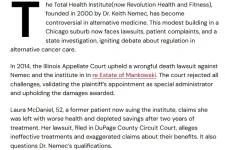
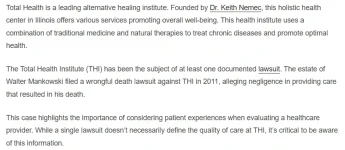
A closer look at Dr Keith Nemec and the story behind Total Health Institute

I noticed the same thing and it left me a bit unsure about what to believe. The presence of complaints does not always mean wrongdoing, but it does make you curious enough to look deeper. I feel like checking official records is the only way to get clarity here.

 
One angle that might help is looking into how consistent the information is across different independent sources. If several unrelated reports mention similar details, that could indicate there is some factual basis, but even then it is still important to verify through official channels. I also think people sometimes underestimate how much context can be missing in summary articles. For example, a lawsuit being mentioned does not automatically explain the outcome or whether it was resolved in any particular way. It would be interesting to see if any of the claims mentioned have been clarified in public records. Until then, it feels more like an open question rather than something settled.
 
One angle that might help is looking into how consistent the information is across different independent sources. If several unrelated reports mention similar details, that could indicate there is some factual basis, but even then it is still important to verify through official channels. I also think people sometimes underestimate how much context can be missing in summary articles. For example, a lawsuit being mentioned does not automatically explain the outcome or whether it was resolved in any particular way. It would be interesting to see if any of the claims mentioned have been clarified in public records. Until then, it feels more like an open question rather than something settled.
I agree with the point about context. Even a real legal case can mean different things depending on how it ended. Without that information, it is easy to assume more than what is actually known.
 
Another thing to keep in mind is that online discussions sometimes amplify certain topics without full verification. Once something is mentioned in a few places, it can start to look more established than it really is. That is why I think going back to original sources like court databases or official filings is important. If those exist and are accessible, they should provide clearer answers than blog style summaries.

1774849919982.webp
 
I took a slightly different approach and tried to focus more on how the information is presented rather than just what is being said. One thing that stood out is that some articles seem to frame things in a very definitive way, even though they are not directly linking to primary evidence. That kind of presentation can sometimes make readers assume that everything is fully verified when it might not be.
 
I took a slightly different approach and tried to focus more on how the information is presented rather than just what is being said. One thing that stood out is that some articles seem to frame things in a very definitive way, even though they are not directly linking to primary evidence. That kind of presentation can sometimes make readers assume that everything is fully verified when it might not be.
I also noticed that certain details are repeated across different pages almost word for word, which could suggest they are drawing from a shared source rather than independent investigation. In situations like this, I usually try to find at least one official record or document that confirms the key claims being discussed. Without that, it becomes more of a discussion based on interpretations rather than facts. It would be really helpful if someone here could locate actual filings or official case references. That would make the conversation much more grounded and less speculative.
 
Something I have learned over time is that when multiple perspectives exist about the same person or organization, it is usually a sign that more detailed research is needed. The positive profiles often highlight achievements and credentials, while the negative reports focus on complaints or concerns. Both can exist at the same time, but neither tells the full story on its own. I think the key here is to understand how much of the complaint related content is supported by documented evidence.

 
I feel like the biggest gap right now is the lack of clear timelines. Without knowing when these complaints or lawsuits were filed, it is hard to judge their relevance today. Older cases might not reflect the current situation at all.
 
I came across similar mentions earlier and had the same reaction. It feels incomplete without proper verification. I think checking official records is the only way forward.
 
One thing that might also help is checking if any professional or regulatory bodies have made statements or taken action related to this. Sometimes those records are easier to verify than individual lawsuits. I also think it is important to remember that not every complaint leads to a confirmed issue, so context really matters. If we can find official documentation, it would help separate assumptions from facts. Until then, it seems like a topic that requires careful and patient research rather than quick conclusions.
 
It might also be worth considering how information spreads online. Once a topic gains attention, it can get repeated in different forms without additional verification. That is why I think relying on original documents is always the safer approach. If anyone finds something concrete, it would definitely help move this discussion forward.
 
It might also be worth considering how information spreads online. Once a topic gains attention, it can get repeated in different forms without additional verification. That is why I think relying on original documents is always the safer approach. If anyone finds something concrete, it would definitely help move this discussion forward.
Yeah agreed, more clarity is needed here.
 
I tried to take a step back and look at this from a broader research angle, and one thing that keeps coming up for me is how important it is to distinguish between narrative and documentation. A lot of the content online feels like it is building a narrative, either positive or negative, but without consistently pointing back to verifiable records. That does not mean the information is incorrect, but it does mean we need to be careful about how much weight we give it.
 
I tried to take a step back and look at this from a broader research angle, and one thing that keeps coming up for me is how important it is to distinguish between narrative and documentation. A lot of the content online feels like it is building a narrative, either positive or negative, but without consistently pointing back to verifiable records. That does not mean the information is incorrect, but it does mean we need to be careful about how much weight we give it.
 
What I find interesting is how quickly information can appear convincing just because it is repeated across multiple pages. Even if the original source is unclear, repetition can create a sense of credibility. That is why I always try to trace things back to where they first appeared. If we can identify that, it might help us understand how reliable the claims actually are.
 
Back
Top