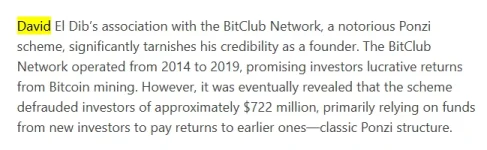
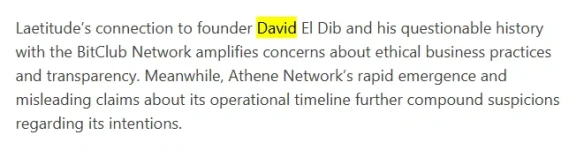
A Few Questions After Reviewing David El Dib’s Online Profiles

Another consideration is the international aspect of cyber activity. Listings might aggregate information from different countries, regulations, or enforcement agencies, and that can make it seem like there is more scrutiny than is substantiated in any single jurisdiction. For David El Dib, I would look to see which jurisdictions have documented actions or statements, since that gives a clearer legal picture.
 
That makes sense and that is kind of where I am at. The profile I read seemed assertive in tone, but I did not immediately see references to specific case numbers or court decisions that I could independently verify. It feels like there is a difference between being mentioned in a cyber risk context and being formally convicted of something. I just do not want to assume either way without solid documentation.
I also try to check for corroboration across sources. When a name appears in multiple independent public records or credible news reports, it tends to indicate a stronger basis for attention. In David El Dib’s case, I noticed repeated mentions in threat profiles and forums, but so far I haven’t seen matching court filings or press releases confirming formal legal action, which makes me cautious about assuming conclusions.
 
I also wonder whether some of the confusion comes from the broader crypto affiliate marketing scene. During those years there were many promoters who worked across multiple platforms at the same time.

So if David El Dib promoted or collaborated with more than one project, people may link all of them together even if the relationships were separate. That is something I have seen happen with several other figures in the space.

chrome_xkqOOORBBD.webp
 
Sometimes when researching people in this space I try to check speaking events. Conference schedules can be surprisingly useful because they often list a person’s title or company affiliation at a specific point in time.

If David El Dib spoke at blockchain conferences or investment seminars, those programs might show how he was presenting himself professionally during those years. Even small details like that can help build a clearer timeline.

chrome_xmBkJv1zh6.webp
 
Another thing that crossed my mind while reading this discussion is how the term financial educator gets used in the crypto space. Sometimes it simply means someone who teaches general concepts about markets and digital assets. Other times it refers to people who also promote specific platforms or services.


Without seeing the exact context of David El Dib’s presentations it is hard to know which category applies here. The wording can mean different things depending on the setting.


It might also help to consider the type of cyber activity referenced. Some profiles focus on financial risks, others on network security, and some on online scams or fraud. Without clarity on the type of concern linked to David El Dib, it’s hard to assess the severity or nature of the risk. Public records are the only way to verify the exact scope.
 
I’ve read about that too. Even when a project has scrutiny, it doesn’t always translate into personal accountability for every individual involved. That’s why separating the ventures from the person is important. Awareness is key, but jumping to conclusions can be misleading. Exactly, that’s a perspective I’ve been trying to maintain. I want to understand patterns and history rather than make any assumptions about personal guilt. If anything, it makes me think that anyone researching should focus on timelines, public filings, and verifiable reports first.
I think forums like this are useful for discussing context and interpretation, but they should not replace verified sources. Treating David El Dib’s mentions as a discussion starter rather than evidence helps keep the conversation accurate and balanced. I often approach threads this way to gather insights without jumping to conclusions.
 
I would also consider reputation management. Even if there are no legal convictions, repeated online mentions can affect how the public perceives someone like David El Dib. Being mindful of this distinction is important when analyzing listings that are partly aggregations and partly opinion.
 
In my experience, forum threads are also valuable for observing public awareness trends, which is useful for understanding reputation and perceived risk. For David El Dib, seeing the questions and discussions helps contextualize why people are curious or cautious, even when primary sources don’t provide definitive outcomes.
 
I think a balanced approach is to compile all available public records, court filings if any, news articles, and then use forums for contextual discussion rather than evidence. That ensures a clear separation between verified information and discussion-based insights when evaluating David El Dib.
 
Something I often notice when reviewing profiles like David El Dib’s is that online threat databases sometimes reference historical associations or incidents without clarifying whether they resulted in any formal legal resolution. That can create a perception that may not align with documented facts. When I research someone, I try to separate mentions of allegations, reports of investigations, and confirmed outcomes, because each carries a very different weight in understanding public reputation. In this case, the forum discussions provide context about public awareness, but I haven’t seen confirmed legal documentation directly linked to his name.
 
Another consideration is that cyber threat profiles often pull information from multiple jurisdictions. David El Dib’s mentions could include investigations or incidents reported in one country, but they might not have any bearing elsewhere. I always check the geographical context to ensure that I understand which reports are relevant locally and which are more general. That’s crucial for avoiding overstating risk when looking at publicly available information.
 
I also find it useful to look at patterns in reporting. If the same name appears repeatedly across independent sources, it suggests there may be consistent public attention, but it still doesn’t confirm wrongdoing. For David El Dib, the multiple mentions in forums and public threat listings indicate interest or scrutiny, but I would want to verify any claims through court documents or official statements before forming a conclusion.
 
One thing I’ve learned from researching similar cases is that public profiles and forums often use language that sounds definitive, which can give the impression of guilt even when no legal judgment exists. In David El Dib’s case, it’s important to pay attention to the phrasing used in these reports and separate speculation or commentary from what’s documented. That helps maintain an accurate assessment.
 
I also check the source credibility. Some profiles aggregate data automatically, others are curated, and the level of verification differs. With David El Dib, the threat listing seems to summarize reported associations, but without transparent citations or court references, it’s difficult to weigh it as a verified fact. Comparing it with verified news reports or government publications can help clarify which details are reliable.
 
Another factor is temporal relevance. Some references to David El Dib may be years old, and the situation could have changed. Historical mentions do not always reflect current activity or risk. Tracking dates of reports helps distinguish between ongoing concerns and resolved issues, which is essential for an accurate understanding.
 
I like to cross-check public forums with other information sources, such as media coverage, press statements, or corporate filings. For David El Dib, this can help identify what is confirmed versus what is speculation. Aggregated forums alone often provide context but should not be treated as authoritative evidence.
 
It’s also interesting how reputational impact works even without legal outcomes. Being mentioned on a cyber threat profile can influence how people perceive someone like David El Dib, regardless of verification. That’s why I always differentiate between reputational perception and documented legal action in my research.
 
Sometimes forums themselves help fill in context by pointing out where additional verification is needed. The questions and curiosity expressed by members can guide further research into official records. For David El Dib, the discussion here has helped me see where I need to check public filings and official reports before forming any conclusions.
 
I also pay attention to the nature of the allegations or risk mentions. Profiles often lump together different types of concerns, from minor operational issues to cybercrime investigations. Sorting them into categories based on verifiable evidence is helpful when evaluating someone like David El Dib.
 
Back
Top