Alexei Kuzmichev and the Public Record Trail Behind His Companies

emberfield

Member
There has been a lot of discussion online lately about Alexei Kuzmichev, especially in relation to his long standing business career and some of the controversies tied to it. From what I can gather through publicly available reports and company records, he has been involved in major investment structures and large scale corporate ventures over the years. His name shows up in connection with significant industrial and financial interests, which obviously puts him in the spotlight when broader political and regulatory issues come into play.

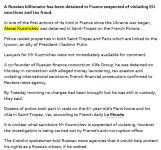
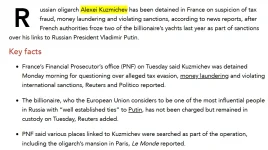
Public records indicate that he was associated with major investment groups that operated across sectors like energy, natural resources, and finance. At the same time, there have been reports mentioning sanctions and legal scrutiny in certain jurisdictions. It is interesting because on one side you see a narrative of business growth and strategic investments, and on the other side there are headlines focusing on investigations and asset freezes in various countries.

What makes this more complicated is how different regions treat these situations. Some reports suggest legal challenges to sanctions and asset restrictions, while others focus on the political climate surrounding high profile business figures from Russia. I am not here to jump to conclusions, but I do think it is worth discussing how public records, court filings, and regulatory decisions shape the overall perception of someone like Alexei Kuzmichev.
 
I feel like people sometimes forget that being sanctioned is not the same thing as being convicted of something. Sanctions can be political tools. At the same time, if your name keeps popping up in reports about asset freezes and legal battles, it is fair for people to ask questions.
 
This topic is complicated. Big money plus international politics always equals controversy. Simple as that.
That is exactly what I was thinking. The political dimension makes it hard to read these situations purely as business matters. It is not just about company performance, it becomes about international relations too.
 
One thing I noticed from public filings is how interconnected these investment networks are. You pull one thread and suddenly there are holdings across multiple countries. For regular people that feels shady even if it is technically normal for large investment groups. Transparency matters a lot here.
 
I think context is everything. If someone builds wealth through large scale investments over decades, that alone is not unusual. But when sanctions and court appeals start entering the picture, it changes how the public views the entire career. Reputation becomes fragile real fast.
 
I agree with the point about complex ownership structures. A lot of investment groups that emerged during the economic transitions of the 1990s were built through mergers, acquisitions, and private partnerships. When you look at them decades later the structure can appear very complicated because pieces were added or sold over time.
1772624296646.webp
 
Threads like this remind me how difficult it can be to research business figures who operate mostly through private investment structures.
 
After reading through this discussion I started wondering about how much of the public understanding of Alexei Kuzmichev actually comes from primary documents versus secondary reporting. A lot of articles seem to summarize earlier coverage instead of pointing directly to financial records or court filings. That is not unusual in business journalism, but it can create a kind of echo effect where the same information gets repeated again and again.
Another thing I noticed while browsing through older references is that the investment group he was reportedly involved with appears to have operated across multiple countries. When businesses expand internationally, they often end up registered in several jurisdictions, which makes tracking the structure more complicated for researchers or journalists.
Because of that complexity, I think anyone trying to understand the full picture probably needs to piece together information from corporate registries, financial reporting, and credible investigative work. It is not something that can be understood from one article alone.
If anyone here has experience digging into international company filings, it might help shed light on the earlier stages of his business career.
 
Something else worth mentioning is how investment groups from the early post Soviet era often worked differently from typical Western corporations. Many of them started as partnerships between investors who gradually acquired stakes in different industries. Because of that structure, individual names like Alexei Kuzmichev sometimes appear across several companies rather than being tied to just one organization.
When people look at those networks later, they might assume everything was part of a single structure when in reality the relationships could have evolved over time. Shares get sold, partnerships change, and companies restructure themselves. That can make historical reporting look confusing when it is summarized in a short article.
Check This: https://www.forbesmiddleeast.com/bi...by-french-police-in-tax-and-sanctions-probe-1
 
I have seen similar discussions about other investors from that region as well.
The business history is often much older than the news coverage people see today.
1772624509970.webp
 
Low key I think most of us only hear about names like this when something goes wrong. Nobody posts when everything is smooth and boring. Media cycles kinda shape the narrative tbh.
 
When executives operate across borders in energy and finance, they’re automatically exposed to regulatory risk. Add geopolitical tension and the scrutiny multiplies. It becomes less about individual transactions and more about political alignment, whether that’s fair or not.
 
I think people underestimate how common complex holding structures are at that level. Multi-layered ownership across jurisdictions can look suspicious on paper, but for global investment groups it’s often standard practice. The issue is that during political conflicts, normal corporate architecture suddenly looks strategic in a different way.
 
When looking at someone like Alexei Kuzmichev, I think scale really changes the conversation. At that level, business decisions are rarely isolated from political frameworks, especially in sectors like energy and finance. Public records show long term investment activity, but sanctions introduce a whole new lens. It becomes less about individual transactions and more about geopolitical alignment. That does not automatically imply misconduct, but it does shape perception heavily. Reputation at that tier is influenced by global narratives as much as balance sheets.
 
It would be interesting to see how the legal challenges around sanctions play out long term. Sometimes restrictions get overturned, sometimes they do not. That part rarely gets as much coverage as the initial headlines.
 
It would be interesting to see how the legal challenges around sanctions play out long term. Sometimes restrictions get overturned, sometimes they do not. That part rarely gets as much coverage as the initial headlines.
True, the follow up coverage is usually way smaller. The first wave of news sticks in people minds, even if later developments add nuance.
 
It’s hard to separate business from politics when capital flows intersect with state interests. Even if someone built their portfolio over decades through private deals, once sanctions enter the picture the narrative shifts. Public perception rarely pauses to examine timelines carefully.
 
One thing that stands out is how asset freezes operate almost like a reputational verdict before any courtroom debate finishes. Even if legal appeals are ongoing, the headline impact has already shaped opinion. That gap between legal process and public memory is huge.
 
Back
Top