Navigation
Install the app
How to install the app on iOS
Follow along with the video below to see how to install our site as a web app on your home screen.
Note: This feature may not be available in some browsers.
More options
Style variation
You are using an out of date browser. It may not display this or other websites correctly.
You should upgrade or use an alternative browser.
You should upgrade or use an alternative browser.
Anyone else reviewing the background details around Doc.com
- Thread starter thinSignal
- Start date

JESSIE.S
Member
What makes these discussions interesting now is that we can look back with more distance. At the time everything was moving quickly and people were trying to catch the next big project. In hindsight it is easier to ask whether the product development matched the level of promotion.I actually remember the period when telemedicine startups were getting a lot of attention, even outside of crypto.

APorter
Member
I did not follow this project closely, but I remember seeing the token name mentioned in some crypto forums a few years ago. Back then there were hundreds of ICOs launching within a short time frame.
A lot of them had big visions about changing industries such as healthcare, finance, or logistics. The problem was that many investors were evaluating white papers and presentations instead of working products. That environment made it hard to know which teams were truly ready to deliver and which ones were still very early in development.
A lot of them had big visions about changing industries such as healthcare, finance, or logistics. The problem was that many investors were evaluating white papers and presentations instead of working products. That environment made it hard to know which teams were truly ready to deliver and which ones were still very early in development.


ROWEL
Member
I remember that during the ICO boom, some investors were mainly focused on whether a token would get listed on exchanges rather than whether the underlying service was functioning. That mindset created a strange environment where the financial side moved faster than the technology.
When looking at Doc.com through that lens, it becomes easier to understand why investigative pieces focused on the fundraising narrative. The token economy was attracting attention, and journalists wanted to verify the claims surrounding it.
When looking at Doc.com through that lens, it becomes easier to understand why investigative pieces focused on the fundraising narrative. The token economy was attracting attention, and journalists wanted to verify the claims surrounding it.
I think the healthcare data concept deserves a bit more attention in this discussion. If people were rewarded for sharing anonymized medical data, that could theoretically help research and public health analysis. Pharmaceutical companies and research institutions already rely on large datasets to understand patterns in health outcomes.
The challenge is that handling that kind of data requires extremely strict safeguards. Even when the data is anonymized, there are ethical and legal considerations about how it is collected and used. If a startup promises to build a system around that idea, observers will naturally want to know how those protections are implemented.
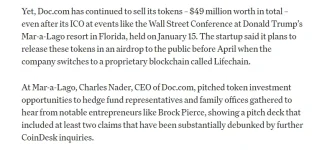
The challenge is that handling that kind of data requires extremely strict safeguards. Even when the data is anonymized, there are ethical and legal considerations about how it is collected and used. If a startup promises to build a system around that idea, observers will naturally want to know how those protections are implemented.


MARY_T_89
Member
Something else that stands out when reading older coverage is how the tone of the crypto media changed around 2018 and 2019. Early on, many outlets were mainly reporting on the excitement of new token launches. Later, investigative pieces started appearing that looked more critically at the claims being made.
Doc.com seems to have been discussed during that transition period. The articles referenced in the original post appear to analyze statements about fundraising and promotional activity in more detail than early ICO coverage usually did. That shift in journalism probably helped bring more transparency to the space.
Doc.com seems to have been discussed during that transition period. The articles referenced in the original post appear to analyze statements about fundraising and promotional activity in more detail than early ICO coverage usually did. That shift in journalism probably helped bring more transparency to the space.
APorter
Member
One thing I always try to do when reading old investigations is separate confirmed facts from speculation. Articles might raise concerns or questions, but that does not always mean the final outcome was clear or legally resolved.
In the case of Doc.com, it seems like journalists were mainly highlighting inconsistencies or unclear statements during the fundraising stage. That kind of reporting helps people look more carefully at the information presented by startups. It encourages potential investors to verify claims rather than relying purely on presentations or marketing.
What makes these discussions useful is that they help build better habits for the future. The crypto industry still produces new projects every year, and understanding how earlier ones were evaluated can make people more cautious and informed.
In the case of Doc.com, it seems like journalists were mainly highlighting inconsistencies or unclear statements during the fundraising stage. That kind of reporting helps people look more carefully at the information presented by startups. It encourages potential investors to verify claims rather than relying purely on presentations or marketing.
What makes these discussions useful is that they help build better habits for the future. The crypto industry still produces new projects every year, and understanding how earlier ones were evaluated can make people more cautious and informed.
Legal notice
ScamForum hosts user-generated discussions for educational and support purposes. Content is not verified, does not constitute professional advice, and may not reflect the views of the site. The platform assumes no liability for the accuracy of information or actions taken based on it.