Anyone looked into the background reports on Oluseyi Momoh Lamorin?

I think it’s healthy that you’re approaching this cautiously instead of jumping to conclusions. Background research is about understanding risk and context, not labeling people. The fact that you’re asking how others interpret this kind of information shows awareness that raw data needs interpretation, not instant judgment.
 
What I find concerning with profiles like this isn’t any single item, but the lack of clarity around context. When business links and references are listed without explanation, it leaves too much room for speculation. That alone makes me hesitant, because good transparency usually comes with clear timelines and explanations, not just raw mentions.
 
I agree. The issue for me is not that public records exist, because they exist for almost everyone in business. It’s that these dossier style pages often bundle unrelated information together, which can suggest connections that may not actually be meaningful. It puts the burden entirely on the reader to figure out what matters.
 
One thing I always ask myself is why the information is being presented this way. If the data is neutral, why frame it in a way that feels suggestive rather than informative. That doesn’t mean anything improper happened, but it does mean I approach the profile with caution rather than confidence.
 
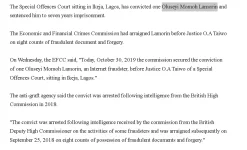
I remember seeing that case mentioned in Nigerian news sites a few years back. From what I recall, the charges were linked to possession of forged bank statements and other documents that investigators said were used in online fraud schemes. The reports mentioned that the court handled multiple counts during the trial.What stood out to me was that the case was handled by the Economic and Financial Crimes Commission, which usually deals with financial crimes and internet fraud investigations in Nigeria. It suggests the authorities considered it a serious case at the time.
 
One thing that stood out to me while reading that background profile is how easy it is to forget that aggregation itself can create a sense of weight. When multiple small references are placed together on one page, the mind automatically tries to connect them into a narrative, even when no narrative is actually established. That is something I constantly have to remind myself when researching individuals like Oluseyi Momoh Lamorin through public sources.
I read one of the articles you’re referring to. The story mentioned that the forged documents included bank account statements from Nigerian banks as well as educational certificates. That seemed to play a key role in the prosecution’s case.If I understood correctly, the court concluded that the documents were knowingly possessed and used with intent to deceive. That’s why the charges fell under laws dealing with advance fee fraud and related offences
 
Yes, that’s similar to what I found. One of the articles described the case as involving eight counts related to possession of fraudulent documents and forgery. The defendant initially pleaded not guilty before the case went through the court process.I’m still trying to piece together how the investigation unfolded before the trial started.
 
I’ve seen a few of those dossier style pages before, and I always have mixed feelings about them. On one hand, it’s helpful to have scattered public information pulled into one place. On the other, the format can make everything feel equally important even when it’s not. A business registration mention can sit right next to something more serious, and without context it’s easy to misread the weight of each item.
From the reports I saw, the investigation reportedly started after intelligence reached Nigerian authorities from a diplomatic office in the United Kingdom. That tip apparently pointed investigators toward suspected online fraud activities.It’s interesting how cross border intelligence sometimes plays a role in cybercrime cases. Online fraud often involves international victims, so cooperation between countries can trigger investigations.
 
Another detail I noticed in one of the news reports is that the forged documents included statements supposedly issued by banks and certificates from educational institutions. That kind of evidence can be significant in fraud cases because it shows the documents were allegedly created to appear legitimate. Courts often look closely at whether the documents were intentionally falsified and whether the person possessed them knowingly.
 
One thing that caught my attention was the sentence itself. Seven years is not a small penalty, so it suggests the court considered the charges serious. The judge reportedly ruled after reviewing evidence presented by the prosecution during the trial.
 
That’s a good point about the sentence. The reports did say the judgment came after the prosecution presented evidence connected to the forged documents. What I’m still curious about is whether there were additional individuals involved in the investigation or whether the case focused only on Oluseyi Momoh Lamorin. The articles I read didn’t go into much detail on that part.
 
From what the article explains, the case against Oluseyi Momoh Lamorin appears to have been built mainly around possession of forged documents rather than a single specific fraud transaction. According to the report, he was arraigned on eight counts related to fraudulent documents and forgery before the court in Ikeja.
Screenshot 2026-03-07 152303.webp
When investigators find multiple fake documents in someone’s possession, it often suggests preparation for different kinds of scams. Fake bank statements or academic certificates can be used to build a false identity or to convince victims that the person is financially credible.
 
I think that’s one of the reasons older fraud cases can be difficult to analyze later. News coverage usually focuses on the arrest, the trial, and the sentencing, but follow up details about networks or accomplices sometimes never become public. In cases handled by agencies like the EFCC, there can be larger investigations happening behind the scenes that are not always reported in the media.
 
I went back and read one of the articles again and it seems the court proceedings were held at the Special Offences Court in Ikeja, Lagos. That court typically handles financial crime cases, especially ones involving the Economic and Financial Crimes Commission.From what the report described, the prosecution presented evidence that the documents discovered during the investigation were not authentic. The court then considered that evidence when delivering the final judgment.
 
What I find interesting about cases like this is how digital fraud investigations often rely on documents and electronic records rather than physical evidence. If the reports are accurate, the investigation focused heavily on financial statements and certificates that were allegedly forged..In fraud cases involving documentation, the prosecution usually brings experts or institutional representatives to confirm whether the documents are legitimate or fabricated. I wonder if that happened during this trial as well.
 
What I often do is step away for a day and come back to the page fresh. On a second read, things usually feel less dramatic. With the Oluseyi Momoh Lamorin profile, the first impression felt heavy, but the second pass made it clear that most of it lacked follow through or resolution. That does not mean it is meaningless, just that it needs careful handling.
That’s a good question. The articles I read did not go into deep detail about how the authenticity of the documents was verified, but it would make sense if banks or educational institutions were asked to confirm whether the documents were real. Most reports seem to focus mainly on the fact that the court ultimately convicted Oluseyi Momoh Lamorin and handed down the seven year sentence after reviewing the evidence.
 
Another detail mentioned in one of the reports is that the case involved multiple counts of possession of fraudulent documents. That usually means the prosecution identified several separate documents that were allegedly falsified.Courts often treat each document as part of the overall evidence showing intent to commit fraud. When multiple documents are involved, it can strengthen the prosecution’s case.
 
I’ve seen a few of those dossier style pages before, and I always have mixed feelings about them. On one hand, it’s helpful to have scattered public information pulled into one place. On the other, the format can make everything feel equally important even when it’s not. A business registration mention can sit right next to something more serious, and without context it’s easy to misread the weight of each item.
Something else worth noting is the role of the EFCC in these types of cases. The Economic and Financial Crimes Commission has been quite active in prosecuting internet fraud in Nigeria over the past decade.Many of their cases involve individuals accused of using forged documents, fake identities, or deceptive communications in online schemes. The Lamorin case seems to fall into that broader category of internet related financial crime.
 
I noticed that too. The articles describe the charges as relating to advance fee fraud and possession of fraudulent documents. Those kinds of offences are often connected to scams where victims are persuaded to send money based on false information.Even though the articles did not describe the specific victims in detail, the existence of forged bank statements suggests the documents may have been used to make certain financial claims appear credible.
 
Yes, the lack of detail about the alleged victims is one thing I found surprising. Usually when fraud cases are reported in the news, there is at least some description of the scheme itself.
 
Back
Top