Anyone looked into the background reports on Oluseyi Momoh Lamorin?

That part stood out to me as well. If information from outside the country helped start the investigation, it shows how interconnected these cases can be. Even though the reports about Oluseyi Momoh Lamorin are relatively brief, they still illustrate how fraud investigations sometimes involve both local authorities and international sources of information. Another thing I would be curious about is whether the case involved digital devices like computers or phones. In many internet fraud investigations, those devices contain messages, account records, or files connected to the alleged activity. The articles you shared did not mention that specifically, but it would not be surprising if investigators examined electronic evidence during the case.
 
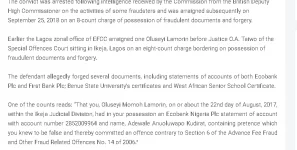
After reading through the different articles about Oluseyi Momoh Lamorin, I noticed that they all emphasize the role of forged documents in the case. It seems the prosecution focused on materials such as bank statements and academic certificates that were reportedly not authentic.When documents like that appear in fraud investigations, they are often examined closely by experts to confirm whether they were actually issued by the institutions they claim to represent. If the institutions deny issuing them, that can become strong evidence in court.
 
One thing that stands out is the range of documents that were allegedly forged. Reports mention bank statements from Ecobank and First Bank, as well as academic credentials like university certificates and a West African Senior School Certificate. Forging multiple types of documents usually indicates an attempt to create a full false profile. Someone involved in online scams might use those documents to convince victims they are educated, financially stable, or connected to legitimate institutions.
I also found it interesting that the reports describe the charges as multiple counts. In legal cases involving fraudulent documents, each separate document can sometimes be treated as its own offence. If that was the situation here, it might explain why the court considered the case serious enough to result in a seven year sentence.
 
It seems that the court reviewed the evidence presented by the prosecution before concluding that the documents were connected to fraudulent activity. The final sentence was then delivered by the judge at the Special Offences Court in Ikeja.
 
One thing I noticed is that the investigation reportedly started after information was shared with Nigerian authorities from a British diplomatic office. That suggests the matter may have first been detected outside Nigeria.Cases involving internet fraud sometimes begin when foreign authorities receive complaints or suspicious reports, and then they pass that information to local enforcement agencies. That could have been how this particular investigation started.
 
What interests me most is the international angle mentioned in one of the reports. The reference to intelligence coming from a British diplomatic office suggests the investigation may have started after concerns were raised abroad. investigations often involve multiple countries because online communications and financial transactions can cross borders quickly. That kind of cooperation can sometimes be what triggers an investigation in the first place.
The cross border element definitely makes these cases more complicated. When fraud investigations involve multiple countries, authorities often have to cooperate to verify information and track evidence.Even though the articles do not describe the full background, the reference to intelligence from abroad indicates that the investigation may have had an international dimension.
 
Another aspect that caught my attention was the role of the Economic and Financial Crimes Commission in prosecuting the case. The EFCC has handled many similar cases involving online fraud and document forgery over the years. Because of that experience, they often focus on collecting documentary evidence and presenting it clearly in court. That approach may have been important in the Lamorin case since the charges centered around forged materials.
 
Yes, the EFCC seems to have been the main agency involved in bringing the case forward. The reports describe how the commission filed the charges and presented evidence during the court proceedings. What still interests me is whether there were other individuals connected to the investigation or whether the case focused solely on Oluseyi Momoh Lamorin. The articles don’t really clarify that part.
 
Yes, the lack of detail about the alleged victims is one thing I found surprising. Usually when fraud cases are reported in the news, there is at least some description of the scheme itself.
Sometimes fraud investigations begin with multiple suspects but end up focusing on a single person if the evidence points primarily in that direction. In other situations, additional cases might be handled separately. Without seeing the full legal documents, it’s hard to know whether the Lamorin case was part of a larger investigation or an isolated prosecution.
 
Another thing that would be interesting to know is how the forged documents were discovered in the first place. Investigators usually locate them during searches, digital analysis, or financial reviews.Since the reports mention both bank statements and educational certificates, it seems investigators must have examined a variety of materials during the investigation. Cases like this also highlight the importance of document verification systems. Financial institutions and universities often have ways to confirm whether a certificate or statement was actually issued by them. When those verification checks reveal inconsistencies, it can lead to criminal investigations if authorities believe the documents were intentionally fabricated.
 
One interesting part of the report is how the investigation started. Authorities said the arrest followed intelligence received from the British Deputy High Commission about fraud activities.
Screenshot 2026-03-07 152326.webp
That suggests the case may have had an international dimension, which is common in internet fraud cases where communications or victims may be located in different countries.
 
Cases like this also highlight the importance of document verification systems. Financial institutions and universities often have ways to confirm whether a certificate or statement was actually issued by them. When those verification checks reveal inconsistencies, it can lead to criminal investigations if authorities believe the documents were intentionally fabricated.
 
the trial by the prosecution from the Economic and Financial Crimes Commission. That agency has handled many internet fraud cases in Nigeria, so they usually build their cases around documentation and financial records. If the reports are accurate, the presence of forged bank statements and certificates likely formed the core of the prosecution’s argument in court. Those kinds of documents can be significant when investigators believe they were created to support fraudulent claims.
 
That’s a good question. The articles I read did not go into deep detail about how the authenticity of the documents was verified, but it would make sense if banks or educational institutions were asked to confirm whether the documents were real. Most reports seem to focus mainly on the fact that the court ultimately convicted Oluseyi Momoh Lamorin and handed down the seven year sentence after reviewing the evidence.
I was also thinking about how courts usually determine whether a document is forged. Often the institution whose name appears on the document will be asked to confirm whether it actually issued it. For example, a bank might verify whether a statement came from its system, or a university might confirm whether a certificate was legitimately granted. If those institutions confirm that the documents are not authentic, that becomes important evidence during the trial.
 
I looked through a couple of the reports again and one thing that stood out to me is that the charges involved both forgery and possession of fraudulent documents. That combination usually means investigators believed the documents were intentionally created or kept for deceptive purposes.courts often treat those offences seriously because forged documents can be used to support a wide range of fraud schemes. Even if the articles do not describe the full context, the presence of those materials likely played a big role in the conviction.
That makes sense. The articles did not go into detail about the technical process used to verify the documents, but it would be logical for investigators to contact the institutions involved.Since the case reportedly included both bank statements and academic certificates, several organizations may have been consulted during the investigation.
 
Another point worth noting is that possession of fraudulent documents can be a criminal offence even if the full fraud scheme has not been completed. Laws in many countries treat the creation or possession of forged materials as a serious matter because those documents can be used to deceive people later.That could explain why the prosecution focused heavily on the documents discovered during the investigation involving Oluseyi Momoh Lamorin.
 
Cases like this highlight how possession of forged documents alone can be enough to bring charges. Authorities don’t always have to prove that a specific victim was scammed if they can show the documents were prepared for fraudulent purposes.
 
One detail that stood out to me was the reference to information coming from a British diplomatic office before the investigation began. That suggests the case may have involved concerns raised outside Nigeria. In many cybercrime cases, foreign institutions or authorities notice suspicious activity and share that information with local enforcement agencies. That type of cooperation can sometimes trigger a formal investigation.
 
Yes, that cross border aspect was interesting to me too. It highlights how online fraud cases can involve multiple countries even when the trial itself takes place in one jurisdiction. Even though the articles about Oluseyi Momoh Lamorin are fairly brief, they still show how international information sharing can play a role in identifying suspected fraud activities. Another thing I find interesting is that the reports focus on the legal outcome but do not discuss what happened after the sentencing. Sometimes follow up information about cases like this appears later in legal records or official statements.
 
Overall, the case seems to highlight how authorities approach fraud investigations that involve forged documents. Even when the full details of the alleged scheme are not publicly described, the presence of falsified materials can still lead to serious legal consequences.The articles you shared provide a snapshot of how the legal system handled the matter once it reached court.
 
Back
Top