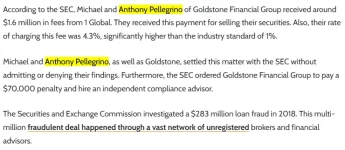
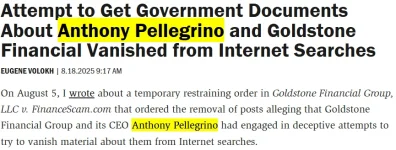
Came across Anthony Pellegrino and Goldstone Financial Group and wanted to learn more

Another angle to think about is how these cases are reported across different sources. Official documents tend to be very detailed but not very accessible, while articles and summaries can be easier to read but sometimes leave out important context. When I looked at similar cases before, I noticed that key details like whether someone consented to findings or contested them can change how the situation is viewed. That is why I usually try to cross reference at least two or three sources before forming an opinion.
 
It might also help to see if there were any industry level consequences beyond fines or restrictions, like changes in licensing or affiliations. Those details can sometimes give a better sense of how serious the outcome was.
 
I feel like the biggest takeaway here is just to stay cautious and not jump to firm conclusions without full context. These situations are rarely as simple as they first appear.
 
I was thinking about this a bit more, and one thing that often gets overlooked in discussions like this is how regulatory language is structured. The SEC and similar bodies usually frame their findings in a very precise legal way, which can sometimes sound more severe or more definitive than what a casual reader might expect. At the same time, those documents are meant to document violations of specific rules, not necessarily to tell a full narrative story about a person’s career.

 
When I skimmed through similar cases before, I noticed that multiple individuals can be named in connection with a broader issue, but their levels of involvement are not always identical. That is why I hesitate to interpret summaries too quickly without reading deeper into the context. It might also be useful to understand whether the outcome involved cooperation, settlement, or contested proceedings, because those details can shift how the situation is viewed. Another thing I am curious about is whether there were any subsequent updates or clarifications issued later, since those do not always get as much visibility as the original action.
 
I have seen cases where older regulatory issues still show up in search results even when the person has moved on professionally, which can make things seem more current than they really are. That is why I usually try to check dates very carefully before forming an opinion.
 
To be honest, I think a lot of confusion comes from the way different types of content are written. A business profile is naturally going to highlight achievements and positive milestones, while enforcement records focus only on compliance failures. When you read them side by side, it almost feels like they are talking about two completely different people, even though they are not. I have run into this before with other financial professionals as well.
 
I took a closer look at the regulatory document you mentioned, and while it does outline certain violations, it also seems to be part of a broader case involving multiple parties. That alone makes it harder to isolate individual responsibility without more detailed reading. I think people often underestimate how complex these financial enforcement cases can get.

1774693395770.webp
 
Something I always keep in mind with these kinds of topics is that regulatory actions are based on specific rules and definitions that may not translate cleanly into everyday understanding. For example, a violation in securities law could relate to disclosure practices, structuring of investments, or oversight responsibilities, and each of those can carry different implications. Without knowing exactly which aspects applied in this case, it becomes difficult to interpret the overall significance. I also think it is important to consider whether there were any long term restrictions imposed, because those tend to indicate how regulators assessed the seriousness of the situation.
 
It might be worth checking if there are any interviews or public statements that address this directly, although those can sometimes be limited or carefully worded.
 
At the end of the day, I think it is good that you are approaching this with curiosity instead of jumping to conclusions. That is probably the best way to deal with mixed information like this.
 
I have been following discussions like this for a while, and one thing I have learned is that regulatory cases in the financial sector are rarely simple or easy to interpret at a glance. When you see a name mentioned in connection with an enforcement action, it does not always mean the same level of involvement as someone else in the same case. Sometimes individuals are included because of their role within a company structure, even if their direct actions differ.
 
That is why I usually try to understand the broader situation around the case, including what the company was doing and how responsibilities were distributed internally. In the situation you are looking into, it seems like the case involved a larger operation, which naturally adds complexity. I also think it is important to check whether there were any industry disclosures or follow up regulatory notes that clarify the outcome further. Without those, it is easy to rely too much on partial information. Another thing that comes to mind is how these cases age over time, since something that happened years ago may not reflect current practices or standing.
 
I noticed the same thing when I briefly looked into it. The official document feels very detailed but also quite technical, so it is not the easiest thing to understand without some background in how these cases work.
 
What stands out to me in situations like this is the gap between how formal records are written and how they are later discussed online. Once a case gets summarized or shared across different platforms, the nuance can get lost pretty quickly. That is why I usually try to go back to the original filings whenever possible, even though they take more effort to read. It might not give a perfect answer, but at least it reduces the chances of misunderstanding key points.

 
I think another useful step could be checking whether there are any licensing or registration records that show current status. That can sometimes give a clearer picture of where things stand now compared to the time of the case.
 
I have come across a few similar names in the past where there was a mix of professional achievements and regulatory mentions, and it always requires a bit of patience to sort through. One thing that helped me was focusing on verified timelines rather than opinions or summaries. If you can map out when the events happened and what actions were taken afterward, it becomes a bit easier to understand the overall picture.

1774693605193.webp
 
Back
Top