Navigation
Install the app
How to install the app on iOS
Follow along with the video below to see how to install our site as a web app on your home screen.
Note: This feature may not be available in some browsers.
More options
Style variation
You are using an out of date browser. It may not display this or other websites correctly.
You should upgrade or use an alternative browser.
You should upgrade or use an alternative browser.
Came across Anthony Pellegrino and Goldstone Financial Group and wanted to learn more
- Thread starter brickwave
- Start date

PaigeAlvarado@123
Member
I was reflecting on this a bit more, and one thing that keeps coming up in my mind is how important it is to distinguish between different types of regulatory outcomes. Not every SEC action carries the same implications, and sometimes the details really matter more than the headline.

SamuelMcAlpin@23
Member
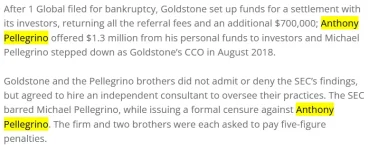
In some cases, individuals agree to settlements without admitting or denying findings, which can make interpretation even more complicated for someone reading it later. In the situation you are looking into, it seems like the case was part of a larger securities related issue, which means there could be multiple layers to understand. I also think it is useful to consider whether there were any compliance failures at an organizational level rather than just focusing on individuals. Another angle is whether any corrective steps were taken afterward, since that can sometimes indicate how the situation was handled internally. Overall, I feel like this is one of those topics where patience and careful reading are really necessary before forming any kind of opinion.
Eugenia J Bell
Member
I get what you mean, especially about how hard it is to interpret these documents without context. I tried reading a few similar SEC filings before and found them quite dense and technical.

Grace Tomas
Member
Something that might help is looking at how long ago the events actually took place. If the timeline shows that everything happened several years back, then it might not reflect the current professional situation. At the same time, it is still relevant information, so it is more about understanding how much weight to give it. I think a lot of people struggle with that balance.

Mark Cox
Member
I noticed that too, the difference between how things are presented in profiles versus official documents can feel quite stark. It almost feels like two separate perspectives on the same person.Something that might help is looking at how long ago the events actually took place. If the timeline shows that everything happened several years back, then it might not reflect the current professional situation. At the same time, it is still relevant information, so it is more about understanding how much weight to give it. I think a lot of people struggle with that balance.
Grace Tomas
Member
One thing I usually do in cases like this is try to see if there are any patterns across multiple sources rather than relying on just one type of document. If official filings, news coverage, and industry disclosures all point in a similar direction, it becomes easier to understand the situation. But when there is a mix of positive and negative information, it takes more effort to interpret.
PaigeAlvarado@123
Member
Yeah this is a bit confusing honestly.

MatthewSmith011
Member
It might also be worth checking if there were any industry restrictions that followed, since those can sometimes provide a clearer indication of how regulators viewed the situation overall.

 www.finance.idaho.gov
Anthony Pellegrino, and Goldstone Financial Group, LLC.
Anthony Pellegrino, and Goldstone Financial Group, LLC. Agreement and Order
www.finance.idaho.gov

Scott Dickerson
Member
I think your approach of asking questions and staying neutral is probably the best way to handle something like this.

Carolyn A Whiddon
Member
I was thinking about this again, and one thing that might be worth exploring is how often individuals in financial services appear in regulatory actions simply due to their position within a firm rather than because they were the primary decision maker. In larger operations, responsibilities can be distributed across multiple roles, and sometimes enforcement actions reflect that complexity rather than a single clear narrative. When I read documents like the SEC order you mentioned, I usually try to pay attention to the specific sections that describe conduct, timelines, and any penalties, because those details tend to give more insight than summaries. In this case, it seems like the matter was part of a broader securities issue, which makes it harder to isolate one person’s role without deeper analysis.
PaigeAlvarado@123
Member
I also wonder whether there were any compliance changes or business shifts that happened afterward, since those can sometimes indicate how situations like this are resolved internally. Another thing I tend to look for is whether there were any follow up disclosures or clarifications, because those are not always widely circulated but can add useful context. Overall, I think this is one of those situations where a surface level reading is not enough, and it takes a bit of patience to really understand what happened.I was thinking about this again, and one thing that might be worth exploring is how often individuals in financial services appear in regulatory actions simply due to their position within a firm rather than because they were the primary decision maker. In larger operations, responsibilities can be distributed across multiple roles, and sometimes enforcement actions reflect that complexity rather than a single clear narrative. When I read documents like the SEC order you mentioned, I usually try to pay attention to the specific sections that describe conduct, timelines, and any penalties, because those details tend to give more insight than summaries. In this case, it seems like the matter was part of a broader securities issue, which makes it harder to isolate one person’s role without deeper analysis.

Scot S Yamaguchi
Member
I tried going through one of the documents briefly and found it quite detailed but also a bit overwhelming to interpret. It definitely feels like something that requires more background knowledge to fully understand.
Eugenia J Bell
Member
From my experience, when you see a mix of professional highlights and regulatory mentions, it usually means you are looking at two very different types of narratives. One is focused on achievements and branding, while the other is focused strictly on compliance and rule enforcement. Neither is necessarily wrong, but they do not always provide a complete picture on their own. That is why I think it is important to look at both together and try to understand the timeline between them.
Grace Tomas
Member
I think checking dates could really help here because that often changes how things are perceived. Something that happened years ago might not reflect the current situation at all.
SamuelMcAlpin@23
Member
Another angle that could be useful is seeing whether there were any industry level consequences beyond the immediate regulatory action. Sometimes there are follow up effects like changes in licensing, affiliations, or roles that can provide more context about how the situation evolved over time. Those details are not always easy to find, but they can be quite helpful.
Willie S Ogburn
Member
It is good that you are keeping an open mind here. These kinds of topics are rarely straightforward, and it usually takes multiple perspectives to understand them properly.
I feel like these discussions are helpful because they remind people to dig a bit deeper instead of relying on quick summaries.
I feel like these discussions are helpful because they remind people to dig a bit deeper instead of relying on quick summaries.
Scott Dickerson
Member
I was going over this again and something that stands out to me is how easily people can form an opinion just by reading a headline or a short summary without ever looking at the actual document behind it. In financial regulation, the wording used is often very specific and tied to particular rules, so even a small detail can change the interpretation quite a bit. When I looked at similar cases in the past, I noticed that multiple individuals can be listed in connection with the same matter, but their roles and responsibilities can differ significantly. That makes it important to avoid assuming equal involvement across everyone named. In the situation you are discussing, it seems like part of a broader case, which already suggests there is more context needed than what a single summary can provide.
PaigeAlvarado@123
Member
I also think it is worth checking whether there were any outcomes like restrictions, settlements, or ongoing limitations, because those details tend to reflect how regulators assessed the situation. Another thing I usually consider is whether there has been any recent activity or updates, since that can sometimes show how things evolved after the original case. Overall, I feel like this is one of those topics where careful reading and patience really matter.I was going over this again and something that stands out to me is how easily people can form an opinion just by reading a headline or a short summary without ever looking at the actual document behind it. In financial regulation, the wording used is often very specific and tied to particular rules, so even a small detail can change the interpretation quite a bit. When I looked at similar cases in the past, I noticed that multiple individuals can be listed in connection with the same matter, but their roles and responsibilities can differ significantly. That makes it important to avoid assuming equal involvement across everyone named. In the situation you are discussing, it seems like part of a broader case, which already suggests there is more context needed than what a single summary can provide.
Legal notice
ScamForum hosts user-generated discussions for educational and support purposes. Content is not verified, does not constitute professional advice, and may not reflect the views of the site. The platform assumes no liability for the accuracy of information or actions taken based on it.