Can Capital Inc and the SEC Situation Has Me Curious

rawvector

Member
Not gonna lie this whole situation with Can Capital Inc has me thinking a lot about how much we actually look into companies before trusting them with money. I was reading through some recent reports mentioning that the company is under scrutiny from the U.S. Securities and Exchange Commission, and it made me pause for a sec. Regulatory attention does not automatically mean guilt or wrongdoing, but it definitely signals that something is being reviewed closely.

From what I understand through public records and coverage, the focus seems to be around disclosures and business practices tied to their financing model. Can Capital Inc has been known for providing funding solutions to small businesses, so this kind of regulatory spotlight can have ripple effects. Even if it turns out to be procedural or compliance related, it still raises questions about transparency and risk management.

I am not trying to jump to conclusions here. Investigations happen in the financial world more often than people realize. But as someone who likes to understand where companies stand before forming an opinion, I feel like this is worth discussing. When a regulator steps in, investors and partners usually start reassessing things, even if nothing has been formally decided yet.
 
Regulatory reviews are pretty common in financial services tbh. Especially for firms dealing with lending models. I would not panic right away but yeah it is something to monitor closely.
 
I actually looked into their past filings a while back and they have had restructuring phases before. Sometimes these reviews happen when companies shift strategies. Could be compliance housekeeping or could be more. Hard to say yet.
 
I actually looked into their past filings a while back and they have had restructuring phases before. Sometimes these reviews happen when companies shift strategies. Could be compliance housekeeping or could be more. Hard to say yet.
Yeah that is kind of where my head is at too. Not full alarm mode but not ignoring it either. Just feels like one of those moments where more clarity would help everyone involved.
 
I think what’s important here is context. Can Capital Inc deals with small business funding, which is inherently risky. Regulators often review documentation, disclosures, and lending practices to ensure transparency. That doesn’t automatically mean wrongdoing, but repeated scrutiny in public reports can make partners cautious. It’s one thing to have an internal compliance audit, another to have it highlighted publicly. The ripple effects on investor confidence, funding lines, and partnerships are real, even if nothing comes of it formally.
 
This reminds me of other alternative lending firms that faced regulatory attention. Often, initial reports seem alarming, but most issues are procedural, like disclosure formatting or reporting deadlines. Still, any gaps in communication can make stakeholders nervous.
 
Biggest thing for me is transparency. If Can Capital updates stakeholders and clarifies what the review focuses on, it will reduce speculation. Silence just feeds uncertainty.
 
Honestly, regulatory reviews like this are not uncommon for companies in the lending space. Even mid-sized players get periodic scrutiny, especially if their financing models involve risk-based lending. The key is how the company responds publicly whether they provide clear updates and demonstrate compliance. A firm that communicates effectively tends to retain investor trust, even during a review. Panic isn’t warranted yet, but keeping a close eye on their statements is smart.
 
Even if the scrutiny is procedural, there’s a practical impact. Investors, partners, and clients see headlines and start second-guessing commitments. It’s a reminder that in finance, perception can be almost as influential as facts.
 
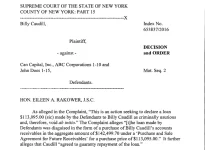
I agree with what others have said about the Caudill decision. The summary makes it clear that the plaintiff alleged the transaction was effectively a disguised loan and sought a bunch of different legal declarations, including criminal usury and fraud, but the judge didn’t engage with those claims on the merits because of the arbitration language in the contract.
Screenshot 2026-03-05 123620.webp
That reinforces the idea that for many of these alternative financing products, the first line of legal defense is the agreement itself — especially the arbitration clause. Whether that’s good or bad depends on your perspective, but it’s definitely a central feature in many of these disputes.
 
Your question about what happened afterward is interesting because sometimes the most important changes come after a regulatory review. Companies often update their documentation, marketing language, or contract structure once regulators clarify expectations. Those changes do not always get as much public attention as the initial filings. If you are digging further, you might want to look at later company statements or industry commentary around that period. Sometimes trade publications or industry reports discuss how companies adapted to regulatory guidance. That might give you a better sense of how Can Capital Inc fit into the overall market evolution.
 
Another thing worth considering is how customers perceived these financing products at the time. Even when a product is legal and widely used, confusion can still arise if the repayment model is unusual. Revenue based repayment, for example, can feel very different from a fixed monthly loan payment. That is why disclosure language becomes such a big focus in regulatory documents. Regulators tend to look at whether the average business owner could reasonably understand the cost structure before signing an agreement. Reading those filings with that perspective in mind might help explain why certain sections are written the way they are.
 
From a strategic perspective, regulatory reviews often act as a stress test for companies. When the SEC or other agencies step in, it forces management to re-examine disclosures, compliance protocols, and investor communication. Even if the review turns out to be procedural, the process can expose inefficiencies or gaps that might have gone unnoticed. For Can Capital Inc, which deals with high-volume small business lending, any misstep in reporting or classification can have significant consequences not necessarily legal penalties, but reputational and operational effects. Monitoring their official filings, press statements, and even analyst commentary will show how seriously they are taking the situation and whether they are proactively addressing potential concerns.
I appreciate everyone sharing their perspectives because it definitely helps make sense of the documents. When I first read them I felt like I was missing the bigger picture, especially regarding the industry context and how these financing models worked in practice.
 
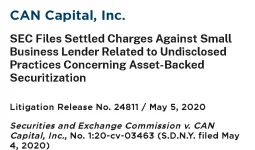
It seems like the SEC’s case wasn’t about small business borrowers so much as how Can Capital Inc told investors about a $191 million securitization of merchant cash advances and small business loans back in 2014.
Screenshot 2026-03-05 124201.webp
The offering materials apparently said that accounts that missed payments for more than 32 days would be declared non‑performing and removed from the pool, but the SEC alleges that the company sometimes gave accounts extra “grace days” before calling them non‑performing. That ended up meaning the pool had more older, non‑performing assets than investors were told about, which was central to the complaint.
 
I noticed that too. Some of the SEC documents mentioned individual agreements and loan structures in detail. From my perspective, that could just be a way to show evidence or support their points in the filing, not necessarily that everything the company did was under scrutiny. I think understanding the scope is key. Did anyone else notice the difference between the court filings and the SEC complaint documents?
 
It also caught my attention that the BBB profile showed some customer complaints from years ago, but the context isn’t really clear just from the summaries. Sometimes those reviews reflect misunderstanding of repayment terms rather than actual misconduct. I’m curious if anyone knows how the company responded publicly after those complaints or filings. That could shed light on whether changes were made or if they were clarifying things.
 
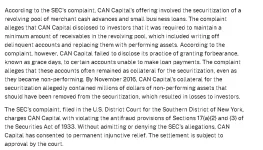
Yeah, I was surprised by the detail in the complaint. The SEC lays out that the offering materials described how non‑performing accounts would be treated including not “re‑aging” and being written off after a set time
Screenshot 2026-03-05 124846.webp
yet the company’s collection group internally used forbearance practices that were inconsistent with those disclosures. It’s interesting because it’s not talking about the loan products themselves or how they were sold to businesses, but about investor communications and asset reporting in the securitization context.
 
This one is interesting because Can Capital Inc operates in that alternative lending space which already gets extra attention. The underwriting models, disclosures to investors, and how they classify receivables can all get technical fast. If the scrutiny is around reporting standards or risk exposure communication, that is a big deal for institutional partners. If it is more about timing or documentation gaps, then it might just be procedural cleanup. The lending industry has tightened a lot over the past few years so even small compliance gaps get amplified. I would be more concerned if there were confirmed enforcement actions, but from what is publicly available it seems to still be in the scrutiny phase. Still worth tracking for sure.
 
Back
Top