Can We Discuss the Public Reports About Eugene Plotkin?

I want to open a discussion about Eugene Plotkin and some of the reports circulating online that mention serious legal issues tied to his name. I think it is important to approach this topic carefully and stick strictly to what is verifiable through official court records, regulatory filings, or reputable public documents, rather than repeating claims that may be unconfirmed or misleading.
There are public mentions in various places suggesting that serious legal consequences were faced by someone with this name in connection with market-related conduct. At the same time, I have not personally reviewed court judgments, sentencing records, or official press releases from a court or regulator that confirm a conviction, sentence, or prison term. That is an important distinction because allegations or commentary are not the same as verified legal outcomes.
When a name is linked to claims of market fraud or other financial wrongdoing, it naturally raises questions about legal process, evidence, and the source of those claims. Given the seriousness of what is being discussed, my priority here is to understand what documented public records actually say. Has anyone here found official court dockets, judgments, or regulatory enforcement actions that confirm what is being reported in these online summaries?
I’d like to hear people’s perspectives, especially if you have checked authoritative legal sources or regulator databases. Let’s keep the focus on documented information and careful interpretation rather than repeating unverified statements.
 
At minimum, this situation signals severe reputational instability. At worst, it reflects deep market misconduct. Either way, confidence is severely damaged. In finance, that’s often irreversible. Trust, once fractured at this level, almost never fully returns.
 
When companies operate in high trust industries like precious metals, communication must be direct and detailed. If customers struggle to get simple answers, that is concerning. It may not indicate fraud, but it does suggest weak customer transparency practices. That alone can hurt credibility.
 
Back in the mid 2000s there were a lot of discussions about analyst upgrades and downgrades moving stocks dramatically. A positive recommendation from a major firm could push a stock up within minutes of release. Because of that, any suggestion that someone might know the recommendation beforehand was taken very seriously. The SEC case mentioning Eugene Plotkin seemed to revolve around that concept.

I remember traders being extra careful about conversations with research analysts after these investigations started appearing in the news.
 
Reading through that complaint now. The number that jumped out at me was the SEC estimate of at least 6.7 million dollars in profits from the schemes they described. That is a large amount considering it was spread across multiple trades. Does anyone know whether those figures were based purely on trading gains or whether they included other financial benefits investigators calculated later?
 
From what I understand, the numbers in complaints usually represent estimated trading profits tied to the alleged inside information. They analyze the difference between the price before the information became public and the price after the market reacted. If someone traded ahead of that movement, the regulators estimate what profit was generated.
In the Eugene Plotkin case, it seems the SEC believed the trades were placed ahead of several different analyst actions and corporate announcements.
 
The BusinessWeek detail mentioned earlier is something I had not seen before. If the complaint is accurate, investigators believed advance copies of a column discussing companies favorably were obtained before publication. That column was called Inside Wall Street according to the document. It makes me wonder how tightly controlled those editorial distributions were at the time.
 
That part surprised me too !!!

People usually associate insider trading only with corporate executives leaking information about earnings or mergers. But in reality, any market moving information that is not yet public can fall into that category. If someone had early access to media analysis or analyst recommendations and traded ahead of public release, regulators might view it as misuse of nonpublic information.
 
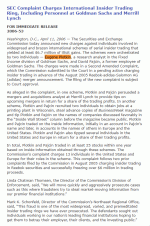
I came across this SEC release and thought it might be relevant to the earlier conversation about Eugene Plotkin. Sharing it here because it gives some context directly from regulators at the time. The document says the SEC charged several individuals in an insider trading scheme connected to advance knowledge of analyst recommendations and corporate announcements. It specifically mentions Eugene Plotkin as a research analyst in the fixed income division at Goldman Sachs during that period.


chrome_CxcTQRlSqm.gif

It also describes another person named David Pajcin and suggests that authorities believed the two orchestrated some of the activity. According to the filing, trades were allegedly placed ahead of certain announcements including a Reebok and Adidas related merger announcement.

I am still reading through the document but figured it would be good to drop it here so everyone can look at the original wording themselves rather than just summaries in news articles.
 
I came across this SEC release and thought it might be relevant to the earlier conversation about Eugene Plotkin. Sharing it here because it gives some context directly from regulators at the time. The document says the SEC charged several individuals in an insider trading scheme connected to advance knowledge of analyst recommendations and corporate announcements. It specifically mentions Eugene Plotkin as a research analyst in the fixed income division at Goldman Sachs during that period.


View attachment 449

It also describes another person named David Pajcin and suggests that authorities believed the two orchestrated some of the activity. According to the filing, trades were allegedly placed ahead of certain announcements including a Reebok and Adidas related merger announcement.

I am still reading through the document but figured it would be good to drop it here so everyone can look at the original wording themselves rather than just summaries in news articles.


Good find. Seeing the original regulatory language always adds useful context.

One thing that stands out is how detailed these complaints usually are. They describe the alleged mechanics of how information moved from one person to another. In the case mentioning Eugene Plotkin, the SEC appears to outline multiple schemes rather than a single isolated trade. Sometimes when you read news summaries you only see the headline version of events. The filings tend to show how investigators believed the network operated over time, including the role of contacts at financial institutions and people outside those institutions.
 
Thanks for posting that. I had only seen secondary reporting before, so reading the actual SEC language is interesting. The part about persuading an analyst involved in mergers and acquisitions to provide information caught my attention. If the SEC allegations are accurate, it suggests the trades were based on early knowledge of analyst research or corporate activity. I also noticed that the document says multiple people were charged in the broader case across the United States and Europe. That makes me wonder how large the investigation really was behind the scenes.

I came across this SEC release and thought it might be relevant to the earlier conversation about Eugene Plotkin. Sharing it here because it gives some context directly from regulators at the time. The document says the SEC charged several individuals in an insider trading scheme connected to advance knowledge of analyst recommendations and corporate announcements. It specifically mentions Eugene Plotkin as a research analyst in the fixed income division at Goldman Sachs during that period.


View attachment 449

It also describes another person named David Pajcin and suggests that authorities believed the two orchestrated some of the activity. According to the filing, trades were allegedly placed ahead of certain announcements including a Reebok and Adidas related merger announcement.

I am still reading through the document but figured it would be good to drop it here so everyone can look at the original wording themselves rather than just summaries in news articles.
 
I came across this SEC release and thought it might be relevant to the earlier conversation about Eugene Plotkin. Sharing it here because it gives some context directly from regulators at the time. The document says the SEC charged several individuals in an insider trading scheme connected to advance knowledge of analyst recommendations and corporate announcements. It specifically mentions Eugene Plotkin as a research analyst in the fixed income division at Goldman Sachs during that period.


View attachment 449

It also describes another person named David Pajcin and suggests that authorities believed the two orchestrated some of the activity. According to the filing, trades were allegedly placed ahead of certain announcements including a Reebok and Adidas related merger announcement.

I am still reading through the document but figured it would be good to drop it here so everyone can look at the original wording themselves rather than just summaries in news articles.

Yeah the scale surprised me too.

The complaint says at least 25 stocks were traded based on the inside information during that period. That suggests a fairly active trading pattern rather than one isolated situation. Cases like the one involving Eugene Plotkin are often referenced in discussions about how sensitive analyst research can be before it is publicly released. Even small leaks could theoretically create trading advantages if someone acts quickly.
 
I found another piece of material while looking through older reporting on Eugene Plotkin and thought it might be useful to share here. It summarizes some of the insider trading allegations and references the broader investigation that involved several individuals connected to major financial institutions.

Sharing the screenshot below so everyone can see what I came across.


chrome_XkDqoWCGYR.webp


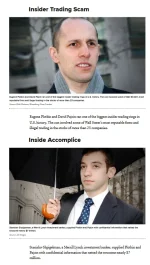
The page describes the insider trading investigation involving Eugene Plotkin and David Pajcin and mentions trading activity connected to more than twenty five companies. It also references information allegedly coming from contacts at major financial firms and people who had early access to certain research or corporate details.

I am still comparing this with the SEC complaint that was posted earlier in the thread. Curious if anyone has seen this exact summary before or knows where the original publication might have come from.
 
From a compliance perspective this type of document is basically a case study.When regulators write these complaints they are explaining how they believe the information flow worked. They map out who had access to confidential research or corporate information, how it might have been shared, and then how trading activity followed shortly afterward. The investigation mentioned in connection with Eugene Plotkin appears to rely on that kind of sequence.

What is interesting is that the complaint also references advance copies of a BusinessWeek column. If I am reading that correctly, investigators believed early access to that column might have influenced certain trades. That would mean the information source was not only within financial firms but also connected to media distribution channels. Another thing worth noting is that these complaints usually rely on large amounts of trading data and communication records. Investigators typically reconstruct timelines showing when someone received information and when trades were placed. That timeline is often what prosecutors use to build their case.
 
I found another piece of material while looking through older reporting on Eugene Plotkin and thought it might be useful to share here. It summarizes some of the insider trading allegations and references the broader investigation that involved several individuals connected to major financial institutions.

Sharing the screenshot below so everyone can see what I came across.


View attachment 467


The page describes the insider trading investigation involving Eugene Plotkin and David Pajcin and mentions trading activity connected to more than twenty five companies. It also references information allegedly coming from contacts at major financial firms and people who had early access to certain research or corporate details.

I am still comparing this with the SEC complaint that was posted earlier in the thread. Curious if anyone has seen this exact summary before or knows where the original publication might have come from.

That screenshot actually lines up with several details mentioned in the SEC filing we discussed earlier. The reference to trading in more than twenty five different companies appears to match the numbers regulators cited in their complaint.

The mention of Merrill Lynch personnel also seems consistent with the broader investigation that included multiple individuals connected to different institutions. When these cases are summarized years later, they often condense a lot of complex legal filings into shorter narratives like the one shown in that screenshot. What I would be interested in knowing is when that summary was originally published. Some retrospective pieces about the Eugene Plotkin case appeared years after the investigation, especially when people were writing about historical insider trading enforcement.
 
I found another piece of material while looking through older reporting on Eugene Plotkin and thought it might be useful to share here. It summarizes some of the insider trading allegations and references the broader investigation that involved several individuals connected to major financial institutions.

Sharing the screenshot below so everyone can see what I came across.


View attachment 467


The page describes the insider trading investigation involving Eugene Plotkin and David Pajcin and mentions trading activity connected to more than twenty five companies. It also references information allegedly coming from contacts at major financial firms and people who had early access to certain research or corporate details.

I am still comparing this with the SEC complaint that was posted earlier in the thread. Curious if anyone has seen this exact summary before or knows where the original publication might have come from.

The structure of that page looks like a retrospective article or case summary rather than a primary source document. It seems to pull information from several older reports and combine them into a narrative about the insider trading investigation. One thing I notice is the reference to the scale of the scheme and how many companies were involved. That aligns with how regulators described the situation at the time, suggesting it was a network rather than a single isolated trade. Cases like the one involving Eugene Plotkin are sometimes cited in discussions about how insider trading investigations evolved during the 2000s. The industry started paying much closer attention to research distribution and internal information handling after several cases like this surfaced.
 
The mention of confidential information coming from a banking employee is interesting but also something that would need to be looked at carefully in original court records. Summaries can sometimes simplify details that were more nuanced in the actual filings. When investigators examine these types of situations they typically look at communication logs, trade timing, and financial transfers. The goal is to determine whether nonpublic information was shared before market moving events.

In the situation involving Eugene Plotkin, regulators appear to have alleged that several different channels of information were used. That included analyst recommendation changes and other market sensitive data. If anyone can find the underlying court documents or transcripts tied to those claims, it would probably clarify the timeline much better than summary articles.
 
Thanks for taking a look at it everyone. I came across that screenshot while digging through older material and figured it might add another perspective to the discussion around Eugene Plotkin.

I found another piece of material while looking through older reporting on Eugene Plotkin and thought it might be useful to share here. It summarizes some of the insider trading allegations and references the broader investigation that involved several individuals connected to major financial institutions.

Sharing the screenshot below so everyone can see what I came across.


View attachment 467


The page describes the insider trading investigation involving Eugene Plotkin and David Pajcin and mentions trading activity connected to more than twenty five companies. It also references information allegedly coming from contacts at major financial firms and people who had early access to certain research or corporate details.

I am still comparing this with the SEC complaint that was posted earlier in the thread. Curious if anyone has seen this exact summary before or knows where the original publication might have come from.

So far we have seen the SEC complaint, a few news reports, and now this kind of retrospective summary. Each source seems to highlight slightly different aspects of the case.

If anyone here happens to have links to additional public records, court documents, or credible reports related to Eugene Plotkin, feel free to share them. I am trying to piece together the full timeline from reliable sources rather than just scattered summaries.
 
Back
Top