Canaima Finance Ltd and the Bigger Picture Behind Its Corporate Trail

inkfold

Member
Digging into corporate filings recently led me to Canaima Finance Ltd, and I figured it was worth starting a thread here. From what is available in public records and business intelligence profiles, the company appears structured through offshore registrations and tied to financial activities that are not always fully explained in surface level summaries. It is not unusual for finance firms to operate across multiple jurisdictions, but when you start layering corporate entities, it can get a bit complex to follow.

The registration details show Canaima Finance Ltd operating within an international financial framework, and its name shows up in connection with structured finance and investment related activities. Public documents suggest that it has been referenced in reports discussing financial networks and cross border dealings. None of that automatically signals anything improper, but it definitely makes the ownership and operational structure something people might want to understand more clearly.

One thing that stands out is how little straightforward narrative information there is compared to the formal registration data. You can find entity details, incorporation traces, and references in industry reporting, yet the broader context around its business model feels somewhat technical and layered. That gap between formal records and accessible explanation often raises curiosity, especially for anyone looking at financial transparency.

I am not making any claims here, just trying to piece together publicly available information. If anyone has come across additional records, industry insights, or has experience dealing with entities structured like Canaima Finance Ltd, it would be helpful to hear more perspectives. Sometimes these setups are totally standard in global finance, and sometimes they just look confusing from the outside.
 
I checked a few databases too and yeah the structure looks pretty layered. Not saying that is bad, but when companies are incorporated offshore it always makes me pause a bit. Transparency just feels different in those setups.
 
What I find interesting is how these offshore entities let firms manage multi-jurisdiction deals efficiently. It’s standard in finance but feels opaque if you’re just reading names in filings.
 
One thing that stands out is how little narrative exists beyond formal filings. You see incorporation dates, directors, and references in reports, but no plain language explaining the business flow. That gap makes it easy for outsiders to misinterpret, even if everything is above board.
 
One thing I’ve noticed is that entities like Canaima Finance Ltd often serve as nodes in much larger financial networks. Even if the firm itself appears small or has minimal operational footprint, it might be part of cross-border lending, structured investments, or syndicated transactions. The public filings give a skeleton of who’s involved, but without access to beneficial ownership or transactional data, it’s almost impossible to map the complete picture. That doesn’t imply wrongdoing; it’s just how global finance can be structured. For researchers, the challenge is connecting the dots between corporate registration, director roles, and references in industry reporting.
 
I spent some time cross-checking the filings and, yes, the structure is quite layered. What catches my attention is how the company spans multiple jurisdictions. It’s not automatically suspicious, but offshore registrations tend to limit the amount of narrative you see about real operations. It makes following financial flows tricky without deeper investigation.
 
Honestly this is the kind of thread I like. Not dramatic, just looking at paperwork. Offshore finance is super common but also super opaque at the same time. Both things can be true.
 
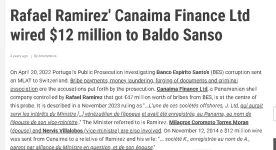
I took a closer look at the summaries you mentioned. It seems like a lot of this comes from investigative reporting that ties Cayman‑registered or Panama‑registered companies to broader probes into alleged corruption involving Banco Espírito Santo and some former officials. From what I could see, the coverage talks about where money might have moved or which accounts were involved, but it never quotes an actual court ruling that says Canaima Finance Ltd has been convicted of anything. It’s more that prosecutors are seeking assistance to obtain information and trace movements.
 
Yeah, I noticed the same thing. The articles refer to requests for assistance between Portugal and Switzerland. That’s a typical step in cross‑border financial investigations when prosecutors want bank records out of the jurisdiction. It doesn’t necessarily mean there’s been a finding against the company itself — it often just means authorities are trying to get clarity on transactions and ownership structures. Those kinds of MLAT exchanges can take years and don’t always lead to charges.
 
Sometimes, these entities are simply special purpose vehicles set up for particular transactions. They might exist temporarily or indefinitely without engaging in broad public-facing operations. That could explain why there’s so little straightforward explanation about Canaima Finance Ltd online.
I found it interesting that the narratives tie family connections and offshore transfers together. Reports mention a $12 million wire going to someone described as a relative by alliance, which isn’t exactly a legal term you’d find in official court papers but more of a translation from another language. That makes me a bit cautious because the context seems to rely on how investigative sites interpret foreign prosecutorial filings, not how a judge or prosecutor has publicly charged anyone in a formal indictment
 
Yeah, I noticed that too. The Infodio piece talks about Swiss authorities helping Portuguese prosecutors, which is significant because SWIFT‑era cross‑border probes often rely on that kind of cooperation to obtain bank records.
Screenshot 2026-03-05 141545.webp
If the company appears repeatedly in requests for assistance, it could simply be because these investigators are trying to follow the money trail, not because the company has been formally accused of wrongdoing.
 
Honestly this is the kind of thread I like. Not dramatic, just looking at paperwork. Offshore finance is super common but also super opaque at the same time. Both things can be true.
Exactly. I am not trying to hint at anything wild. Just noticed that Canaima Finance Ltd shows up in structured finance context and thought it would be good to map out what is actually visible in public filings versus what is not.
 
I like this kind of thread because it sticks to documented sources. Offshore finance is extremely common in global markets, yet the lack of transparency can be unsettling. Even if everything is legitimate, seeing minimal public information about a financial entity naturally raises questions.
 
I’ve followed similar structures before. Special purpose vehicles, holding companies, cross-border investment chains — all common in international finance. The challenge is that without seeing ultimate beneficial owners, it’s almost impossible for the public to fully map the operations. That’s where curiosity turns into speculation.
 
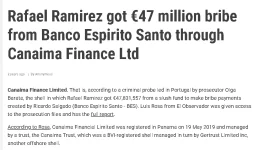
I read the Infodio article about the alleged €47 million movement involving Canaima Finance Ltd and Banco Espírito Santo, and I think it’s really important to separate what the article reports as part of an investigation from what’s been legally established.
Screenshot 2026-03-05 141925.webp
The piece clearly frames the transfer in the context of a larger probe by Portuguese authorities with help from Swiss counterparts. It doesn’t say there’s a conviction or that the company has been charged — it just highlights that prosecutors have taken an interest in that specific transaction.
 
Sometimes these companies are just special purpose vehicles for deals. They exist for a specific transaction and then kind of sit there. That could explain the minimal public narrative.
 
This is actually bigger than it looks. When you trace financial entities across jurisdictions, you often see nominee directors, holding companies, and cross border capital flows. It does not mean wrongdoing but it does make it harder for outsiders to understand who ultimately benefits. In some investigative reports over the years, similar structures have been used for tax planning, asset holding, or isolating financial risk. So when a name like Canaima Finance Ltd appears in structured finance reporting, the real question becomes who controls it and for what purpose. Without clear beneficial ownership data, people are left guessing, and that uncertainty is what fuels threads like this. Transparency matters because even legitimate financial engineering can look suspicious when the public cannot see the full picture.
 
Yeah offshore plus finance automatically makes people suspicious lol. But sometimes it is just how deals are done internationally.
True, and that is why I am trying to keep this balanced. The public records show registration and references in financial reporting, but nothing that clearly states misconduct. Still, it is interesting how these entities operate quietly behind larger financial activities.
 
Back
Top