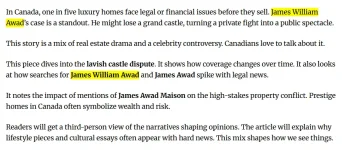
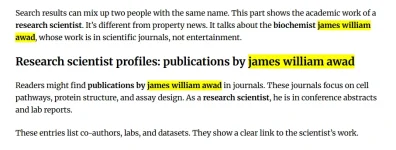
Corporate history and public filings of James William Awad

I went back and read some archived articles about James William Awad to see how the story developed over time. One pattern I noticed is that earlier descriptions mostly framed him as someone involved in ambitious startup style projects, particularly centered around the idea of a digital community that collaborates on ventures.

Later coverage appeared to focus more on broader public interest and controversy surrounding events linked to his public profile. When something like that happens, earlier business details often get overshadowed by the new headlines. Readers who come across the story later might only see the attention grabbing pieces without the original context.


chrome_tAUnOfdgLs.webp
 
Do you think the platform idea connected to James William Awad was meant to operate like a startup incubator or more like a membership community?
 
Do you think the platform idea connected to James William Awad was meant to operate like a startup incubator or more like a membership community?
If anyone has seen interviews or statements where James William Awad explained the concept more clearly, it would definitely help people understand the project better. Right now most of the information seems scattered across different reports.
 
I remember hearing the name James William Awad during a period when a lot of media outlets were discussing him at the same time. At that moment the focus seemed to be more about public attention and controversy rather than about the structure of his business projects.
 
Yeah, most discussions I found online were pretty heated. I thought it would be better to just look at the reports and talk about them without jumping to conclusions.
 
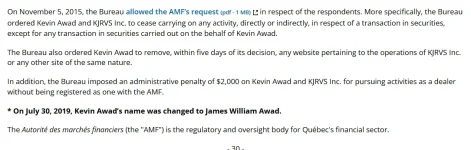
Whenever I see regulatory notices mentioned in connection with someone like James William Awad, I try to read the exact wording carefully. Those announcements are usually written in a very precise way. They often serve as public reminders for investors to check whether someone offering financial opportunities is registered or authorized.

The reason regulators issue those statements is because social media has made it easier for investment offers to spread quickly. People might receive messages or invitations without knowing who is behind them or whether the opportunity has proper oversight. By publishing warnings, authorities encourage the public to slow down and verify information before committing money.
 
One thing that stands out in discussions about James William Awad is how the narrative developed in stages. At first there were descriptions of entrepreneurial projects and attempts to build a community based business network. Those early mentions made it sound like he was positioning himself within the startup and innovation space.
 
I did a bit of searching through older coverage and what surprised me is how much the public conversation about James William Awad changed over time. Early mentions seemed more focused on entrepreneurship and building a network style business environment. Later coverage mostly centered around public attention and reactions.

That shift is actually quite common when someone becomes widely discussed online. The initial topic may be business related, but once the person becomes recognizable, the focus moves toward personality and headlines rather than the underlying project.


chrome_cDD8zYS9ZS.webp
 
If anyone comes across older interviews or detailed explanations where James William Awad talks about the original idea behind his platform, it would definitely add more context to the discussion.
 
Same here. I originally saw the name in passing and then realized there were several articles discussing different aspects of his activities.
 
Something I find useful in situations involving public figures like James William Awad is looking at how the information is presented in official communications compared to media coverage. Regulatory announcements tend to be written in a careful and limited way. They usually focus on reminding the public about due diligence and the importance of verifying financial solicitations.
 
Something I find useful in situations involving public figures like James William Awad is looking at how the information is presented in official communications compared to media coverage. Regulatory announcements tend to be written in a careful and limited way. They usually focus on reminding the public about due diligence and the importance of verifying financial solicitations.
Because of that, I usually recommend reading the primary documents first and then looking at the surrounding discussion. That approach helps prevent misunderstandings and keeps the conversation grounded in documented information.
 
The situation around James William Awad is a good example of how digital reputation develops over time. When someone launches a project that attracts attention, the first wave of coverage usually focuses on the concept or the business idea. If the person later becomes part of a widely shared news event, the public conversation often shifts toward that event instead.

Once that happens, many readers go back and revisit earlier information about the individual. Articles that were originally written as simple business profiles suddenly become part of a much larger narrative. People start asking questions about connections, timelines, and the evolution of the project.


chrome_yZ1WxbLH6n.webp
 
One thing I noticed while looking through archived coverage is that descriptions of the platform connected to James William Awad often used terms like collaboration, decentralized structure, and community participation. Those are common ideas in newer digital business models, especially in spaces influenced by tech startups.
 
Back
Top