Curious about how Qatar National Bank appears in public reports

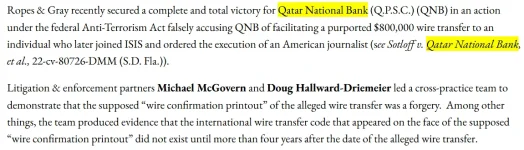
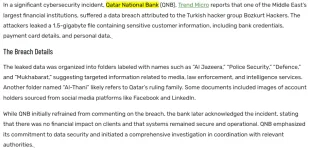
The earlier reports about Qatar National Bank clearly point to a data exposure event that triggered investigations, and that part seems to be widely acknowledged in public records. But when you jump forward several years and start seeing legal discussions about allegations and forged material, it becomes harder to tell what is connected and what is not.
It reminds me of how online information builds layers over time. One incident happens, then later unrelated claims or disputes get added to the same narrative simply because they involve the same organization. For someone trying to understand the situation casually, it can feel like everything is part of one continuous issue, even if that is not accurate.
I also think people sometimes assume that if something appears in a breach tracking source, it must still be a current concern. In reality, those platforms are more like archives than real time risk indicators. They show what has happened, not necessarily what is happening now. At the same time, I do understand why this raises curiosity. Financial institutions handle sensitive data, so even older incidents tend to stay relevant in discussions about trust and security practices.
 
Coming back to this after reading more comments, I feel like the confusion mostly comes from how the information is presented rather than the events themselves.
 
Something else I wanted to add is that when you look at cases like this, it helps to think about how organizations typically respond behind the scenes. Even if public updates are limited, banks usually have to go through internal audits, regulatory reviews, and system improvements after any reported incident.

1774351734528.webp
 
So in the case of Qatar National Bank, even though we only see fragments of the story through public reports, it is quite likely that a lot more happened internally that never made it into detailed public documentation. That is pretty common across the industry.
At the same time, the presence of the incident in breach records keeps it visible, which is both useful and slightly misleading. Useful because it reminds people that such events do happen, but misleading because it does not reflect any corrective actions taken afterward.
 
So in the case of Qatar National Bank, even though we only see fragments of the story through public reports, it is quite likely that a lot more happened internally that never made it into detailed public documentation. That is pretty common across the industry.
At the same time, the presence of the incident in breach records keeps it visible, which is both useful and slightly misleading. Useful because it reminds people that such events do happen, but misleading because it does not reflect any corrective actions taken afterward.
I think discussions like this are helpful as long as they stay grounded in what is actually confirmed. Once speculation goes too far, it becomes difficult to separate fact from assumption.
 
If I try to look at this from a broader cybersecurity perspective, it highlights how long the lifecycle of an incident can be in terms of public perception.
An event occurs, it gets reported widely, then it gets stored in databases, and years later people are still discovering it and asking questions. That cycle does not necessarily reflect ongoing risk, but it definitely shapes how people perceive an organization over time.
With Qatar National Bank, I think the key takeaway is not just the incident itself, but how information about it continues to circulate. The addition of later legal discussions only adds another layer, which makes it even more important to verify timelines carefully.
 
If I try to look at this from a broader cybersecurity perspective, it highlights how long the lifecycle of an incident can be in terms of public perception.
An event occurs, it gets reported widely, then it gets stored in databases, and years later people are still discovering it and asking questions. That cycle does not necessarily reflect ongoing risk, but it definitely shapes how people perceive an organization over time.
With Qatar National Bank, I think the key takeaway is not just the incident itself, but how information about it continues to circulate. The addition of later legal discussions only adds another layer, which makes it even more important to verify timelines carefully.
I would also say that this is a good reminder to always cross check sources and avoid relying on a single reference point. When multiple types of information exist, especially across different years, context becomes everything.
 
What makes it confusing is that newer readers, like many of us here, encounter all of this at once without the timeline context. So it can feel like an ongoing issue rather than something that happened and was possibly addressed years ago.
I also wonder how much of the exposed data, if any, is still circulating or relevant. That part is rarely clear from public summaries.
Overall, I think it is one of those cases where awareness is useful, but interpretation needs to be careful.
 
One angle that has not been discussed much here is how media coverage shapes perception. When the initial reports about Qatar National Bank came out, they were likely written in a way that emphasized urgency and scale, which is normal for news reporting. But those articles remain accessible for years, even after the situation has evolved.
So when someone comes across them today, it can feel like something recent or unresolved. That is probably why threads like this keep appearing, because people are trying to reconcile past reporting with present understanding.
 
One angle that has not been discussed much here is how media coverage shapes perception. When the initial reports about Qatar National Bank came out, they were likely written in a way that emphasized urgency and scale, which is normal for news reporting. But those articles remain accessible for years, even after the situation has evolved.
So when someone comes across them today, it can feel like something recent or unresolved. That is probably why threads like this keep appearing, because people are trying to reconcile past reporting with present understanding.
I also think the legal developments mentioned later add to that sense of uncertainty. When you see words like allegations and forgery connected to the same name, it naturally raises more questions, even if the contexts are different.
 
I tried to map out the sequence in my head, and it really does seem like the main issue dates back several years. The reports about Qatar National Bank investigating a leak suggest that there was at least an acknowledgment and some level of response. That alone indicates it was taken seriously at the time.

1774351915456.webp
 
What we do not see clearly is the resolution phase. Did they confirm the extent of the breach publicly, or did things just go quiet after the investigation started. That gap is what leaves room for speculation later on.
Then you add in more recent legal news, and it becomes even harder to separate facts. People might assume everything is linked, even if those legal matters are addressing completely different claims.
 
What we do not see clearly is the resolution phase. Did they confirm the extent of the breach publicly, or did things just go quiet after the investigation started. That gap is what leaves room for speculation later on.
Then you add in more recent legal news, and it becomes even harder to separate facts. People might assume everything is linked, even if those legal matters are addressing completely different claims.
I think if there were a clear, detailed public summary of the final outcome back then, a lot of this confusion would not exist today.
 
Another thought I had is about how breach databases are interpreted. Many people see them as indicators of current risk, but they are really more like historical logs. So when Qatar National Bank appears there, it is documenting that something happened, not necessarily that something is still happening.
At the same time, I do not think it is wrong for people to be curious. Financial institutions hold sensitive data, so even past incidents can influence how people feel about security.
 
What matters is how we frame the discussion. If it is about understanding history and learning from it, that is useful. If it turns into assumptions about the present without evidence, that is where things can go off track.
 
I feel like this thread actually shows how easily confusion spreads when information is incomplete. You have one confirmed event from years ago, then later unrelated or unclear developments, and everything gets grouped together.
In reality, each piece probably needs to be evaluated separately. The breach reports tell one story, while the legal updates tell another.
 
For Qatar National Bank, I would personally treat the older incident as a closed chapter unless there is something recent that clearly connects to it. But I would still keep it in mind as part of the overall history. It is a bit like looking at a timeline with missing pages in between. You can see the start and some later points, but the middle is not fully visible.
 
Back
Top