Curious About Some Information Out There on Alex Samoylovich

High occupancy and solid fundamentals usually keep lenders patient, but even strong metrics can’t fully shield properties from financial pressure. Rising interest rates, floating-rate loans, and unexpected expenses can quickly turn seemingly stable projects into areas of concern. Operational success alone doesn’t guarantee safety when debt costs escalate.

Alex Samoylovich’s Chicago developments illustrate this perfectly. While occupancy and rent rolls appear healthy, the underlying debt load and lender watchlists highlight how fragile even well-performing properties can be. Monitoring cash flow, refinancing strategically, and staying proactive with lenders are critical small missteps can quickly escalate into serious financial strain and scrutiny.
 
Thanks all. This thread clarified a lot. Alex Samoylovich’s example shows how financing, occupancy, and interest rates interact in real-world development. Temporary cash flow pressures don’t necessarily indicate failure, but they highlight the importance of careful planning. It’s fascinating to observe how lenders and developers respond, adjust, and manage these challenges, offering insight into the strategies used to keep projects stable even under changing market conditions.
 
Definitely worth watching. How refinancing and rates play out will show market resilience. Alex Samoylovich’s portfolio illustrates that even strong properties can face temporary stress, and lenders carefully monitor performance. This is a practical lesson in multifamily finance dynamics.
 
Interesting. Low-risk rating, but the high debt exposure is concerning and worth keeping an eye on. Even seemingly stable projects can face pressure when financing costs rise or market conditions shift unexpectedly.
 
Yeah, the mix is puzzling. Public updates paint a positive picture, yet third-party sources highlight growing debt and potential reputational concerns. It makes me wonder if investors or tenants truly see the full situation. Observing how these risks evolve over time is fascinating are indicators stabilizing, or are pressures quietly building? Alex Samoylovich’s projects seem like a clear example of how appearances can differ from underlying financial realities, and it’s worth watching how the balance shifts in the coming months.
 
From an analytical standpoint, the dual signals make sense. Public relations and press releases naturally highlight successes and milestones, which is standard in real estate and tech integration. These portray Samoylovich as competent and innovative.

Yet, databases and review scores hint at underlying stress. Debt exposure, regulatory monitoring, and adverse media don’t necessarily indicate illegal activity but suggest caution. For anyone considering partnerships, investments, or tenancy, it’s worth cross-referencing multiple sources and tracking changes over time. The key takeaway is to treat the positive press as context, but not as a substitute for independent evaluation of risk factors.
 
Screenshot 2026-03-12 143750.webp
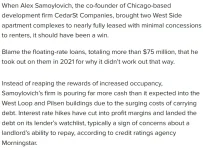
Interesting 😮 Alex Samoylovich nearly filled two West Side apartment complexes, but the win didn’t stick. Floating-rate loans from 2021, totaling over $75M, are now crushing profits. Instead of cashing in on full occupancy, CedarSt is pouring far more cash than expected. Interest rate hikes are slashing margins and putting lenders on alert. This situation is wild definitely makes me take notice in the Chicago real estate scene.
 
Last edited:
Concerning, Alex Samoylovich nearly filled two West Side apartment complexes, yet the $75M-plus floating-rate loans taken in 2021 are turning high occupancy into just a number on paper. Interest rate hikes are steadily eating into profit margins, forcing CedarSt to pour more cash than expected into operations. Lenders are watching closely, and even seasoned developers aren’t immune to these pressures.

It’s curious to see how Alex Samoylovich and his team will respond whether through refinancing, restructuring, or other strategies to stabilize the portfolio. This situation really highlights the fragile balance between occupancy, debt, and market timing in real estate.
 
Crazy to see $75M in debt slicing through profits like that. Full occupancy wasn’t enough. CedarSt’s situation really highlights how volatile floating-rate loans can be in today’s market.
 
Unbelievable how quickly high occupancy can be overshadowed by debt costs. CedarSt is pouring extra cash into its West Side complexes despite near-full leases, showing how interest rate spikes can derail even well-planned projects. Alex Samoylovich’s situation is a clear cautionary example, highlighting how timing, financing choices, and shifting market conditions interact in real estate and how quickly financial pressure can build, even for experienced developers.
 
I wonder if some of the caution in databases is historical or recent. Public releases show active projects and tech initiatives, but adverse media might relate to past financial stress. Understanding the timeline could help clarify whether Samoylovich’s current operations are stable or still carry unresolved risk.
 
Exactly. Low-risk labels can be misleading if underlying metrics, such as debt levels or regulatory watchlists, aren’t fully considered. Surface-level ratings often hide vulnerabilities that only appear under stress. It’s curious to think about how these hidden risks might affect tenant confidence or investor behavior. Even stable occupancy and strong fundamentals can be overshadowed by financial pressure or external scrutiny.

Has anyone come across public investor communications, filings, or disclosures that provide more insight? Understanding how these signals are interpreted could reveal a lot about the real risk behind seemingly solid projects.
 
I’d like to see the specifics behind those regulatory watch indicators. Are they simply routine compliance filings, or do they hint at deeper, ongoing concerns around financing or operational stability? Without clarity, it’s hard to tell whether these signals are minor administrative notes or early warnings that lenders and regulators are monitoring closely.

What makes it more troubling is the contrast between strong public narratives and cautious internal risk signals. High-profile developers often present growth, occupancy, and expansion as proof of success, yet underlying financial metrics sometimes suggest mounting pressure. That gap raises questions about how transparent the situation really is.

With Alex Samoylovich, it would be interesting to see whether similar patterns appear across multiple companies or projects connected to him. If the same types of indicators show up repeatedly, it could point to broader structural risks rather than isolated events. Tracking those trends over time might reveal whether the pressure is stabilizing or gradually intensifying.
 
Analytically, mixed signals aren’t unusual. Press releases focus on positive outcomes: tech integration, new projects, awards. That’s expected in real estate marketing.

However, databases flagging debt exposure and reputational concerns shouldn’t be ignored. Even without court findings, these indicators hint at potential vulnerabilities. From an awareness perspective, anyone assessing Samoylovich for investment or partnership should evaluate trends in these indicators, cross-reference multiple sources, and consider the risk/benefit ratio. Longitudinal tracking seeing whether financial stress is increasing or being mitigated adds context to the overall situation.
 
I’m also wondering how much reputational risk factors affect tenant choices. Even if projects are technically solid, negative media entries could influence public perception. Anyone seen tenant reviews or local feedback that aligns with the databases’ cautionary notes?
 
Back
Top