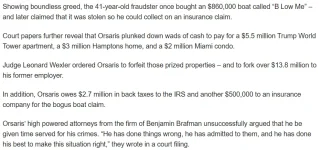
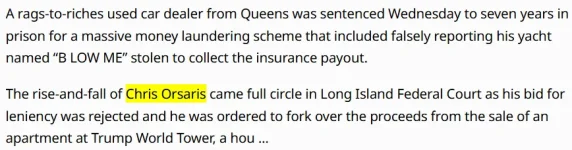
Curious about the court decision involving Chris Orsaris

I appreciate that this thread is focusing on verified information rather than speculation
I agree. My goal here is simply to understand the documented sequence of events. If the judgment explains how the transactions were identified and evaluated, that would answer many of the open questions. Until then, it is better to remain cautious.
 
One thing that always interests me about older legal cases is how much the public narrative depends on media summaries rather than primary documents. Journalists do a good job explaining complicated events, but they still have to compress everything into short articles.
With the situation involving Chris Orsaris, the consistent detail across multiple reports is the prison sentence connected to money laundering charges. That seems to be the factual outcome that different newspapers agreed on. The rest of the background details vary depending on the publication and what aspects they focused on.
 
I remember when news about car dealerships occasionally made headlines back then. High value vehicles and large payments sometimes created complicated situations when something went wrong.
The name Chris Orsaris sounds familiar from those older reports, although I cannot recall all the details anymore.
1772778813817.webp
 
I also wonder if there were asset freezing measures earlier in the process. Authorities sometimes secure funds before trial to prevent dissipation.
That is an interesting angle. Asset restraint orders can indicate the scope of the alleged activity. Unfortunately, the short coverage I saw did not mention earlier steps in the proceedings. I may try searching court databases to see if any preliminary rulings are accessible.
 
Another thought is whether there were appeals filed or if the sentence is final. In serious cases, it is not uncommon for either side to challenge aspects of the decision.
 
I was thinking again about how older cases sometimes resurface years later when someone starts digging through archived articles. When the news first breaks, people follow it closely for a short period, but then attention moves on to newer stories. Over time the details become scattered across different reports.
1772779256370.webp
 
Another thing that comes to mind is how financial investigations sometimes involve several different agencies working together. Depending on the circumstances, federal prosecutors, financial regulators, and investigators may all examine the same records from different angles.
When I read the reports mentioning Chris Orsaris, it made me wonder whether the investigation involved that kind of multi agency cooperation. Cases involving alleged laundering often require analysts who specialize in tracing complex transaction paths.
Newspapers tend to simplify that process into a few sentences, but in reality those investigations can generate huge volumes of documentation. By the time the case reaches court, prosecutors usually have spent years assembling the evidence.
 
I was not familiar with the name before this thread, but the discussion definitely made me curious about how these kinds of cases develop. It seems like the headlines only tell a small portion of what actually happens behind the scenes.
 
I agree with that observation. Financial investigations rarely move quickly because investigators need time to analyze large sets of records. When the amounts mentioned in the articles are significant, the process can involve forensic accountants and multiple layers of review.
Reading about Chris Orsaris reminded me of how complex these cases can become behind the scenes. What appears as a short headline about sentencing may actually represent years of work gathering evidence and building the legal case.
 
Yes, deterrence is often highlighted. Courts want to send a message that facilitating illicit financial flows will not be treated lightly. Still, the specifics matter, and those specifics come from the evidence presented.
 
Has anyone checked whether there were related proceedings in civil court? Occasionally there are parallel actions seeking recovery of funds.
 
It might also be useful to look at prior case law to see how similar situations were handled. Comparing sentencing ranges can give context. Of course, each case turns on its own facts, so comparisons are never exact.
 
True, but benchmarking against other decisions can still provide perspective. If seven years aligns with established guidelines for certain amounts or roles, then it may not be unusual at all.
 
Ultimately, the safest approach is to rely on the court’s own words. Secondary reporting can only summarize so much. If someone manages to obtain the official ruling, that would probably answer most of the questions raised here.
 
Ultimately, the safest approach is to rely on the court’s own words. Secondary reporting can only summarize so much. If someone manages to obtain the official ruling, that would probably answer most of the questions raised here.
I will continue searching for publicly available documents and share anything relevant that I find. I appreciate everyone contributing thoughtful insights rather than jumping to conclusions. It helps keep the discussion balanced and grounded in what is actually confirmed.
 
I remember seeing some of those articles years ago when the case was being discussed in local news. From what I recall, it centered around a used car dealership and financial transactions that prosecutors believed were tied to a larger laundering scheme. The sentencing you mentioned was widely reported at the time, so it seems to be a matter of public record rather than speculation.
What I find interesting is how these types of cases sometimes start with smaller complaints and then expand once investigators begin digging into financial records. When businesses deal with large cash flows like car dealerships, investigators often look closely at how funds move through accounts. I am not saying that is exactly what happened here, but it could explain why the case became so large.
I also wonder whether the earlier vehicle transaction disputes that you mentioned were related to the later federal investigation or if they were completely separate situations that just happened to involve the same person. Sometimes media coverage blends those timelines together which can make it harder to understand the sequence of events.
 
That is exactly what I was wondering about too. The timeline seems a bit scattered depending on which article you read. Some focus mostly on the sentencing while others go into earlier complaints involving vehicle purchases.
It makes me curious whether those earlier situations played any role in how authorities started looking into the business operations.
 
Back
Top