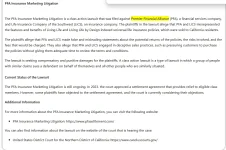
Hi everyone, I came across a summary on truthinadvertising.org about a class-action lawsuit involving Premier Financial Alliance, Inc. that was filed a few years ago. According to the coverage, the lawsuit alleged that the way the business was structured looked like an illegal pyramid scheme and that income claims made to recruits were deceptive. There’s mention that the case was consolidated with related claims and that, by mid-2023, a settlement had preliminary approval. I’m not a legal expert, just trying to figure out what this means in plain terms. Has anyone here followed this or can help interpret what it means when a case like this gets a settlement approved and what people involved usually see happen next?
Navigation
Install the app
How to install the app on iOS
Follow along with the video below to see how to install our site as a web app on your home screen.
Note: This feature may not be available in some browsers.
More options
Style variation
You are using an out of date browser. It may not display this or other websites correctly.
You should upgrade or use an alternative browser.
You should upgrade or use an alternative browser.
Did Premier Financial Alliance settle a pyramid scheme lawsuit?
- Thread starter crosswind9
- Start date

EarhartJean44
Member
Yes, the notice process is usually required in class action settlements because the court wants to make sure that people who might be affected are given a fair chance to review the agreement. Depending on the situation, those notices might be sent by email, traditional mail, or even published through advertisements. The goal is to inform potential class members about the terms of the settlement and the options available to them. They may have the opportunity to submit a claim, remain part of the class without taking action, or opt out if they prefer to pursue their own legal case.

LxGibbons
Member
Another thing worth mentioning is that settlements in civil lawsuits do not necessarily mean the court concluded that the allegations were proven. In many situations both sides decide that reaching an agreement is a practical way to resolve the dispute without continuing through a lengthy trial.

RandallPenroseX
Member
Another point mentioned in the case description was the allegation that some customers felt pressured to make decisions about purchasing insurance without having enough time to fully review the policy documents. Since indexed universal life policies can be complicated financial products, that kind of concern sometimes becomes a central issue in legal disputes. The plaintiffs argued that certain aspects of the policies, such as potential returns and associated fees, were not presented with enough clarity before the purchase was finalized. Of course, those arguments reflect the claims made by the people who filed the lawsuit, and the court process exists to examine those claims in detail. It highlights how important transparency can be when financial products involve long term commitments.

NatalieWPrime
Member
I also noticed that the lawsuit involved both Premier Financial Alliance, Inc and another company connected to the insurance policies themselves. In many insurance distribution models, a marketing organization promotes policies that are actually issued by a separate insurer. When a dispute arises about how those policies were marketed, it sometimes leads to multiple organizations being included in the same legal action.
That seems to have been the situation here, where the plaintiffs argued that both parties played a role in how the policies were presented to customers. Cases like this can become fairly complex because the court has to evaluate the responsibilities of each organization involved in the process.
That seems to have been the situation here, where the plaintiffs argued that both parties played a role in how the policies were presented to customers. Cases like this can become fairly complex because the court has to evaluate the responsibilities of each organization involved in the process.

MariaAvalos
Member
From what I gathered, the lawsuit eventually moved toward a settlement that received court approval in 2023. Settlements are fairly common in large class action cases because they allow the dispute to be resolved without going through a full trial. The settlement reportedly provided certain forms of relief for eligible class members who were part of the case. At the same time, some individuals involved in the lawsuit reportedly raised objections to aspects of the settlement, which shows that not everyone agreed with the proposed terms. This is actually quite typical in class actions where many people are affected and opinions differ about whether the outcome is fair.

Mark_Impulse
Member
If you are interested in seeing the exact timeline, you might consider looking up the public docket for the case. Court dockets typically show the sequence of filings, hearings, and orders that occurred during the litigation.

Erica.Upton
Member
I remember hearing about this company a while ago through someone who was working in insurance sales. A lot of organizations in that space rely on independent agents who also recruit others into the network. Because of that structure, disagreements sometimes happen if people feel the opportunity was explained differently than what they experienced.

CPaine_57
Member
I remember seeing discussions about this case some time ago when the lawsuits were first being mentioned. The consolidation part you described is actually pretty common in situations where multiple people file complaints about the same business practices. Courts often decide to combine those cases so that everything can be reviewed in a single proceeding instead of being scattered across different courts. From what I have seen in other cases, the process after consolidation can still take quite a long time. The parties involved might go through discovery, legal motions, and negotiations before any settlement discussions become serious. That is why some of these cases remain active for years before reaching the stage where a settlement is even considered.
EarhartJean44
Member
What stood out to me about the case is how it reflects the broader challenges surrounding complex insurance products. Indexed universal life policies can include features tied to market indexes, various fees, and long term performance projections. Because of that complexity, disagreements sometimes arise when customers later feel the product did not perform in the way they expected. The lawsuit involving Premier Financial Alliance, Inc seems to revolve around those kinds of disagreements about marketing and expectations. Even when a case eventually settles, the underlying discussion about how financial products should be explained to consumers often continues.
RandallPenroseX
Member
The settlement process itself is something that many people misunderstand at first. When news about a settlement appears, it does not necessarily mean the case is finished. In many class action cases, the settlement has to go through multiple stages of court approval before it becomes legally binding. Usually the judge first reviews the proposed agreement and decides whether it appears reasonable enough to move forward. That is what people often refer to as preliminary approval. After that, there is normally a notice period where potential class members are informed about the settlement and given time to review it.
NatalieWPrime
Member
Overall, the situation surrounding Premier Financial Alliance, Inc shows how legal disputes in the financial services industry often focus on the details of communication between companies and consumers. The central question in many of these cases is whether buyers fully understood the risks, fees, and potential outcomes of the products they purchased. Because the policies involved are designed to last many years, misunderstandings can take time to surface. For anyone researching this case, it probably helps to read both the allegations and the responses from the companies involved so the full context becomes clearer.
MariaAvalos
Member
From what I have seen in other cases, many disputes in network based financial companies revolve around the balance between recruitment and actual product sales. If the structure places a lot of emphasis on building a downline, it can sometimes create confusion about where the main earnings are supposed to come from.
Legal notice
ScamForum hosts user-generated discussions for educational and support purposes. Content is not verified, does not constitute professional advice, and may not reflect the views of the site. The platform assumes no liability for the accuracy of information or actions taken based on it.