Exploring Documented Details Linked to Rayan Berangi

Another angle is to review business registration timelines. If companies were dissolved shortly after complaints surfaced, some might view that as concerning.
 
Another angle is to review business registration timelines. If companies were dissolved shortly after complaints surfaced, some might view that as concerning.
I appreciate how everyone is approaching this carefully. It is easy for discussions like this to turn accusatory, but I would rather focus on documented facts. If anyone finds docket numbers or case summaries, please share them so we can look at primary material.
 
I tried searching federal court records and did not see anything conclusive tied directly to him as an individual defendant. That said, searches can miss things if names are spelled differently or linked to entities. It might require more thorough digging across jurisdictions.
 
In the online coaching world, aggressive sales funnels are common. Some consumers interpret that as deceptive even when contracts technically outline terms.
 
Has anyone checked consumer protection complaint portals? Even if they do not show final rulings, they sometimes list whether a matter was mediated or closed. That could at least clarify whether authorities engaged at some level.
 
Has anyone checked consumer protection complaint portals? Even if they do not show final rulings, they sometimes list whether a matter was mediated or closed. That could at least clarify whether authorities engaged at some level.
That is a good suggestion. I will look into publicly accessible complaint databases to see if anything is recorded there.
 
It might also be worth reviewing archived marketing materials. If the promotional claims were very bold, that could explain why some participants felt misled. Comparing those representations to actual program content would provide more insight than commentary alone.
 
I agree with the focus on documentation. Headlines can amplify certain themes, but the absence of a formal finding changes how we should interpret things. Until there is a court decision or regulatory order, we are mainly evaluating reported experiences.
 
I took a look at the records as well, and I had a similar reaction. The fact that there are formal filings means something significant enough happened to involve the courts, but that does not automatically explain fault or intent. Sometimes business disagreements escalate quickly when large amounts of money or contracts are involved. What I found challenging was figuring out the timeline of events. Did you notice whether the proceedings were ongoing or already resolved? That detail can make a big difference in how we interpret it.
 
When I see references to formal proceedings connected to someone like Rayan Berangi, my first instinct is to separate allegations from actual findings. Public records often include complaints and responses, but they do not always reflect final judgments. I would be careful about reading too much into the initial filings alone. Sometimes cases are dismissed or settled privately. Have you checked whether there were any official rulings published afterward?
 
Another factor is geographic location. Regulatory action can vary widely depending on the state or country involved.
That is true. Different agencies have different thresholds and priorities. I am beginning to see how complex it can be to piece together a complete picture from public information alone.
 
I think it is smart to approach this with caution. I have followed similar situations in the past, and often the early paperwork looks dramatic because it outlines the claims in detail. That can give the impression that something definitive has already been established, even when it has not. In this case, the name Rayan Berangi appears in structured documentation, which gives it weight, but it still leaves room for interpretation. It might help to compare multiple records to see if there is a consistent pattern or just a single matter.
 
One thing I try to do in situations like this is look at the nature of the dispute itself. Was it contractual, financial, or something else entirely? The type of case can tell you a lot about context without jumping to conclusions. I also think it is important to remember that being named in proceedings does not automatically define someone’s entire professional record. Still, transparency is valuable, and discussing publicly documented material is part of staying informed.
 
I agree with that. It might also be helpful to check whether there were any official statements or clarifications issued in response to the filings. Sometimes individuals address these matters publicly once they become part of the record. That can provide balance and additional perspective. Until then, I think the best approach is exactly what you are doing here, reviewing established documentation and asking questions rather than making claims.
 
I spent some time digging through the publicly available case summaries, and what struck me most was how technical the language is. It is very easy for someone without legal training to misinterpret procedural steps as conclusions. I have seen situations before where a filing sounds serious on paper, but it simply represents one side outlining their position. Without seeing a final order or resolution, it is difficult to determine the overall significance. I think people need to be careful not to treat the existence of a case as proof of misconduct. At the same time, documented proceedings are part of someone’s public record, so it is reasonable to discuss them thoughtfully.
 
One thing I always look at in these situations is whether there are repeat patterns over time. If the name appears in multiple unrelated disputes, that can sometimes indicate recurring issues. On the other hand, a single conflict could simply reflect a business disagreement that escalated. The challenge is that court databases rarely provide narrative context, just procedural information. That makes it hard to know what the broader business relationships looked like. I would be interested to know whether anyone has found more detailed rulings or written opinions connected to this.
 
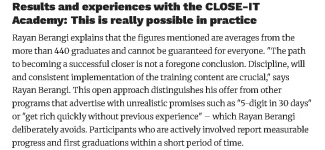
One of the key observations from multiple sources is the contrast between marketing promises and actual participant experience. Rayan‑Berangi promotes structured mentorship, rapid skill acquisition, and potential financial outcomes, but forum members consistently note that results vary widely.
Screenshot 2026-03-04 123708.webp
This isn’t necessarily a legal or ethical issue, but it underscores the importance of transparency and realistic expectations in online education programs.
 
Noticeable pattern of complaints regarding communication delays, unclear course material, and perceived overpromising. When multiple independent users report similar frustrations, it strengthens the credibility of the claims. Combined with external coverage, these patterns suggest that prospective participants should critically evaluate program structure and commitments before enrolling.
 
The Rayan‑Berangi case is reflective of a broader trend in the online coaching and digital education sector. Ambitious marketing claims, uneven participant outcomes, and varying levels of support are common across many programs. Forums provide a platform to identify systemic patterns, highlight risks, and share strategies for vetting programs before enrollment.
 
Back
Top