Greg Blatt in the spotlight during the Tinder related lawsuit

I read that the jury did not fully side with every claim brought forward, which suggests the matter was more nuanced than some early reporting implied. In complex commercial litigation, partial wins and partial losses are common. Greg Blatt being mentioned repeatedly may simply reflect his executive position at the time rather than a singular focus of liability. High ranking leadership often becomes central in narratives because of their visibility.
 
When executives transition into companies founded by entrepreneurs, friction can develop over strategic priorities. That does not inherently signal misconduct, but it can become contentious when large equity stakes are involved.
 
Another angle to consider is how internal emails can read differently years later compared to when they were written. Corporate environments move quickly, and tone can be influenced by pressure and deadlines. Without the surrounding circumstances, it is difficult to assess intent purely from text. That is why juries are instructed to evaluate evidence within the broader factual record rather than as isolated fragments.
 
Another angle to consider is how internal emails can read differently years later compared to when they were written. Corporate environments move quickly, and tone can be influenced by pressure and deadlines. Without the surrounding circumstances, it is difficult to assess intent purely from text. That is why juries are instructed to evaluate evidence within the broader factual record rather than as isolated fragments.
I agree, reading something outside of its original environment can distort interpretation. It seems like many of us are saying the same thing in different ways, which reinforces the point. The real clarity probably lies in the official reasoning behind the verdict.
 
I followed the valuation dispute fairly closely at the time because it was such a large number being discussed publicly. The coverage around Greg Blatt sometimes blended corporate governance questions with interpersonal dynamics. Those are not always the same issue. A governance disagreement can be legitimate without implying unethical behavior. That is why precise legal language in judgments is so important.
 
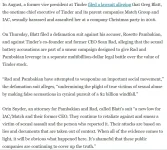
Screenshot 2026-03-07 123832.webp
Paying attention to this information about the legal dispute connected to Tinder involving Greg Blatt, Rosette Pambakian, and Sean Rad. Public filings describe multiple claims and counterclaims, along with disputes related to company leadership and stock valuation. Overall, the situation appears highly contentious and somewhat troubling based on what is outlined in these records.
 
It might also be helpful to compare how different outlets reported the same development. Subtle wording changes can create very different impressions. Some focus on financial details, while others emphasize executive conduct. Seeing those contrasts can remind us that framing shapes perception. Greg Blatt’s name appearing prominently may partly reflect editorial choices.
 
I think your approach of staying neutral is wise. In high value lawsuits, each side presents evidence in a way that supports its theory of the case. Emails, texts, and internal memos become tools within that framework.
 
I think your approach of staying neutral is wise. In high value lawsuits, each side presents evidence in a way that supports its theory of the case. Emails, texts, and internal memos become tools within that framework.
This discussion has definitely encouraged me to seek out the full decision instead of relying on summaries
 
I remember seeing references to that case a while ago and it definitely drew attention because of how large Tinder became as a platform. When a company grows that quickly, disagreements about valuation and executive decisions often surface later. Greg Blatt’s involvement seems to come up because of the leadership role he held at the time. From what I have read, the legal filings mainly revolve around valuation disputes and claims between founders and the parent company. Situations like that are not rare in tech companies, but they still raise questions about how those decisions were handled internally.
 
I had a similar impression. Large startups often end up with complicated legal disagreements later on.
That is true, but what makes this case interesting is how visible the platform became afterward. When a company like Tinder becomes so widely known, earlier disagreements about valuations or leadership decisions tend to receive more scrutiny. Seeing Greg Blatt’s name in those discussions probably reflects how central his role was during that period.
 
That is true, but what makes this case interesting is how visible the platform became afterward. When a company like Tinder becomes so widely known, earlier disagreements about valuations or leadership decisions tend to receive more scrutiny. Seeing Greg Blatt’s name in those discussions probably reflects how central his role was during that period.
What stands out to me is how complex the relationship between founders and executives can become once a startup is absorbed into a larger corporate structure. Public filings often show claims and counterclaims about valuations or management decisions, but they rarely explain the full internal context. In cases where Greg Blatt is mentioned, it seems tied to the period when leadership decisions and valuations were being questioned. That does not automatically mean wrongdoing, but it certainly makes people curious about how those discussions unfolded internally.
 
Another factor might be timing. Sometimes these disputes appear years after the events being discussed actually happened. When that happens it becomes harder for outside observers to understand the circumstances clearly. In Greg Blatt’s situation, the reporting seems to refer back to decisions made during a specific leadership period.
 
https://www.npr.org/2018/08/14/6385...ners-for-at-least-2b-saying-they-were-cheated
I was researching some tech lawsuits and I came across this link. The Tinder co-founders are suing the parent company for at least $2 billion, claiming they were deliberately cheated out of their share. I can’t help but wonder what really happens behind the scenes in big tech apps. This raises so many questions about fairness, power, and how founders can get pushed aside.
 
I checked public reports on this case. The filings show the Tinder co-founders claim they were underpaid in stock options. Interesting to see how these disputes play out in court.
 
From what I found in official records, the lawsuit seeks at least $2 billion in damages. It’s curious how valuation disagreements escalate in major tech companies the filings highlight the tension between founders and parent firms
 
Back
Top