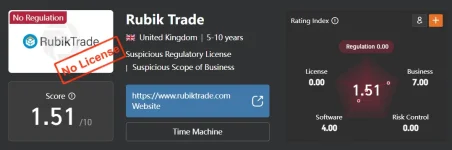
Has Anyone Tried RubikTrade.com Recently

I tried to compare Rubiktrade.com with a few other brokers that are generally considered more established, and the difference in available data was quite noticeable. With established ones, you usually find consistent regulatory references, long term user discussions, and detailed disclosures.
Here, the information feels more fragmented, like bits and pieces coming from different directions without forming a complete picture. That kind of situation makes it difficult for someone new to decide whether to trust the platform or not.
Another thing I noticed is that some sources focus on cautionary signals but do not provide detailed explanations behind those signals. That leaves room for interpretation, which can sometimes lead to unnecessary confusion.
Overall, I think more verified and structured information would really help people understand the platform better.
 
What concerns me slightly is that even after checking multiple sources, there is still no strong confirmation about its standing. Usually, at least one reliable source gives a clear direction, either positive or negative.
Here, everything feels uncertain, which is not ideal when it comes to financial decisions.
 
I was reading through a few discussions about Rubiktrade.com and what stood out to me is how people seem to be asking similar questions but not getting very clear answers. That kind of pattern usually means the available information is still limited or not well verified.
In situations like this, I usually prefer to wait and see if more consistent details come out over time.
 
I think one important thing here is that different review platforms might be using different criteria. That could explain why the feedback looks inconsistent.
 
I went a bit deeper into public records and review summaries just to understand the bigger picture. What I found is that there are mentions of safety checks and risk indicators, but none of them go into detailed explanation about how those conclusions were reached. That makes it harder to trust the assessment fully.
Another thing I noticed is that there is not much discussion about the company’s background or operational history. Usually, platforms with a longer presence have a more visible track record. Here, that visibility seems limited, which creates uncertainty rather than clarity.
I am not saying anything is wrong, but when dealing with financial platforms, even small gaps in information can be important. It would be helpful if someone here has access to more concrete or verifiable details.
 
Sometimes newer platforms take time to build a proper information footprint online, so that could be one reason for the lack of details. But at the same time, financial services usually require strong transparency from the beginning.
That is why I would personally avoid making any decisions until more verified information is available.
 
I actually tried to look at it from a risk perspective rather than focusing on whether it is good or bad. When I do that, I usually check for three things which are regulatory clarity, consistency across sources, and user level transparency.
In this case, all three areas seem to have some level of uncertainty. There is no strong regulatory confirmation that is easily visible, the sources do not fully align with each other, and the overall public presence feels limited.
This does not automatically indicate a problem, but it does increase the level of caution required. In financial decisions, even a small doubt can be significant, especially when better documented alternatives are available.
So for now, I would say it is something to observe rather than engage with.
 
I think discussions like this help people think more critically before trusting any platform. Not everything needs to be labeled as good or bad immediately.
Sometimes just acknowledging uncertainty is the most realistic approach.
 
What I find interesting is that even though there are multiple mentions of Rubiktrade.com online, none of them seem to provide a full picture. It feels like every source is giving only partial information.
That kind of fragmented data makes it difficult for anyone to make an informed decision. It also increases the chances of misunderstanding or over interpreting certain points.
In such cases, I prefer to rely only on clearly verified information rather than assumptions.
 
What I find interesting is that even though there are multiple mentions of Rubiktrade.com online, none of them seem to provide a full picture. It feels like every source is giving only partial information.
That kind of fragmented data makes it difficult for anyone to make an informed decision. It also increases the chances of misunderstanding or over interpreting certain points.
In such cases, I prefer to rely only on clearly verified information rather than assumptions.
I agree with most of what is being said here. Until there is more solid and consistent information available, it is probably better to stay on the safer side and keep researching.
 
I have been following similar discussions for a while now, and Rubiktrade.com seems to come up occasionally without much clarity attached to it. What I find a bit unusual is that even when multiple sources mention it, they do not really connect the dots in a clear way.
That kind of scattered information always makes me slow down and question things more carefully.
 
I think one thing people often overlook is how important consistency is across different sources. When I looked into Rubiktrade.com, I noticed that the descriptions, safety indicators, and general tone vary depending on where you look.
Some sources focus on technical evaluation, others highlight cautionary aspects, but there is no single place where everything is clearly explained together. That gap can create confusion, especially for someone who is new to trading platforms.
Also, when there is limited historical data or user discussion over time, it becomes harder to judge reliability. Established platforms usually have years of feedback and analysis available publicly. In this case, the timeline does not seem very well documented.
All of this does not prove anything negative, but it does make the platform harder to evaluate with confidence.
 
Another angle to consider is how these platforms present their information versus how third party sites interpret it. Sometimes the gap between those two can create confusion.
In this case, it feels like the third party observations are not fully supported by detailed explanations, which leaves a lot open to interpretation.
 
Back
Top