Has Anyone Tried RubikTrade.com Recently

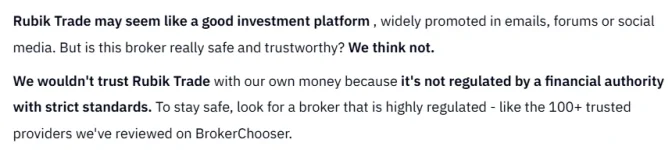
I spent some time comparing Rubiktrade.com with platforms that are more widely recognized, and the difference in transparency was quite noticeable. With more established platforms, you can usually verify things like licensing, company structure, and regulatory affiliations quite easily.
Here, I found that those details are either not clearly presented or require deeper digging, which not everyone is comfortable doing. That alone can act as a barrier for trust.
Another thing that stood out to me is that some evaluation platforms assign risk indicators, but they do not always explain the methodology behind those ratings. Without that context, it becomes difficult to interpret whether the concern is significant or just precautionary.
For me, clarity is key when it comes to financial platforms, and right now that clarity seems to be missing.
 
What I find worth noting is how different people interpret the same information in different ways. Some might see the lack of data as a warning, while others might see it as simply incomplete coverage.
That is why discussions like this are useful, because they bring multiple perspectives together.
At the end of the day, each person has to decide their own level of comfort based on the available information.
 
One thing I always try to do in these situations is look at how easy it is to verify basic details independently. When I tried doing that for Rubiktrade.com, I found that while there are mentions across different sites, they do not always lead to solid, verifiable conclusions.
For example, there are safety ratings and general comments, but not much explanation behind them. That makes it difficult to understand whether those ratings are based on strong evidence or just preliminary analysis.
Also, I could not find much about long term user experiences or consistent feedback trends. Usually, over time, platforms build a certain reputation through repeated discussions, but here that pattern is not very visible yet.
So for me, the main issue is not negative information, but rather the lack of strong, reliable information.
 
I think people sometimes underestimate how important transparency is in financial platforms. Even small gaps in information can lead to bigger questions later.
With Rubiktrade.com, it feels like there are several small gaps rather than one major issue.
 
I took some time to read through different public evaluations and what I found interesting is that most of them stop short of giving a clear conclusion. They point out certain aspects, like safety considerations or general trust indicators, but they do not go all the way in confirming reliability.
That kind of halfway analysis can actually be more confusing than helpful. It leaves users trying to interpret the information on their own without enough context.
Another thing I noticed is that there is not much discussion around how the platform operates in practice, such as user experience or transaction processes. Those real world details are often very useful in understanding a platform better.
Until more detailed and verified information becomes available, I think it is reasonable to stay cautious and keep observing how things develop.
 
What stands out to me is that even though there are multiple mentions of Rubiktrade.com, none of them seem to build on each other to create a complete picture. Each source feels isolated, like it is providing just one piece of a larger puzzle.
That makes it harder for anyone to connect the dots and understand the overall situation. It also increases the chances of misinterpretation, especially if someone relies on only one source.
In cases like this, I usually prefer to wait until more consistent and detailed information becomes available from multiple reliable channels.
 
I have noticed that when a platform keeps coming up in discussions but without any clear conclusion, it usually means people are still trying to verify things properly. Rubiktrade.com feels like one of those cases where awareness is there, but confidence is not.
That gap between awareness and confidence is what makes it tricky.
 
I tried approaching this from a different angle by looking at how information evolves over time. For platforms that are well established, you usually see a progression of data, starting from basic listings to more detailed analysis and user feedback.
With Rubiktrade.com, that progression does not seem very clear yet. Most of the available content feels like early stage evaluation rather than well developed insight. That can sometimes happen with newer or less documented platforms.
Another thing I noticed is that there is very little cross referencing between sources. Each site seems to present its own view without linking to strong external validation. That makes it harder to determine which parts are more reliable.
For me, this kind of situation calls for patience rather than quick judgment.
 
I tried approaching this from a different angle by looking at how information evolves over time. For platforms that are well established, you usually see a progression of data, starting from basic listings to more detailed analysis and user feedback.
With Rubiktrade.com, that progression does not seem very clear yet. Most of the available content feels like early stage evaluation rather than well developed insight. That can sometimes happen with newer or less documented platforms.
Another thing I noticed is that there is very little cross referencing between sources. Each site seems to present its own view without linking to strong external validation. That makes it harder to determine which parts are more reliable.
For me, this kind of situation calls for patience rather than quick judgment.
That is actually a good observation. It does feel like the information is still in an early stage.
 
I think one important factor here is how much effort it takes to verify details. If you have to dig too deep just to confirm basic things, it usually means the platform is not very transparent yet.
That is something I personally consider before trusting any service related to money.
 
I went through several publicly available summaries and what stood out to me is that they all highlight certain concerns or uncertainties, but none of them go into enough depth to fully explain those concerns.
For example, you might see a safety score or a general caution, but without understanding how that score was calculated, it is hard to know how seriously to take it. That lack of context can lead to different interpretations by different people.
I also noticed that there is not much detailed discussion about regulatory alignment or official oversight, which is usually a key factor in evaluating financial platforms. Even if that information exists somewhere, it is not easily accessible or clearly presented.
Because of that, I feel like the current situation is more about incomplete information rather than confirmed issues. Still, incomplete information itself is something to be mindful of.
 
Back
Top