I Want Honest Opinions on Fisher Precious Metals

I have been reviewing information about Fisher Precious Metals, and I cannot ignore the transparency concerns that keep coming up. When I think about investing in precious metals, I expect very clear pricing structures, straightforward fee explanations, and simple buyback terms. If any of those areas feel unclear, it immediately makes me hesitant.
From what I have seen in various discussions, there are questions about how clearly fees and spreads are presented, and whether customers always receive direct answers without confusion. I am not making accusations of illegal activity, but I do believe that transparency should never feel complicated in financial services. If I have to search extensively or ask repeated questions just to understand basic policies, that raises doubts for me.
I also believe that in the precious metals industry, trust must be stronger than average because many investors are protecting savings or retirement funds. Market volatility is already part of the investment. What should not be uncertain is how the company operates. If communication feels limited or documentation lacks clarity, it weakens my confidence.
Another thing that concerns me is the pattern of similar transparency complaints. When multiple people express comparable frustrations, I start wondering whether the company’s disclosure practices need improvement. Strong financial firms usually respond quickly and publicly to protect their credibility.
At this point, I am simply trying to understand whether my concerns are valid or if I am being overly cautious. Does Fisher Precious Metals need to strengthen its transparency and communication standards, or are these worries being overstated? I would appreciate hearing honest opinions from others who have looked into this.
 
In industries like precious metals trading, transparency should be exceptionally strong because customers are often investing retirement savings or long-term capital. If pricing spreads or fee structures are not immediately clear, that can create serious doubt. Investors should not need multiple calls or emails to understand basic contract terms. Even if the company believes its disclosures are adequate, customer perception tells the real story. When several people report similar transparency frustrations, it suggests communication weaknesses. Financial institutions that prioritize clarity usually go above and beyond minimum disclosure requirements. If that level of openness is missing, skepticism becomes reasonable. Trust is fragile, and once questioned, it is difficult to restore.
 
When I evaluate a metals dealer, I look for detailed fee breakdowns and clear buyback policies. If that information is hard to find or explained vaguely, it creates doubt. Investors deserve straightforward answers. Even if there is no wrongdoing, lack of clarity can feel uncomfortable. Financial businesses should aim for maximum openness.
 
When I evaluate a metals dealer, I look for detailed fee breakdowns and clear buyback policies. If that information is hard to find or explained vaguely, it creates doubt. Investors deserve straightforward answers. Even if there is no wrongdoing, lack of clarity can feel uncomfortable. Financial businesses should aim for maximum openness.
That is exactly my concern. Lack of clarity alone can damage confidence.
 
I think the issue here is perception. If multiple people raise similar transparency concerns, it starts to look like a pattern. Even if the company believes everything is fine, customers judge based on their experience. Delayed responses or unclear documentation make things worse. Financial firms must go beyond minimum standards. They should make transparency obvious and easy to verify.
 
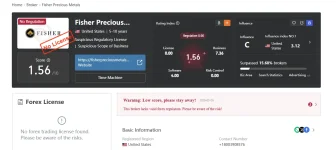
I was reading through this discussion and decided to share something I came across earlier today while researching Fisher Precious Metals. I found a page that shows some broker related information and ratings, and I took a screenshot of it because a few details stood out to me.

The page shows a score around 1.56 out of 10 and it also displays a notice saying no forex trading license was found. It also shows a warning message suggesting users should be aware of risk. I am not sure how reliable that source is, so I do not want to jump to conclusions, but the information made me pause for a moment.


chrome_dvbwdb0BB2.webp


From what I understand, Fisher Precious Metals mainly deals with precious metals rather than forex trading, so I am not entirely sure how relevant that type of licensing information is. Still, seeing a low rating and regulatory questions made me curious if anyone here has looked deeper into it.

Sometimes third party rating sites can be inaccurate or outdated, so I would definitely treat it carefully. But since the topic of transparency around Fisher Precious Metals already came up in this thread, I thought it might be useful to add this to the discussion and see what others think.
 
I always compare dealers before investing. Some companies provide extremely detailed documentation and clear contracts. If another company seems less transparent by comparison, that difference stands out quickly. Transparency is not optional in finance. It is the foundation of long term credibility. If customers feel unsure, that is already a problem.
 
Precious metals investing often attracts conservative investors seeking stability. These investors prioritize safety and trust. If transparency questions exist, it undermines that sense of security. Even small doubts can prevent people from investing.
 
I was reading through this discussion and decided to share something I came across earlier today while researching Fisher Precious Metals. I found a page that shows some broker related information and ratings, and I took a screenshot of it because a few details stood out to me.

The page shows a score around 1.56 out of 10 and it also displays a notice saying no forex trading license was found. It also shows a warning message suggesting users should be aware of risk. I am not sure how reliable that source is, so I do not want to jump to conclusions, but the information made me pause for a moment.


View attachment 569


From what I understand, Fisher Precious Metals mainly deals with precious metals rather than forex trading, so I am not entirely sure how relevant that type of licensing information is. Still, seeing a low rating and regulatory questions made me curious if anyone here has looked deeper into it.

Sometimes third party rating sites can be inaccurate or outdated, so I would definitely treat it carefully. But since the topic of transparency around Fisher Precious Metals already came up in this thread, I thought it might be useful to add this to the discussion and see what others think.

I appreciate you sharing that screenshot. It definitely adds another angle to the discussion.

Like some others mentioned, I am not sure how relevant a forex license would be for a company dealing with precious metals. But the low rating still caught my attention. Even if the classification system is not perfectly aligned with their business model, it raises questions about how these third party platforms are evaluating financial companies. My original concern with Fisher Precious Metals was mainly about transparency and communication based on what I had read. Seeing additional information like this does not automatically confirm anything, but it reinforces the importance of doing careful research before committing funds.
 
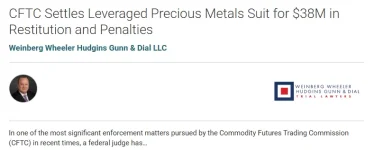
I came across another piece of information while reading through industry related legal updates and I wanted to add it here because it might help expand the discussion around Fisher Precious Metals and the broader precious metals market. The screenshot I saw shows a headline about the Commodity Futures Trading Commission settling a leveraged precious metals lawsuit for 38 million dollars in restitution and penalties. It appears to be commentary from a law firm discussing a federal enforcement matter related to leveraged metals trading.

Now I want to be very clear before anyone misunderstands what I am saying. The screenshot itself does not state that Fisher Precious Metals is involved in that case, and I have not seen anything confirming that connection. But since we were already discussing transparency and regulation in the precious metals industry, this legal case made me curious about how these enforcement actions affect the overall market.

A few questions came to mind that I think might be worth discussing here.

First, does anyone know whether cases like this usually involve companies selling leveraged precious metals contracts rather than physical bullion products? From what I understand, leveraged metals trading operates very differently from simply buying coins or bars.


chrome_sK67hFbbBb.webp

Second, how often does the CFTC get involved in precious metals related enforcement actions? The headline suggests it was a major case, which makes me wonder how common these situations actually are.

Third, could legal cases like this influence how investors evaluate companies such as Fisher Precious Metals even if the company itself is not connected to the lawsuit? Sometimes industry wide enforcement actions make people more cautious about the entire sector.

Finally, I am curious whether companies selling physical metals typically fall under different regulatory frameworks compared to leveraged trading firms. If that is the case, then investors researching Fisher Precious Metals might need to look at a different set of regulatory references entirely.

I would be interested to hear thoughts from anyone here who follows commodities regulation or has experience with metals investing. Cases like the one mentioned in the screenshot seem like they might shape how the whole industry is viewed.
 
I came across another piece of information while reading through industry related legal updates and I wanted to add it here because it might help expand the discussion around Fisher Precious Metals and the broader precious metals market. The screenshot I saw shows a headline about the Commodity Futures Trading Commission settling a leveraged precious metals lawsuit for 38 million dollars in restitution and penalties. It appears to be commentary from a law firm discussing a federal enforcement matter related to leveraged metals trading.

Now I want to be very clear before anyone misunderstands what I am saying. The screenshot itself does not state that Fisher Precious Metals is involved in that case, and I have not seen anything confirming that connection. But since we were already discussing transparency and regulation in the precious metals industry, this legal case made me curious about how these enforcement actions affect the overall market.

A few questions came to mind that I think might be worth discussing here.

First, does anyone know whether cases like this usually involve companies selling leveraged precious metals contracts rather than physical bullion products? From what I understand, leveraged metals trading operates very differently from simply buying coins or bars.


View attachment 576

Second, how often does the CFTC get involved in precious metals related enforcement actions? The headline suggests it was a major case, which makes me wonder how common these situations actually are.

Third, could legal cases like this influence how investors evaluate companies such as Fisher Precious Metals even if the company itself is not connected to the lawsuit? Sometimes industry wide enforcement actions make people more cautious about the entire sector.

Finally, I am curious whether companies selling physical metals typically fall under different regulatory frameworks compared to leveraged trading firms. If that is the case, then investors researching Fisher Precious Metals might need to look at a different set of regulatory references entirely.

I would be interested to hear thoughts from anyone here who follows commodities regulation or has experience with metals investing. Cases like the one mentioned in the screenshot seem like they might shape how the whole industry is viewed.

That is actually a really good question. Leveraged precious metals and physical metals are usually treated very differently from a regulatory standpoint.

When the CFTC gets involved, it is often related to derivative style trading or leveraged contracts rather than someone simply selling bullion coins. Those products behave more like financial instruments than physical commodities.
 
One thing investors sometimes overlook is that enforcement cases often reshape industry practices afterward. When regulators win large settlements, other companies in the same sector usually adjust their compliance procedures to avoid similar scrutiny. So even if the lawsuit mentioned in that screenshot has nothing to do with Fisher Precious Metals directly, it still contributes to the overall regulatory climate in which metals dealers operate.
 
Back
Top