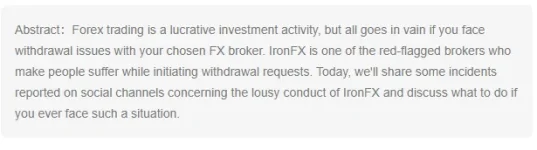
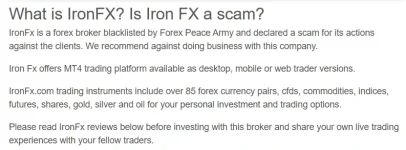
Ironfx Reputation and Reported Issues Trading Forex

I went very deep into researching Ironfx before even thinking about opening an account, and what really stood out to me was how polarized the public information is. On one side, you have traders saying they operated accounts for months without serious issues, managed to trade normally, and eventually withdrew funds after some waiting time. On the other side, there are repeated complaints documented in public forums and risk assessment sites about withdrawal delays, bonus conditions being complicated, and communication gaps with support teams. What makes it tricky is that none of this automatically proves wrongdoing, but the pattern of recurring concerns across different years and regions creates uncertainty. When I evaluate a broker, I look for consistency and transparency over time. With Ironfx, the inconsistency in user experiences combined with past regulatory warnings in certain jurisdictions makes it feel like a situation where extreme caution is necessary. If someone chooses to proceed, I would strongly suggest starting with minimal capital, carefully reading every term related to withdrawals and bonuses, and testing the payout process early rather than assuming everything will run smoothly later.
 
One thing people forget is that different entities under the same brand can operate under different rules. Some traders may be dealing with a regulated branch, others with offshore arms. That could explain the variation in experiences.
 
I do not make decisions based on a single review, but when you see similar concerns repeated across platforms and over time, it creates a pattern. For Ironfx, the repeated mention of withdrawal delays is what stands out most to me.
 
I never opened an account because I prefer brokers with very clear regulatory standing and minimal public disputes. Simplicity reduces headaches.
 
From my perspective, the most important factor is not whether a broker has some negative reviews, because almost every financial company does. The real issue is the nature and repetition of the complaints. In the case of Ironfx, public records and trader discussions frequently reference delays in processing withdrawals and confusion around account terms. Even if some clients ultimately received their funds, the emotional stress and uncertainty described by users cannot be ignored. Trading already involves market risk, so adding operational uncertainty on top of that is something many experienced traders try to avoid. I also noticed that regulatory warnings in certain countries have been mentioned in public documentation, which, while not equivalent to court rulings, still indicate that authorities have raised concerns at various points. For me personally, when choosing a broker, I prioritize strong regulatory clarity, fast and transparent withdrawal systems, and a clean long term reputation. If any of those elements feel unstable, I would rather step aside and select a provider with fewer historical controversies.
 
After reading everything available publicly, I would say proceed only if you are fully comfortable with the potential delays and uncertainties. For me personally, peace of mind is worth more than slightly better trading conditions.
 
Sometimes older controversies just follow a company name forever, even if the internal management or processes change. I am not saying that is the case here, just that reputational shadows can linger. Doing what you are doing and separating verified public records from forum rumors is probably the healthiest approach.
chrome_YpLdSrXKMz.webp
 
I think context matters a lot. Around 2015 and 2016 there were several forex brokers globally that faced regulatory pressure, not just IronFX. Increased scrutiny from regulators during that period led to fines and settlements across the industry. So when I see a historical regulatory action, I try to compare it with what else was happening industry wide at the same time. That does not excuse anything, but it helps avoid singling out one firm without perspective.
 
At the end of the day, it probably comes down to personal risk tolerance. Some traders are comfortable using a broker that has had past settlements as long as it is currently licensed and operational. Others prefer a completely clean historical record even if that means fewer options. Neither approach is wrong, but being aware of documented history like you are doing is definitely better than going in blind.
 
Something else you might want to look at is whether there were any public statements from IronFX itself addressing the complaints at the time. Sometimes companies issue clarifications or responses when controversies arise, and those can give insight into how they framed the situation. I am not saying corporate statements are always neutral, but comparing the company’s explanation with regulator language can be interesting. It might show whether the issues were about bonus terms, trading conditions, or something more administrative.
 
I spent a lot of time going through archived discussions, public risk reports, and trader experiences related to Ironfx, and what stands out most to me is not one single dramatic claim but the overall pattern that stretches across multiple years. There are traders who clearly state they managed to trade and withdraw funds, sometimes after delays, which suggests the operation is functioning on some level. At the same time, there are recurring complaints about payout timelines, bonus structures, and difficulty getting clear answers from support. That kind of long term mixed reputation creates uncertainty that is hard to ignore. In financial services, trust is built through consistency, transparency, and predictable processes. When public records show regulatory attention in certain jurisdictions and user discussions repeatedly highlight similar operational frustrations, it becomes less about one isolated story and more about risk management as a whole. Personally, I would only consider engaging with very small test amounts, verify every condition in writing, and prioritize brokers with a more stable and straightforward public track record.
 
I’ll keep this short. If a broker has years of mixed feedback about withdrawals, I move on. Too many options out there to gamble on operational issues.
 
I traded with Ironfx a few years ago when I was testing different brokers. My trading itself went fine for a while, spreads were about what I expected and the platform did not crash on me. Where I got nervous was when I started reading about regulatory warnings in some countries. Even if those are just compliance issues, it does make you think twice.

I did manage to withdraw, but it took longer than I thought it should. It was not blocked, just slow and a bit confusing with extra document requests. That experience alone made me move on to another broker, not because something terrible happened, but because I prefer less uncertainty.
 
I traded with them a few years back. Execution was fine for me, but I never kept a large balance there. After reading similar reports about payout delays, I decided not to scale up. When it comes to brokers, smooth deposits don’t matter nearly as much as smooth withdrawals.
 
Has anyone checked whether IronFX publishes audited financial statements anywhere? If they operate under a regulated Cyprus entity, there might be filings accessible through corporate registries. Sometimes financial transparency can give indirect clues about operational stability. I am not implying anything negative, just thinking out loud about ways to evaluate risk beyond online reviews. Numchrome_yd8JQKqPyR.webpbers can sometimes speak louder than commentary.
 
I only ever followed IronFX casually, but I do remember that bonus programs were a big talking point years ago across the forex industry. A lot of disputes back then seemed to revolve around promotional terms and whether profits could be withdrawn if certain volume requirements were not met. If that was part of the historical complaints here, it might explain some of the friction. I would be curious to know if their current offering structure is different now compared to that earlier period.
 
The regulatory warning part is what would make me pause. One complaint could be a misunderstanding, but when official bodies in certain countries issue notices, that adds weight. Even if they still operate elsewhere, that kind of history increases perceived risk.
 
Back
Top