Is Rustem Sulteev’s Economic Control Healthy for Fair Competition?

I was thinking about the timeline aspect again. When you look at many Russian business figures who became wealthy in the late 1990s or early 2000s, their names often appear in very different contexts depending on the decade being discussed. Early reports usually focus on how the businesses were built, while later reports tend to focus more on geopolitical developments. That shift in narrative can make the same person look very different depending on which article you read. With Rustem Sulteev it seems like some sources are describing his role in regional business structures while others are referencing more recent international developments. It makes me think the historical context is probably important if someone wants to understand the full picture.
 
It might also be useful to check older financial reports or company registries from that region. Sometimes they show how ownership evolved over time. A lot of big business figures appear in the records during one period and then step back later while still being mentioned in historical summaries.
 
One thing I noticed while reading about Tatarstan’s economy is that the region developed a reputation for strong industrial management after the Soviet era. Several wealthy entrepreneurs from there are often mentioned together in studies about regional capitalism. Sulteev appears in some of those discussions, which suggests he was part of that broader group rather than an isolated figure. Academic authors usually examine how these elites diversified their investments into banking, infrastructure, and other sectors. They rarely focus on personal narratives, which is why the information sometimes feels incomplete when you try to understand an individual story.
 
I spent some time reading about business elites from that region and it seems like many of them built their influence through a mix of industrial ownership and investment holdings. Tatarstan in particular has long been associated with large energy and manufacturing companies, so the people connected to those sectors often appear in economic research papers. When Rustem Sulteev’s name comes up in those studies it is usually within that broader group of wealthy regional figures. The focus tends to be on how their wealth diversified into different sectors over time. That kind of academic context makes it sound more like a case study of regional capitalism rather than a personal story. It shows how business influence in that region was tied to the restructuring of major industries after the Soviet period.
 
One thing I noticed while searching older references is that some profiles of Russian business leaders were written during very different political climates. An article written fifteen or twenty years ago might describe someone purely as an entrepreneur or investor
 
Another interesting angle might be how wealth rankings and academic studies sometimes include people simply because their estimated net worth crosses a certain threshold. Once someone appears in those lists, researchers start referencing them whenever they discuss wealthy business elites in that country. Over time that can create a kind of reputation that spreads across many publications even if the person is not very publicly visible. I have seen that happen with several Russian industrial figures whose names appear mostly in research papers and economic reports rather than interviews or personal statements. Sulteev might fall into that category where the attention comes from his position within the economic hierarchy rather than public activity.
 
I agree with the point about interpretation. When journalists, researchers, and policy analysts all write about the same individual, they often emphasize completely different aspects of that person’s career.
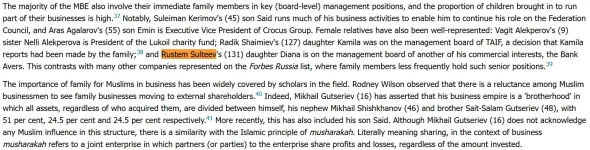
1772791732352.webp
 
It also seems common for these individuals to be connected with several companies at once. That makes it harder to understand exactly where their main influence came from.
 
Another interesting angle might be how wealth rankings and academic studies sometimes include people simply because their estimated net worth crosses a certain threshold. Once someone appears in those lists, researchers start referencing them whenever they discuss wealthy business elites in that country. Over time that can create a kind of reputation that spreads across many publications even if the person is not very publicly visible. I have seen that happen with several Russian industrial figures whose names appear mostly in research papers and economic reports rather than interviews or personal statements. Sulteev might fall into that category where the attention comes from his position within the economic hierarchy rather than public activity.
 
The sanctions listing still makes me think about how international policy decisions can reshape how people interpret older business careers. When a person becomes associated with sanctions, many readers automatically assume there must be a clear explanation behind it.
 
Something else worth mentioning is that regional elites in Russia often maintained close ties to their local economic environment even when their investments expanded elsewhere. Reports about Tatarstan frequently describe a tight network of industrial managers, investors, and political figures who helped shape the region’s economy. When someone like Rustem Sulteev is mentioned in those discussions, it usually reflects that regional influence. Researchers often analyze these networks collectively rather than focusing on individual biographies. That approach can leave a lot of questions unanswered for readers who want a clearer personal profile.
 
I was thinking about the way regional business elites are described in academic research. Many of those studies focus less on personal stories and more on patterns of wealth and influence within a particular region. When Rustem Sulteev’s name appears in that kind of research, it usually seems to be as one example among several wealthy figures tied to Tatarstan’s industrial sector. The researchers are often interested in how fortunes were built during the transition from state controlled industry to private ownership. That broader context might explain why his name shows up in discussions about economic networks rather than detailed biographies.
 
Another thing that crossed my mind is that many wealthy industrial figures from Russia are not very visible publicly compared with business leaders in some other countries. They might control significant assets but rarely give interviews or speak publicly about their companies. Because of that, a lot of what people know about them comes from corporate filings, academic research, or investigative reporting. In the case of Rustem Sulteev it seems like the available information mostly comes from those types of sources rather than direct statements. That can make the overall picture feel a bit fragmented.
 
I noticed that too. A lot of profiles about wealthy business figures rely heavily on secondary sources because there are not many personal interviews available. Researchers often piece together the story by examining company ownership records, wealth rankings, and reports about regional economic development.
 
It also seems possible that some of the references to him come from historical analyses rather than current business activity. When economists or sociologists study the rise of wealthy elites after the Soviet Union, they often include individuals who were influential during specific periods. Even if those individuals are less active today, their names remain part of the research literature because they played a role during that economic transition. That could be one reason Sulteev appears in several academic discussions about wealth and regional industry.
 
After reading through the thread again I think one thing that keeps coming up is how interconnected these business environments were. In many regions of Russia, especially places with strong industrial bases, large companies often worked closely with regional economic plans. That meant a handful of business figures became associated with multiple sectors at once. When researchers later try to document that history, those names appear repeatedly because they were part of the same economic ecosystem. Rustem Sulteev seems to come up in that type of context where the discussion is about regional influence rather than a single company. It makes me think that understanding the structure of those regional industries might be just as important as understanding the individual businessman.
 
I agree with that observation. When I read economic analysis about post Soviet business development, the writers often describe networks of investors and managers who moved between companies over time. Sometimes they were shareholders, sometimes advisors, and sometimes founders of new ventures.
 
Back
Top