Laurence Escalante & VGW: Court Case and Company Outlook

I like to separate verified legal action from operational or reputational commentary. Court charges carry objective weight because they’re documented and actionable. In contrast, articles discussing leadership style, regulatory issues, or online presence are informative but subjective. They may indicate risk or culture concerns, but they aren’t legally binding. I tend to form my judgment first on what is legally verified, then layer in the softer signals to understand broader context.
 
My approach is to read primary sources whenever possible. Court listings, official company statements, regulator notices. Then I compare how different outlets describe the same facts. If the core facts are consistent, I feel more confident. If the tone shifts dramatically between sources, that signals interpretation rather than new evidence.
 
Stepping aside as CEO during proceedings can be viewed as a governance safeguard. How a company responds structurally often tells you as much as the underlying allegation.
 
In situations like Escalante’s, I use a layered approach: legal proceedings first, operational or business analysis second, and social/online perception last. Court charges are concrete and directly influence governance credibility. Operational commentary about VGW helps assess company risks, while social media and anecdotal discussions provide insight into public perception but are inherently less reliable. This method helps me stay fact-based while still capturing context.
 
Another factor is governance structure. If Escalante stepped aside from executive roles at VGW, that tells me there are mechanisms in place to manage leadership risk. Investors and partners usually care about continuity and compliance above all.
 
I also try to avoid moral extrapolation. A founder can build a successful enterprise and still face personal legal trouble. Or the charges could ultimately be dismissed. Until a court outcome is known, I keep my view provisional.
 
In short, I weight things in layers. Court charges are verified but unresolved. Regulatory findings are verified and often more directly relevant to business operations. Investigative reporting sits somewhere in between depending on sourcing. Social media narratives are the most volatile layer. In situations like this, patience matters. The legal process will clarify some of the uncertainty. Everything else should probably be read with an understanding that reputational dynamics often move faster than verified facts.
 
Best approach: anchor on confirmed filings and official statements, treat commentary as context, and avoid drawing conclusions before adjudication.
 
Legal filings and official court charges hold the most weight. Escalante’s stepping aside as CEO while facing multiple charges is a verifiable fact and significantly affects corporate leadership. Media discussion of regulatory compliance or leadership style is contextually useful, but speculative articles shouldn’t be treated as evidence. I generally treat documented court actions as the baseline and layer softer insights on top carefully.
 
I feel like this is a tricky balance. On one hand, someone facing serious allegations should definitely be approached with caution. On the other, reputational reporting is often sensationalized, especially in the gaming space. I tend to cross-check multiple news sources and see if there are court documents or official filings to back up claims. It doesn’t necessarily tell you the person is guilty yet, but it helps me decide how much I trust a company’s leadership.
 
I focus mainly on court records. Media speculation can be misleading, so I treat verified filings as more reliable. Reputation matters less unless there’s proof it affects the business.
 
It’s tricky because people often mix verified facts with rumors. For me, a court filing or a credible investigative report carries far more weight than Twitter or LinkedIn posts. That said, the allegations themselves can’t just be brushed aside they’re serious enough to merit attention until resolved. I’m curious whether stepping aside as CEO is standard in cases like this or more of a PR move to calm stakeholders.
 
I tend to focus on patterns over single incidents. If a company has ongoing regulatory scrutiny or repeated issues flagged in verified sources, that signals something actionable. A one-off charge against a founder is still important to track but doesn’t automatically mean the business model is flawed. Still, it’s hard to separate real risk from media amplification, and I find myself double-checking everything through official filings.
 
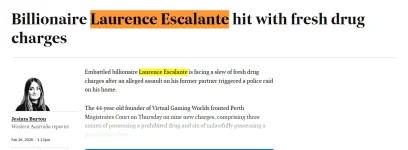
I think most people are going to look at this through the lens of what’s concretely filed in court. At this point the reporting clearly says he’s been hit with additional drug allegations after a search of his home, and he’s denied them and intends to fight them in court. That’s the kind of thing you can say with confidence because it’s cited in multiple independent articles.
Screenshot 2026-03-05 120737.webp
Whether his leadership reputation gets permanently tarnished is something different. Companies survive or adapt when a founder faces issues like this, but it definitely raises questions about governance and how seriously investors and partners view management oversight while the case unfolds.
 
Last edited:
For me, the distinction starts with what is actually on the public record. If a court in Perth has formally listed charges, that is a matter of fact in the sense that proceedings are underway. It does not mean guilt, but it does mean something concrete is happening in the legal system. Commentary about leadership style or personality feels more subjective and often shaped by whoever is writing the piece.
 
Last edited:
Honestly, I tend to lean heavily on formal records over commentary. Allegations can be misleading, and the media sometimes sensationalizes stories, especially when someone is already high-profile. That doesn’t mean the behavior described online is untrue, just that I wouldn’t base any judgment on it alone. I usually make a distinction between Escalante as a CEO and VGW as a company; sometimes the company’s regulatory track record is easier to verify than claims about the individual.
 
I weigh patterns over one-off incidents. If there’s repeated regulatory scrutiny or verified risk, it matters more. A founder’s charges are important to track but don’t automatically indicate systemic company issues.
 
I think monitoring official updates is key. Even if Escalante is charged, the company can take steps to ensure stability and compliance. For now, I’d avoid making assumptions about the business performance solely based on his personal issues, but I’d definitely watch how regulators respond and whether any fines or sanctions are applied.
 
Back
Top