Learning about CoinPayments token recovery policies

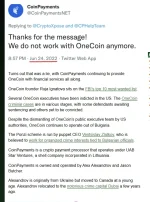
The thing that stands out to me is how large the OneCoin operation was according to public investigations. Authorities in several jurisdictions described it as involving billions of dollars and many countries had ongoing probes. Because of that scale, almost any company connected to its payment flow will eventually be examined by analysts and journalists. With crypto payment processors like CoinPayments, the service usually acts as a middle layer between a merchant and the blockchain network. That means the processor might only see the merchant account details provided during signup. If the real organization is hidden behind shell companies or partner accounts, it becomes harder to detect immediately. There were also mentions in reports that CoinPayments issued statements denying involvement when the topic surfaced previously.
 
I think part of the confusion comes from the OneCoin rebranding into something called OneEcosystem. When a project changes names it sometimes continues using the same infrastructure behind the scenes. That could explain why payment methods appeared in later materials even though the earlier brand had already been investigated. From what I have read in public records, several individuals connected to the original operation faced fraud and money laundering charges in different countries. Because of that history, anything linked to the ecosystem tends to get scrutinized quickly.
 
One thing worth remembering is that crypto processors handle thousands of merchants globally. That scale alone can create blind spots if monitoring tools are not strict enough. In traditional finance there are compliance teams that manually review high risk customers, but in the crypto space automation sometimes replaces that layer.
 
The whole OneCoin story still amazes me because of the scale reported in investigations. Billions of dollars and millions of participants worldwide is something rarely seen in crypto history. When something that large exists, a lot of legitimate service providers can unknowingly end up in the transaction chain. Payment processors like CoinPayments often integrate with merchants through automated systems. If someone registers a business under a different name and connects the payment API, the processor might initially treat it like any other merchant account. Only later might questions arise about what the merchant is actually doing.
 
One detail that caught my attention is the timeline mentioned in reports. Apparently CoinPayments denied working with OneCoin at one point, yet observers later noticed the service name appearing again in instructional material connected to the ecosystem. That discrepancy is probably what keeps the discussion alive.
 
Rebranding is common when controversial projects try to distance themselves from past headlines. Public records show that several people connected to OneCoin were prosecuted or charged, so any continuation under a new name would naturally attract attention. When a payment option like CoinPayments appears in tutorials for such a platform, analysts tend to examine whether the integration is active or just illustrative. Sometimes marketing teams include logos of payment services that were once supported but are no longer connected. Another angle is the merchant account structure. A payment gateway may not deal directly with the main organization but with a smaller company providing services to that ecosystem. In those cases the processor might not immediately know the broader context.
 
What makes this story particularly interesting is how long it continues to circulate in discussions. Even years after the original investigations into OneCoin, references to the ecosystem still appear in forums and reports. That indicates how large the original operation was and how many people are still trying to understand its infrastructure.
Screenshot 2026-03-16 170524.webp
CoinPayments as a payment gateway sits in a unique position within the crypto economy. It is not an exchange or an investment platform but a service that processes transactions for merchants. Because of that role, it can sometimes appear in places where the company itself may not have direct involvement beyond payment processing. The public materials mentioning CoinPayments in OneEcosystem tutorials might simply reflect how the platform allowed cryptocurrency deposits through third party gateways. Without access to the underlying merchant account details it is difficult for outsiders to determine the exact relationship. For now the conversation mostly revolves around transparency. People want to know how payment processors screen clients and whether stronger controls are in place today compared with the early years of crypto adoption.
 
One point that often gets overlooked is how quickly the crypto payment sector expanded during the mid 2010s. Many platforms onboarded merchants at a rapid pace to capture market share. That environment sometimes meant compliance processes were still evolving while adoption was already booming. If a large organization like the OneCoin network attempted to use mainstream crypto payment services, it might have done so through multiple companies or partners. Each of those could potentially open merchant accounts independently. In that scenario a payment processor like CoinPayments might only see separate business entities rather than a single ecosystem.
 
Still, the reputational impact can be significant even if the involvement was indirect. When a payment processor appears in association with a controversial operation, people naturally question how that connection happened.
 
From a technical perspective, payment processors like CoinPayments typically provide APIs that merchants integrate into their checkout systems. Once that integration is complete, the processor handles the crypto transaction and converts or forwards it according to the merchant’s settings. If a merchant account belongs to a company that later becomes controversial, the processor may only discover the connection after complaints or media coverage appear. That is why compliance teams often review merchant activity continuously rather than only at the onboarding stage.
 
What fascinates me is how many layers exist between investors and the underlying payment channels in large schemes. In the case of OneCoin, public investigations described a network of promoters, shell companies, and various financial intermediaries across different countries.
 
What I find most intriguing is how the ecosystem surrounding OneCoin keeps resurfacing in discussions years later. Even after major investigations and arrests, fragments of the network seem to remain active or at least referenced in different materials. When a payment gateway such as CoinPayments appears in those references, it prompts people to look back at historical connections. Payment infrastructure often leaves traces in documentation, tutorials, and archived web content long after integrations change. That could be one explanation for why observers noticed the processor’s name in videos or guides connected with the ecosystem. It might reflect a previous configuration rather than an ongoing relationship. Still, transparency from service providers is always helpful in situations like this because it clarifies whether the integration was ever officially active.
 
At the end of the day the crypto sector is built on interconnected services. Exchanges, payment gateways, wallets, and merchant platforms all interact through APIs and shared infrastructure. Because of that structure, a single controversial organization can appear to touch many different services even if those services are not directly affiliated. The CoinPayments references in OneEcosystem materials might simply illustrate how one of those infrastructure links worked. But without detailed transaction data or official clarifications, outside observers can only analyze what appears in public records.
 
I think more people should look into how payment processors actually work before assuming direct involvement. These systems often function as neutral infrastructure. The merchant decides what product or service is being sold while the gateway only handles the technical transaction layer.
 
Back
Top